History
The date of construction of the church at Ystradfellte was not recorded in documents, although the settlement itself was mentioned in 1230 (“Stradmelthin”) and again in 1316 (“Strathvelthly”). The church’s architectural details suggest it was built only in the late 15th or early 16th century, or that a major reconstruction of the older church was carried out at that time. In the latter case, the church may have been enlarged than with a tower and perhaps a chancel. In the second half of the 19th century, a major renovation was carried out. Among other things, the roof truss in the nave and the window jambs were renewed, although the new ones imitated the appearance of earlier ones, probably dating from the early modern rebuilding of the 17th or 18th century. The last repairs to the church were carried out in the 1970s.
Architecture
The church was built in the Mellte Valley, on a slope descending towards the river and between smaller streams to the north and south, flowing into the river from the hills to the west and northwest. By the end of the Middle Ages, the building consisted of a rectangular, perhaps older nave, and a lower, shorter chancel of the same width, ended on the eastern side by a straight wall. A quadrangular tower was erected on the axis of the western façade. The entire structure was constructed from small to medium-sized fragments of brown and gray sandstone and fairly precisely orientated to the cardinal sides of the world.
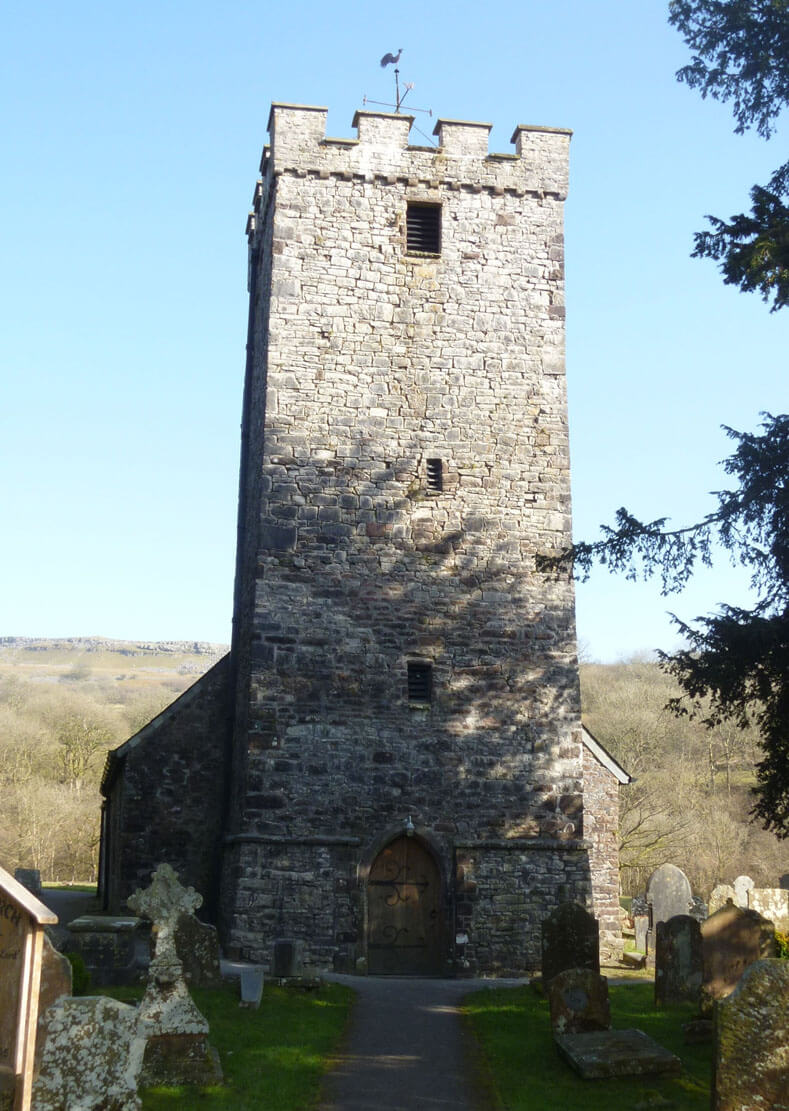
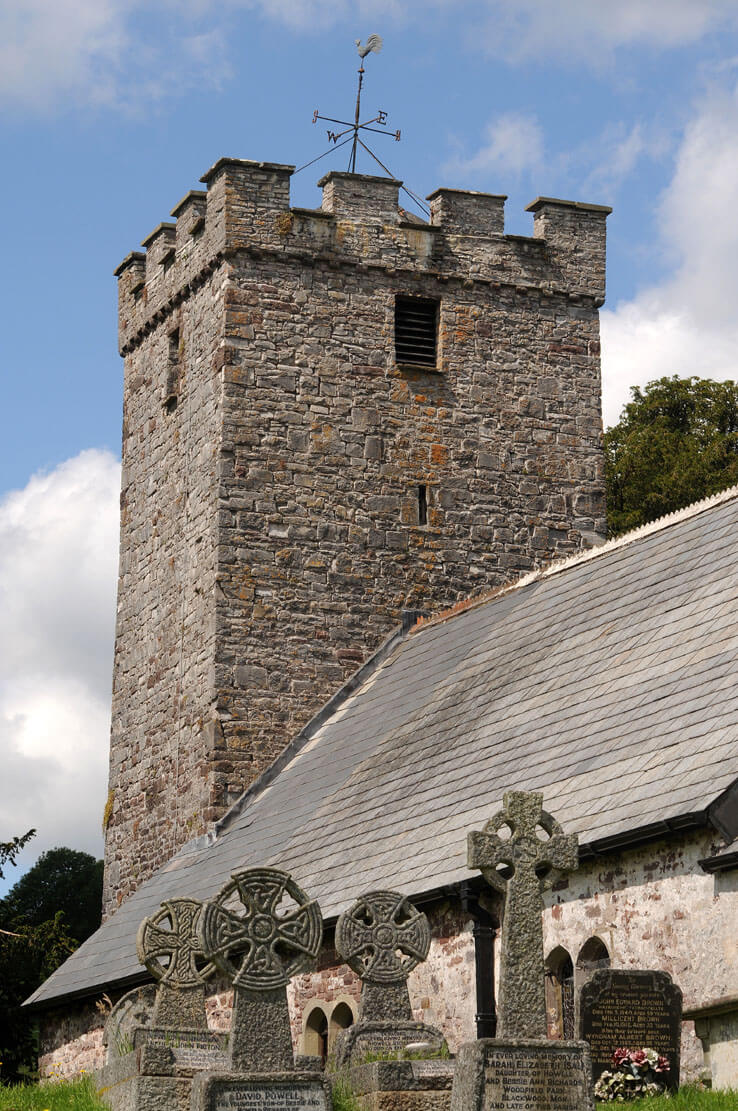
The tower in its most massive plinth section, acquired prominent batter, separated from the upper stories by a cornice. Above the cornice, the tower walls were slightly narrowed, giving the structure a slender shape. The tower’s windows were small, even on the highest story intended for the bells. A pointed portal was set in the ground floor of the western wall, interrupting the continuity of the aforementioned cornice. The crown of the walls was topped with a parapet typical of late medieval Welsh churches, mounted on corbels projecting from the face, originally likely with decorative and symbolic battlement.
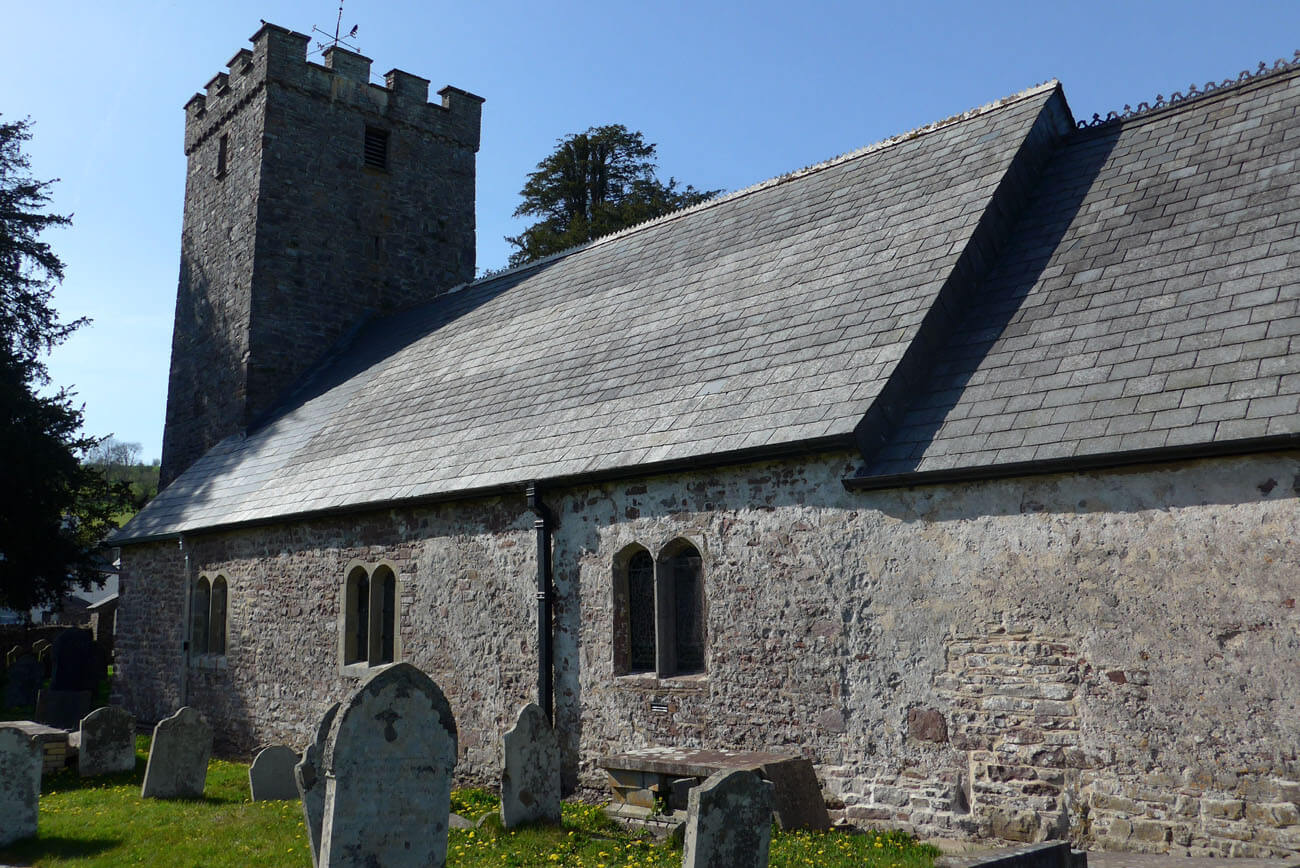
The external elevations of the nave and chancel were simple, devoid of buttresses. At the turn of the 15th and 16th centuries, they were pierced with single and two-light windows in the English Perpendicular Gothic style, set in quadrangular frames with trefoil tracery inscribed in pointed arches. The eastern window of the chancel, traditionally distinguished for its illumination of the main altar and good visibility from the nave, may have had a more decorative form. The entrance was originally located in a pointed portal in the western part of the south wall of the nave. A second pointed portal was located in the north wall of the nave.
Inside, the nave was separated from the chancel by a simple, unmoulded arcade with a pointed arch, characterized by several irregularities, perhaps indicating a 15th- or 16th-century perforation in the eastern wall of the older nave. Furthermore, the nave and chancel were separated by a timber rood screen, the upper level of which was accessed by a door and stairs pierced through the northern wall. The chancel interior was covered with densely spaced, arched wooden ribs, stiffened by straight ribs running along the church axis, together forming numerous rectangular panels with an open frame structure (unless they were plastered in the Middle Ages). The nave may originally have been covered with an open roof truss or in a similar manner to the chancel.
Current state
The church retains its medieval layout and perimeter walls, but many architectural details had to be replaced in the 19th century. The tower’s battlements and most of the north and south nave windows date from this period, replicating the appearance of older early modern jambs carved in red sandstone. A late medieval two-light window is visible in the south wall of the chancel, as does a single lancet window in the north wall, while the large east window was replaced in the 19th century. Two now-blocked medieval portals remain in the nave. Inside, a 15th/16th-century barrel roof and a font from the same period are in the chancel.
bibliography:
Haslam R., The buildings of Wales. Powys (Montgomeryshire, Radnorshire, Breconshire), London 1979.
Martin C.H., Silvester R.J., Watson S.E., Historic settlements in the Brecon Beacons National Park, [n.p.p.] 2013.
Salter M., The old parish churches of Mid-Wales, Malvern 1997.