History
The first sacral building on the site of the later Gothic church of St. Trillo was already in use by the early 12th century. Rhos on Sea (Welsh: Llandrillo yn Rhôs) was then known as Dinerth, and the building served as the settlement’s parish church. It was next recorded in 1230, in a charter issued by Llywelyn ap Iorwerth to Ednyfed Fych, seneschal of the Welsh kingdom of Gwynedd. It is possible that the church was rebuilt in stone at his expense, or that a chapel was added to the older stone nave. The settlement and church were again recorded in the tax registers of 1254 (Norwich Taxation) and 1291 (Lincoln Taxation).
At the turn of the 15th and 16th centuries, the church of St Trillo was thoroughly rebuilt in the late Gothic style and enlarged with a second nave. Further construction work continued around 1540, when bequests were made for the chancel and porch. The former may have concerned the furnishings, not the structure itself, as the chancel was integrated with the nave. In 1552, a tower was to be built or rebuilt. Thanks to its hilltop location and whitewashing, it served as a landmark for sailors at sea. By then, the new name of the settlement at the church had finally been established, changed from Dinerth to Llandrillo.
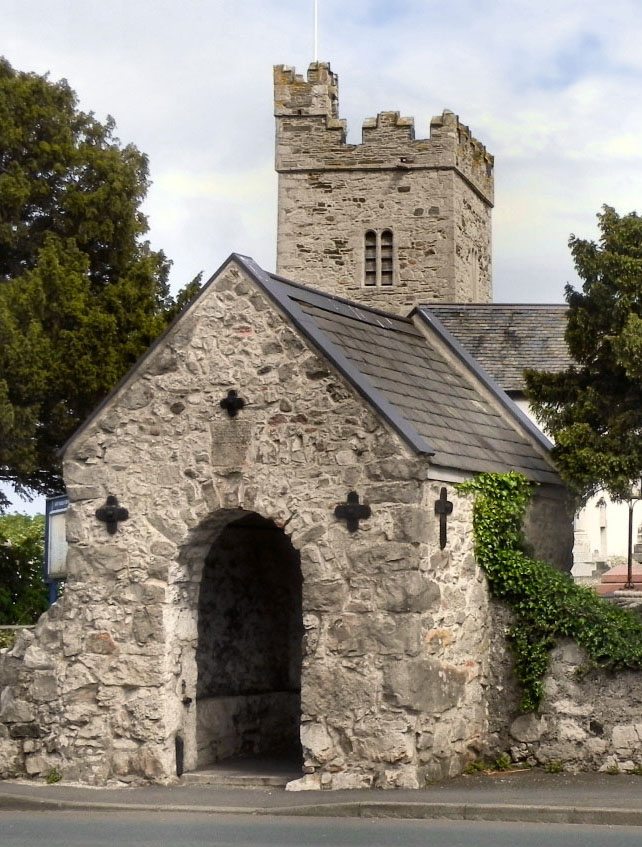
The first significant early modern modifications to the church’s architecture were introduced in the early 17th century, when a smaller watchtower was added to the tower to warn the local population of pirate attacks, a real scourge of the Welsh coast at that time. In 1677, a new lychgate to the cemetery was built. A thorough Victorian renovation of the church was carried out in 1857. Among other things it involved replacing or renovating most of the windows and the roof truss.
Architecture
The church of St. Trillo was situated on a high hill surrounded by a cemetery. It likely stood in the northern part of a small settlement, stretching along a road that skirted Bryn Euryn mountain to the east, with relics of an Iron Age or early medieval stronghold. The church hill was lower than Bryn Euryn but was closer to the seashore, where a harbor may have operated. It was characterized by the steepest slopes to the north and east.
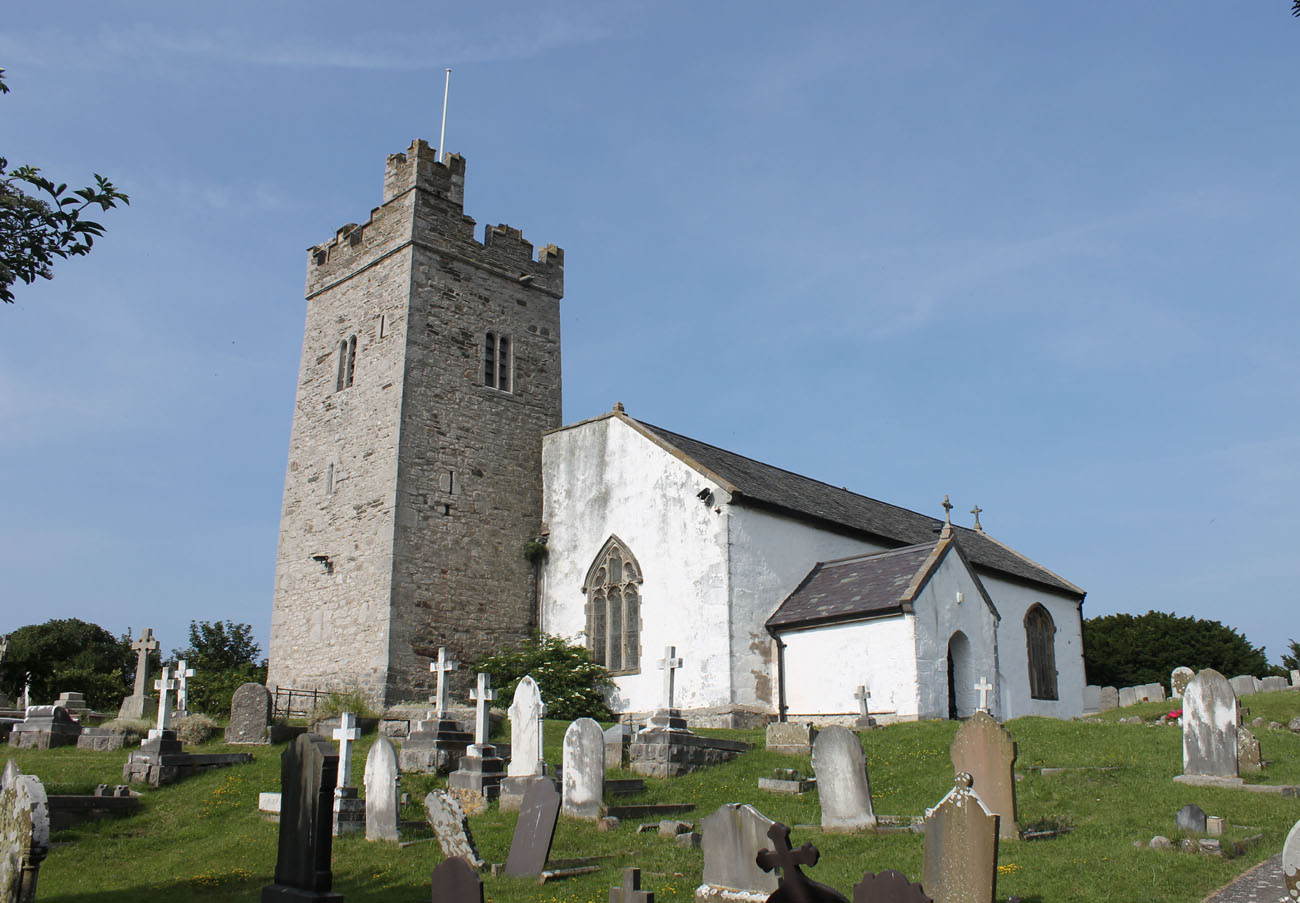
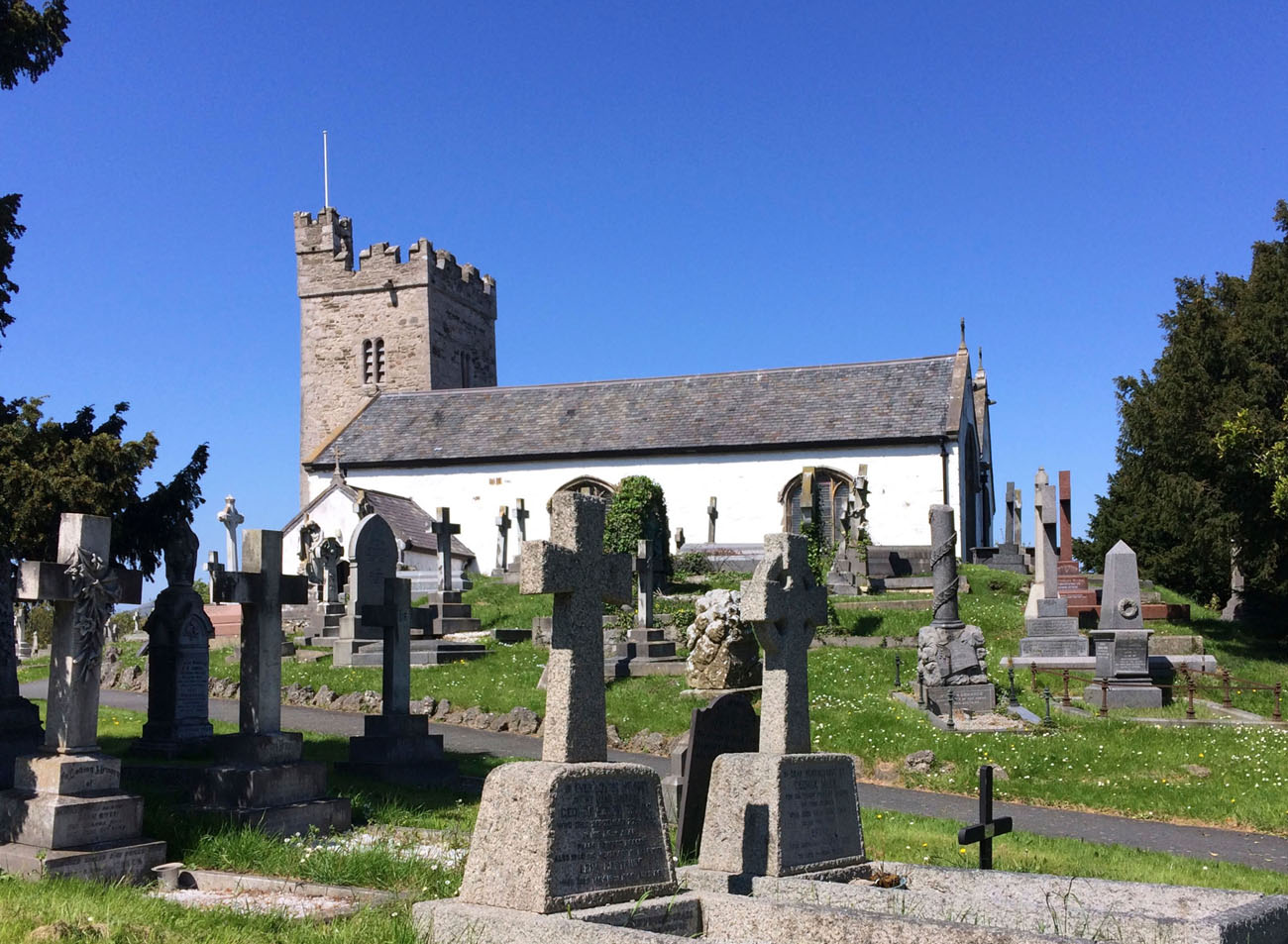
In the 15th century, the church consisted of a rectangular nave without an externally separated chancel, a design very common in northern part of the Wales. Adjacent to this would have been a 13th-century chapel or short aisle, located to the west part of the north wall of the nave. In the first half of the 16th century, a south nave of equal length and similar width to the earlier nave was added, as well as a slender quadrangular tower to the west of the older nave. Also porches were built to both the south and north naves. With the exception of the tower, each of these elements being covered by a separate gable roof.
The tower walls were 1.4 meters thick at ground level, where a low batter with sloping facades was created. The tower was topped with a parapet slightly projecting from the face of the walls and featuring battlements with characteristic stepped merlons, typical of Irish churches or tower houses. Simple two-light openings were made in the tower walls on the top floor with bells, and smaller slit openings on the lower floors. No portal was created in the west wall, leaving the tower accessible only to the interior of the north nave.
The church interior was divided into naves by a four-bay arcade with richly moulded and strongly flattened archivolts, characteristic of late medieval architecture in Wales and England. The arcades were lowered onto octagonal piers with flat capitals. The northern chapel was connected to the older nave by two pointed arcades. Both naves were covered with an open roof truss, the southern one supported by simple stone corbels, and the northern one by the crown of the wall.
Current state
The oldest part of the current church is the north nave, where the northern wall shows two bricked-up arcades from the former chapel and a later pointed portal. Other elements of the church date from the late Middle Ages, but were altered during the 19th-century renovation (especially the tracery windows of the north and south sides). Inside, a 13th-century font and a 14th-century tombstone in the porch remain.
bibliography:
Hubbard E., Clwyd (Denbighshire and Flintshire), Frome-London 1986.
Martin C.H., Silvester R.J., Watson S.E., Historic settlements in Conwy, Welshpool 2014.
Salter M., The old parish churches of North Wales, Malvern 1993.
Smith G.H., Archaeological Investigation and Recording at the Late Medieval House of Llys Euryn, Rhos-on-Sea, Conwy, 1998, [no place] 1999.
The Royal Commission on The Ancient and Historical Monuments and Constructions in Wales and Monmouthshire. An Inventory of the Ancient and Historical Monuments in Wales and Monmouthshire, IV County of Denbigh, London 1914.