History
Chapel of St. Deniol was probably built in the late 15th or early 16th century on the site of a small monastery dating back to the early 6th century. According to tradition, after the Celtic monastery disappeared, the site was occupied by a group of nuns from Aconbury in Herefordshire. Their monastery was dissolved by Henry VIII in 1534, and the buildings became the residence of the priests of the local parish church. The chapel eventually fell into disrepair. Along with the adjacent premises, it was converted into a fernery by the local landowner before 1870, but it later fell into disrepair again.
Architecture
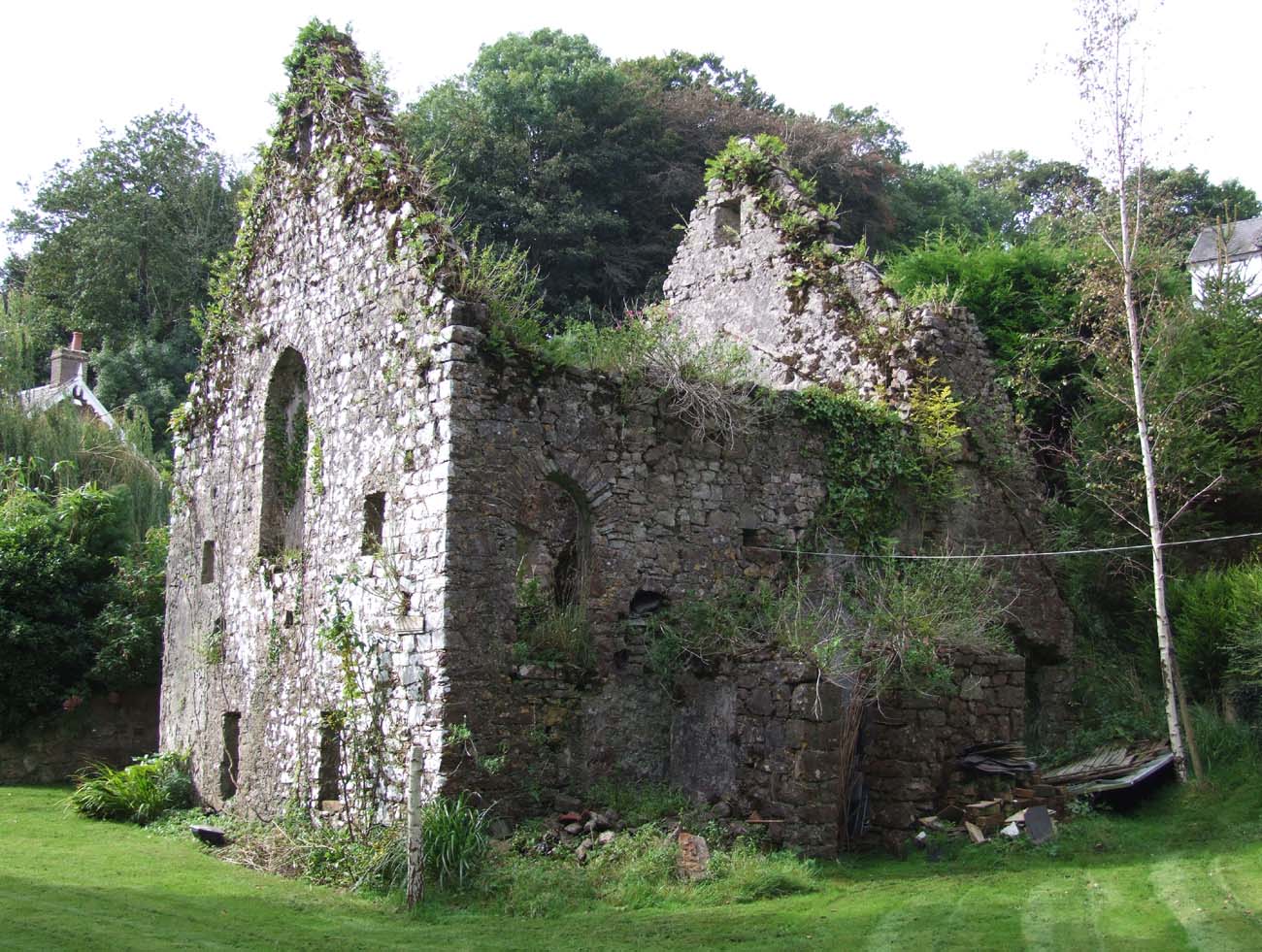
The chapel, or rather the structure identified with the chapel, was built on a flat piece of land, on the slope of a vast hill. It was a simple and small aisleless structure on an orientated rectangular plan, measuring approximately 8 x 14 meters, built of limestone rubble and covered with a gable roof over two stories. The roof, made of tiles or slate and a wooden truss, rested on two triangular, undecorated gables on the shorter sides of the building.
Lighting in the chapel came from medium-sized, pointed and quadrangular windows. The largest one was located on the axis of the eastern wall, where it partially extended into the gable. It may have originally been filled with two-light tracery, but the jamb was made in a simple way, without ashlar stone, from the same building material as the walls. Single, slit-like, splayed inward openings, were made in the upper sections of both gables, likely providing light to the attic.
Inside, there was a small crypt on the lower level and the chamber on the upper level. The undercroft or crypt consisted of two narrow rooms topped with barrel vaults. Entry was through a pointed portal in the southern wall. The first floor was accessed via stone stairs through a high, pointed entrance in the western gable. The spatial layout of the interior, despite the building’s orientation and the large axial eastern window, would rather indicate a secular purpose of the building with a hall above the utility ground floor.
Current state
The chapel was converted into a fernery in the early modern period, which, among other things, altered some of its windows. It is now a roofless ruin. Much of the ashlar stone has been looted, but the remains of the building are essentially intact. Adjacent to the chapel are the remains of early modern buildings.
bibliography:
Murphy F., Page M., Later medieval and early post-medieval threat related assessment work: monasteries, [n.p.p.] 2012.
The Royal Commission on The Ancient and Historical Monuments and Constructions in Wales and Monmouthshire. An Inventory of the Ancient and Historical Monuments in Wales and Monmouthshire, VII County of Pembroke, London 1925.