History
Church of St. John the Baptist in Newton, near Porthcawl, was probably erected in the eighties of the 12th century, because the first parish priest was recorded in 1189. The initiator of the construction was William, Earl of Gloucester, or de Sanford, a knight of the Order of St. John of Jerusalem, who received local lands from William. Newton was then a small seaport trading with centers across the Bristol Channel, and therefore needed a church that would meet the ambitions of local merchants and traders, who may also have participated in the construction works. In the late 15th century, Jasper Tudor, uncle of King Henry VII, carried out a Gothic reconstruction of the church. Further work was carried out in 1860-1861, when the northeastern sacristy was built, and again in the early 20th century.
Architecture
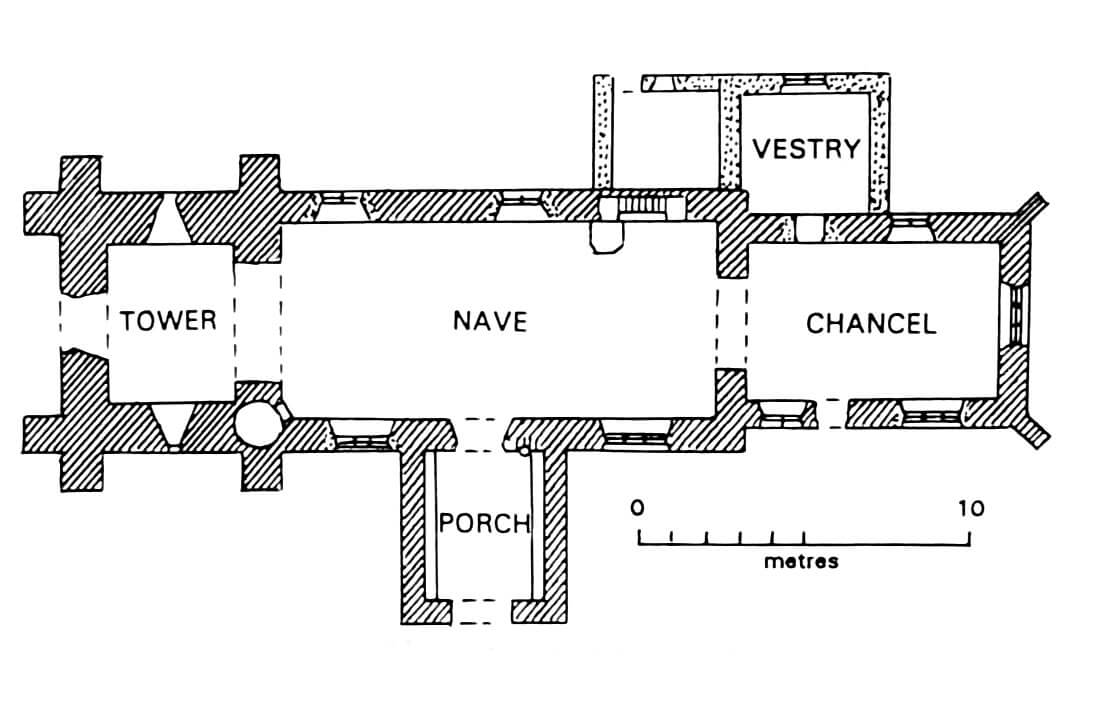
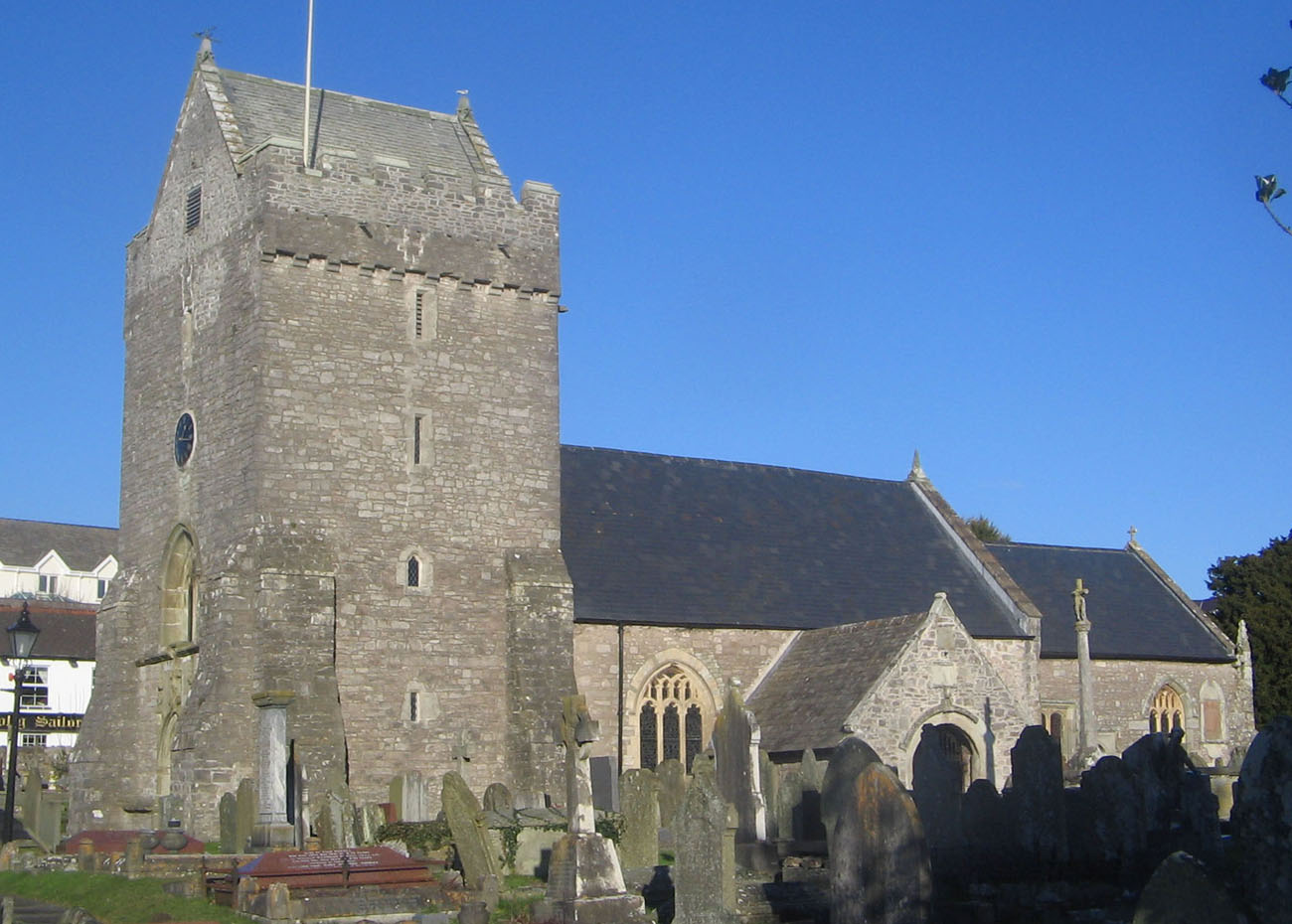
After its 15th-century reconstruction, the church consisted of a rectangular nave, a rectangular chancel on the eastern side, a massive, squat tower on the western side, and a porch preceding the nave entrance on the southern side. The tower had a quadrangular base and, unusually, the same width as the nave. The chancel was traditionally built narrower, shorter, and lower than the nave. The entire structure was orientated toward the cardinal sides of the world and constructed of gray limestone, contrasting with the greenish-brown sandstone of the architectural details.
The nave walls were largely smooth on the exterior, pierced only by windows and the southern entrance. The chancel was supported at the eastern corners by two stepped buttresses. These were placed at an angle and topped with pinnacles. Both nave and chancel were framed by a plinth with a moulded cornice. Lighting was provided by large, three-light, pointed windows with tracery featuring trefoil and cinquefoil motifs. The northern elevation of the nave and chancel may originally have been windowless. Two additional, two-light windows with quadrilateral frames were probably added to the chancel in the 16th century. A portal for the priests was placed in the southern wall of the chancel, topped by a flattened pointed arch and with decorated spandrels on the sides of the archivolt. The hood mould above it was suspended by two angels bearing heraldic shields. The main entrance portal to the nave was also topped by a flattened pointed arch and uniformly moulded above the plinth throughout its height.
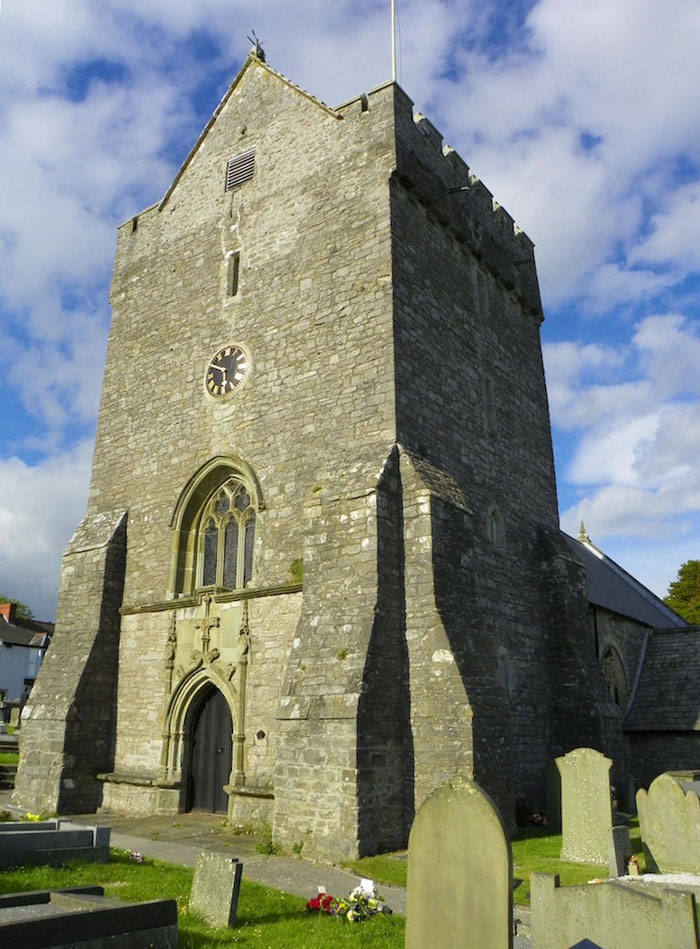
The four stories of the tower were pierced on the north and south by narrow windows with straight and trefoil-shaped openings. A battlemented parapet was also located on these sides, supported by corbels projecting from the wall face. This gave the tower a defensive character, though more symbolically than practically. A highly unusual solution was the portal on the tower’s eastern façade, leading from the attic covered by a gable roof, to a wooden porch suspended on stone corbels. The tower’s corners were reinforced with wide buttresses, somewhat archaically placed perpendicularly and parallel to the walls, rather than at an angle.
On the west axis of the tower façade, the entrance portal to the vestibule in the ground floor of the tower was placed, flanked by two stone benches at plinth height, very rarely found in such a location. The handsomely moulded portal was completed with an ogee arch, decorated with large bas-relief crockets, a broadly developed fleuron and two pinnacles bearing coats of arms carried by angels. The portal’s archivolt was set on triple shafts with polygonal capitals and bases. Above the portal was a moulded cornice with a slight bend encompassing the fleuron. A three-light window was placed on the cornice, set in a deep concave frame and filled with trefoil tracery.
Inside, the nave was separated from the chancel by an arcade, flanked by openings for viewing the altar section of the church (hagioscopes). The arcade’s imposts were double-chamfered and ended with high plinths. Stairs and a portal in the north wall led to a stone pulpit, rarely found in parish churches, decorated with a bas-relief frieze featuring a vine motif and three figures depicting a scene of flagellation. The church also had a rood screen, the upper floor of which was supported by a prominent shelf. The tower opened onto the nave with a wide, high, pointed-arch arcade supported by semicircular imposts.
Current state
The church is one of the most valuable monuments of late medieval sacral architecture in the region. It retains late 15th-century layout, though it has been expanded to include a modern sacristy, and the nave was extensively rebuilt in 1860. Late Gothic windows and a portal remain in the chancel walls. The entrance portal to the nave and the south porch are also original. A valuable element is the western tower, with its western portal and unusual benches or parapet. Inside, a 13th-century font and late medieval arcades (under the tower and at the chancel) have been preserved, but the most exceptional monument is the stone pulpit from around 1500. Inscriptions painted on the northern wall of the nave date back to the 17th century.
bibliography:
Newman J., The buildings of Wales, Glamorgan, London 1995
Salter M., The old parish churches of Gwent, Glamorgan & Gower, Malvern 2002.
Wooding J., Yates N., A Guide to the churches and chapels of Wales, Cardiff 2011.