History
Church of St. Michael was probably built in the early 14th century by the local knightly family of de Reigny, although the first historical record of church in Michaelston le Pit dates back to a tax register from 1254. In the Middle Ages, the parish housed a manor house, whose owners held patronage of the church until the 17th century. The church survived the 19th and 20th centuries without any significant alterations to its historic medieval structure.
Architecture
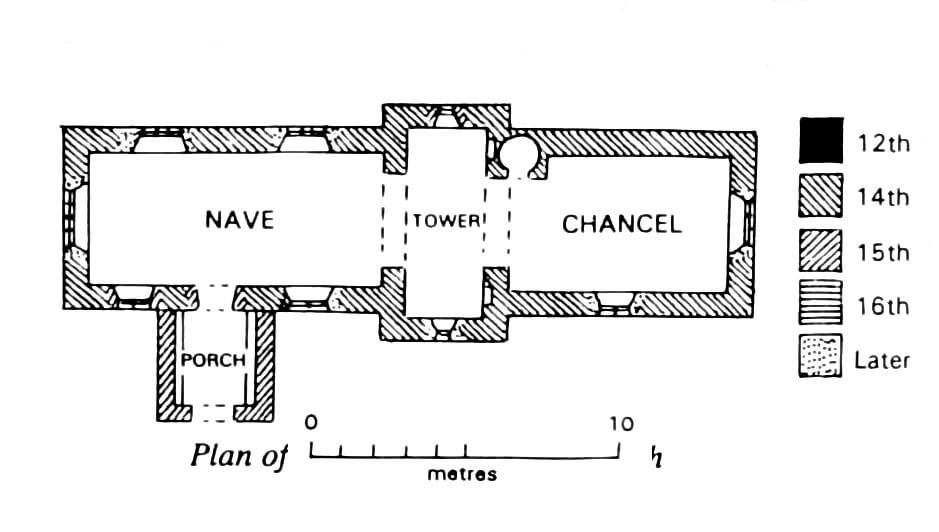
The church was built in the floodplain of the Cadoxton River, on a slope descending southward. In the 14th century, it consisted of a rectangular nave with a prominent plinth, a central tower with a small, very short transept, and a long, rectangular chancel on the eastern side. The south entrance to the nave was preceded by a late medieval porch, also featuring a plinth with a chamfered cornice, integrated with the nave plinth (the porch, however, must have been later than the nave, as it partially overlapped one of the south windows).
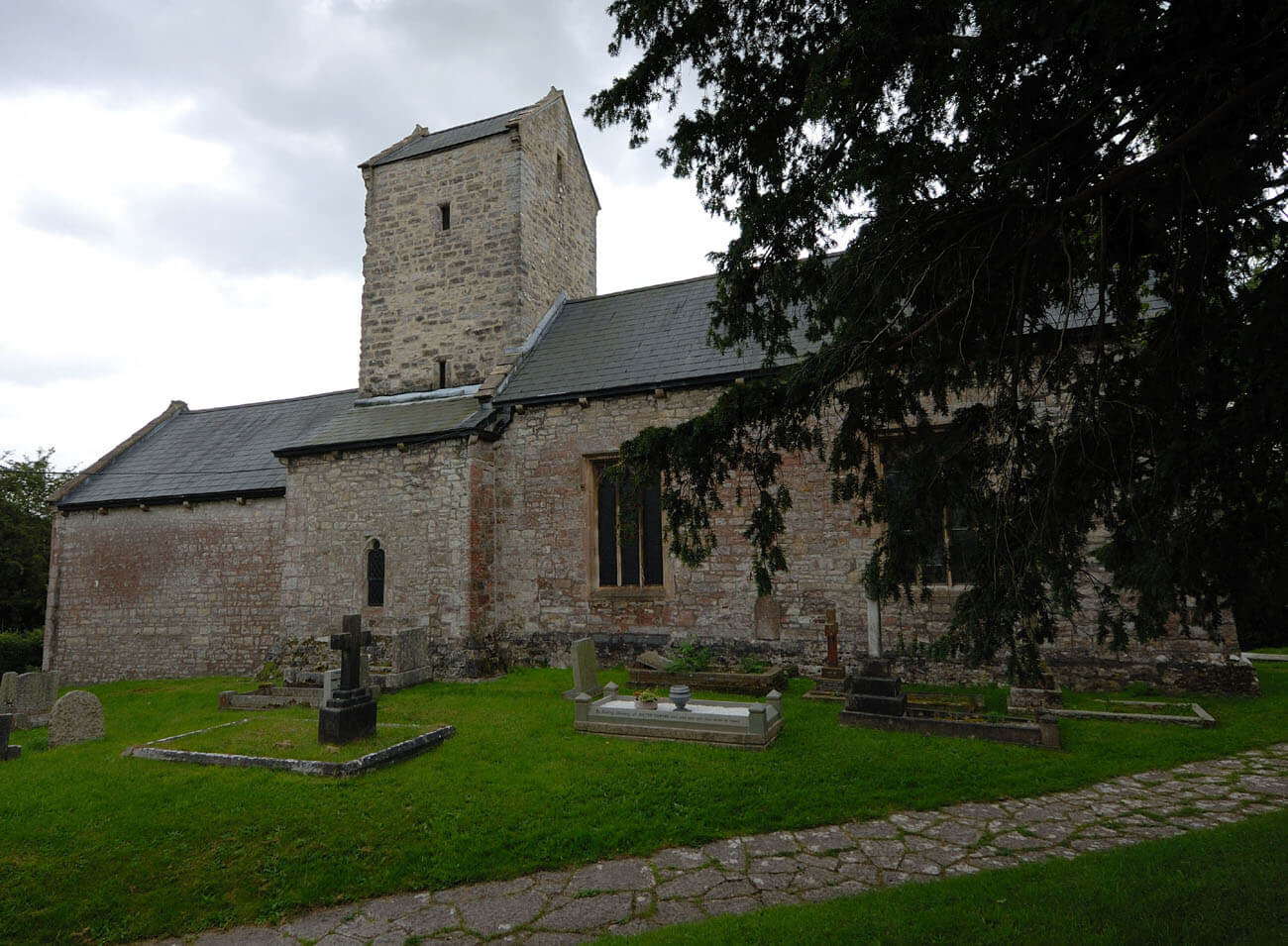
The oldest parts of the church were built of rubble, mortared stone, with the chancel and transept reinforced at the corners with massive, carefully crafted ashlars made from Sutton stone. Smaller-sized stone was used to form the corners of the nave. While the tower’s corners were not reinforced with ashlars, all the building materials on the facades were quite well-worked and laid in even layers.
The windows of the nave, transept, and chancel were mostly single-light or double-light, with trefoil heads. Larger pointed windows, filled with more elaborate tracery featuring ogee arches, were inserted in the 15th century in the eastern wall of the chancel, and probably also in the western and southern walls of the nave. The tower was topped with a gable roof typical of the region and provided only with narrow, quadrangular openings, giving it a fortified character. The entrance to the church was located in the center of the southern wall of the nave. The original portal there was replaced in the late 14th or in the 15th century by a portal with a pointed arch and continuous moulding from the archivolt to the small plinth.
Inside the church, the characteristic feature, the transept arms, were actually altar recesses. One had a diagonal opening (squint) facing the chancel, and the other a wall niche. The space beneath the tower was vaulted, but the arcades facing all sides were exceptionally crude, devoid of ashlar or ornamentation. The nave and chancel, as in most medieval rural Welsh churches, were covered with open roof trusses or timber wagon roofs.
Current state
The church is a valuable example of a rural sacral building with a layout that is unusual and extensive for a small village. Its facades retain the original 14th-century windows topped with trefoils, two renewed 15th-century windows (south in the nave and east in the chancel), and a pointed, moulded south portal. Inside, the font from around 1400 and the original arcades under the tower are visible.

bibliography:
Newman J., The buildings of Wales, Glamorgan, London 1995.
Salter M., The old parish churches of Gwent, Glamorgan & Gower, Malvern 2002.