

History
The parish church of St David in Llanwrtyd was built in the 14th or 15th century, probably on the site of a much older church dating back to before the Anglo-Norman conquest. It was rebuilt or renewed in the early 16th century, primarily to the windows and the addition of a chancel. From 1740 to 1742, William Williams Pantycelyn, the renowned Welsh hymnist, writer, and poet, served as vicar in Llanwrtyd. In 1862, the building underwent a Victorian renovation. Further repairs were made in 1935.
Architecture
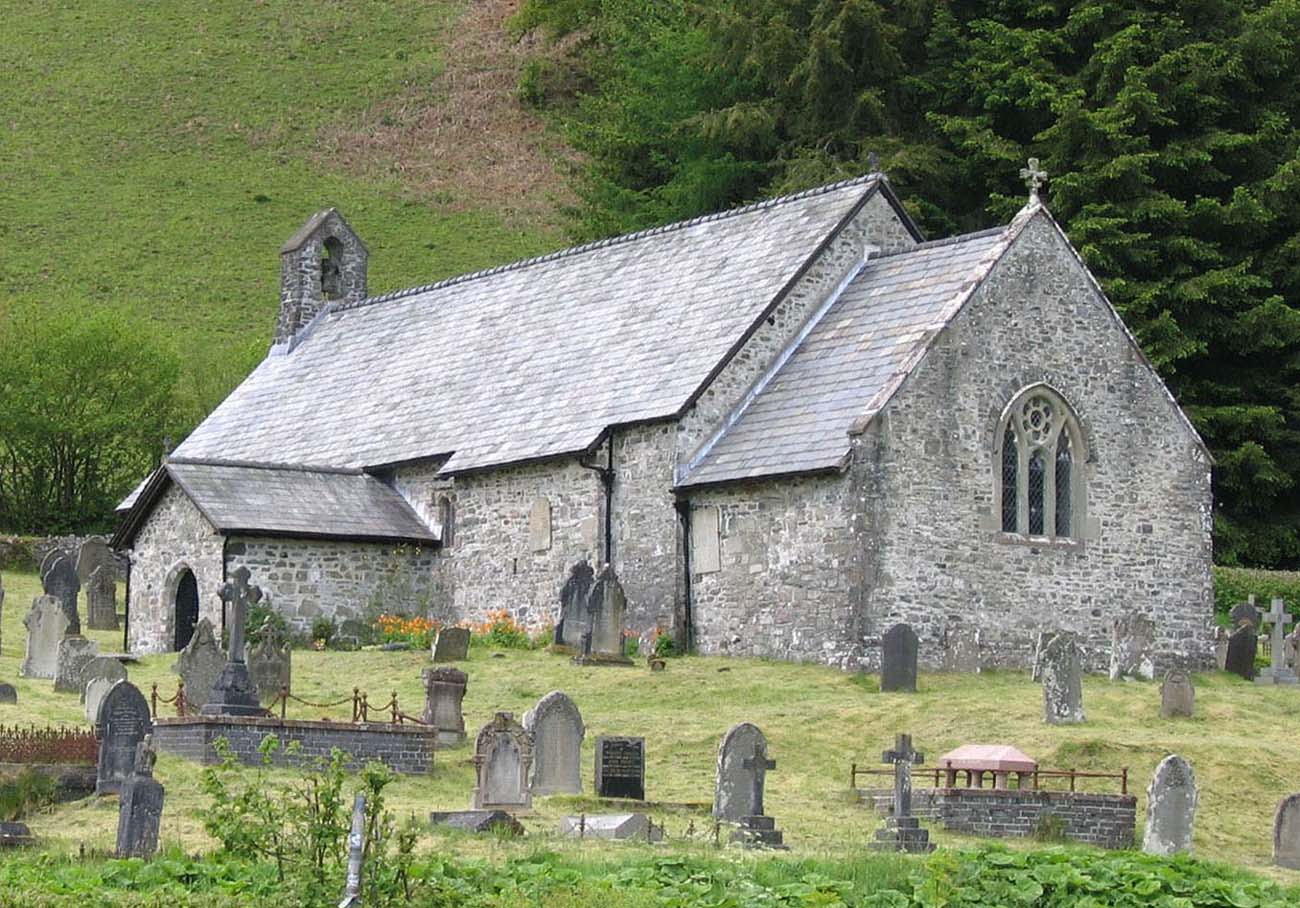
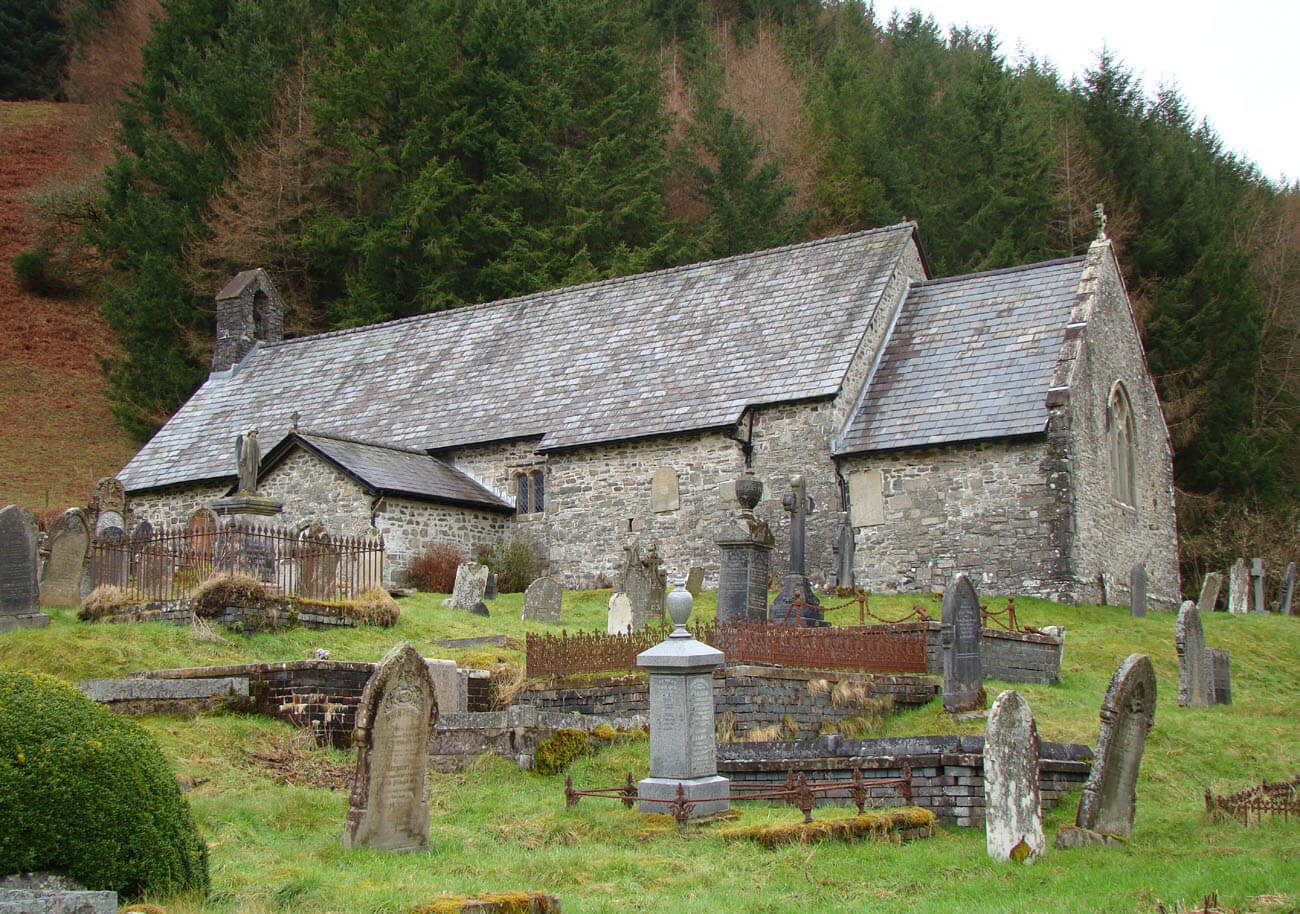
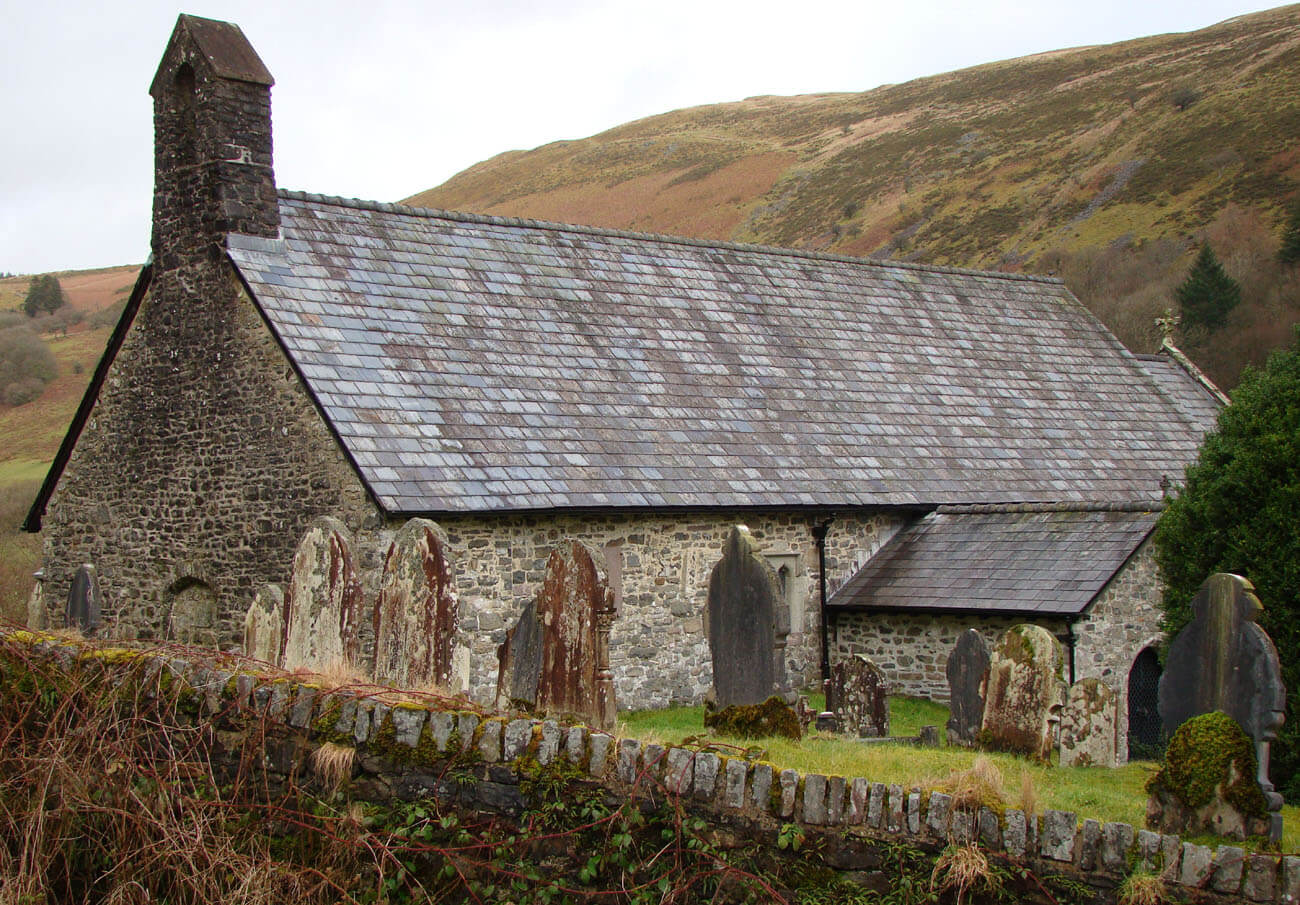
St. David’s church was built in a deep valley on the west bank of the Irfon River, at the foot of a high hill to the northwest. The church ground may have required leveling, as the churchyard sloped down towards the river and, to a lesser extent, towards the Lletgwial stream to the south, which flows into the Irfon about two hundred meters from the church. The cemetery was originally oval in plan and enclosed by a rampart and ditch. The few buildings of a small settlement were located to the south of the church.
The church was constructed of irregular fragments of gray and brown sandstone, mudstone, slate, and large river boulders, all laid uncoursed. Originally, it was a very simple aisleless structure consisting of a long rectangular nave. In the early 16th century, a chancel was added to the east: slightly narrower and lower, very short, and terminating in a straight wall. Furthermore, the nave itself may have been extended on the west side. A porch was also added to the nave from the south during this period.
Inside the church a rood screen with an upper loft must have been located within the nave, as a straight staircase leading upwards was built into the thickness of the shallow projection in the southern wall. The nave was separated from the chancel by a narrow, unmoulded arcade. Both parts of the church were likely covered with open roof trusses in the Middle Ages.
Current state
The church retains its medieval layout, although the porch was rebuilt in the 19th century, likely using older demolition materials. Most of the church’s windows date from the 16th century, but were renewed in the 19th century. Inside there is a 14th-century font and a stone with a cross carved in a circle from the 8th or 9th centuries, moved to the church from a nearby house in 1902 or 1903.
bibliography:
Martin C.H., Silvester R.J., Watson S.E., Historic settlements in the Brecon Beacons National Park, [n.p.p.] 2013.
Haslam R., The buildings of Wales. Powys (Montgomeryshire, Radnorshire, Breconshire), London 1979.
Salter M., The old parish churches of Mid-Wales, Malvern 1997.