History
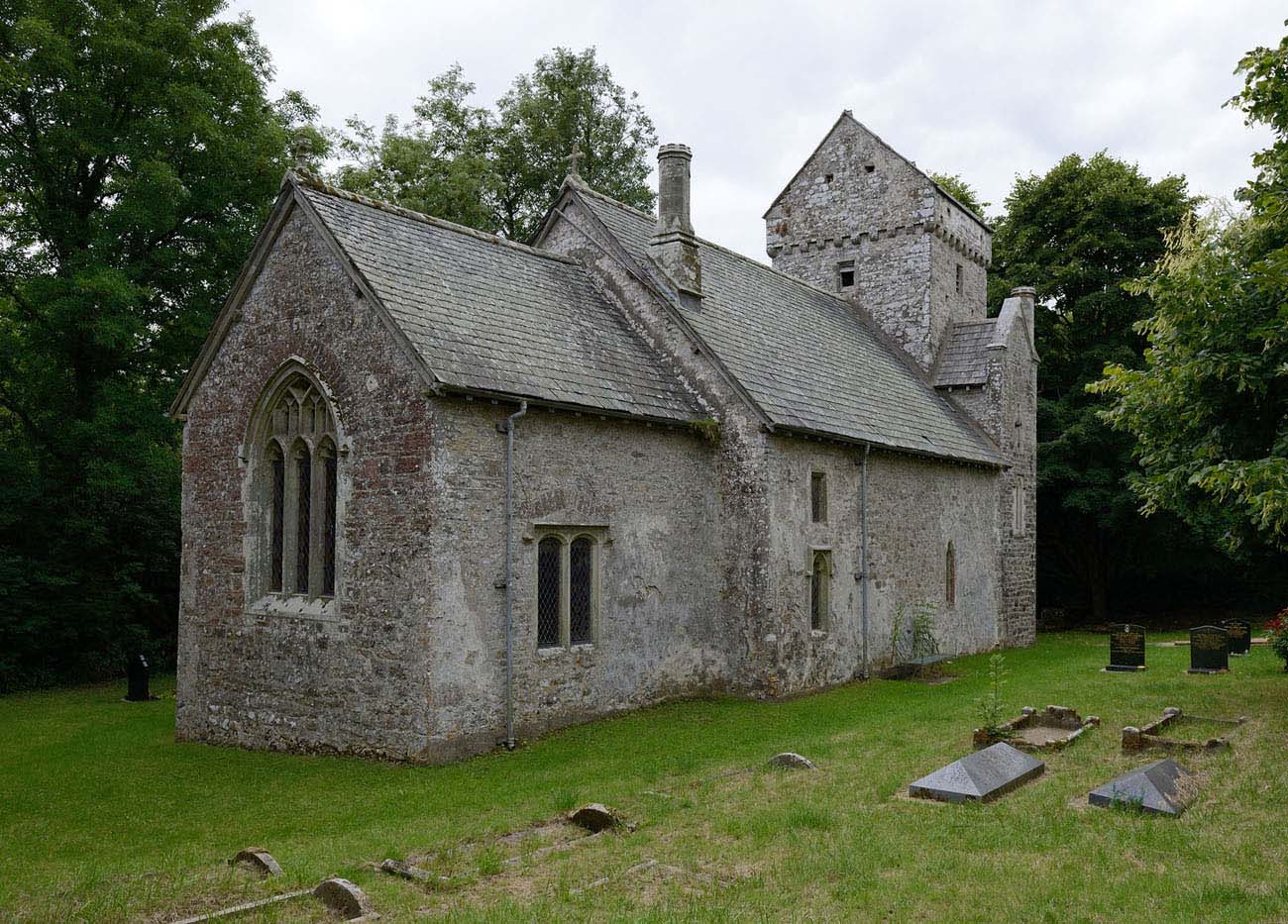
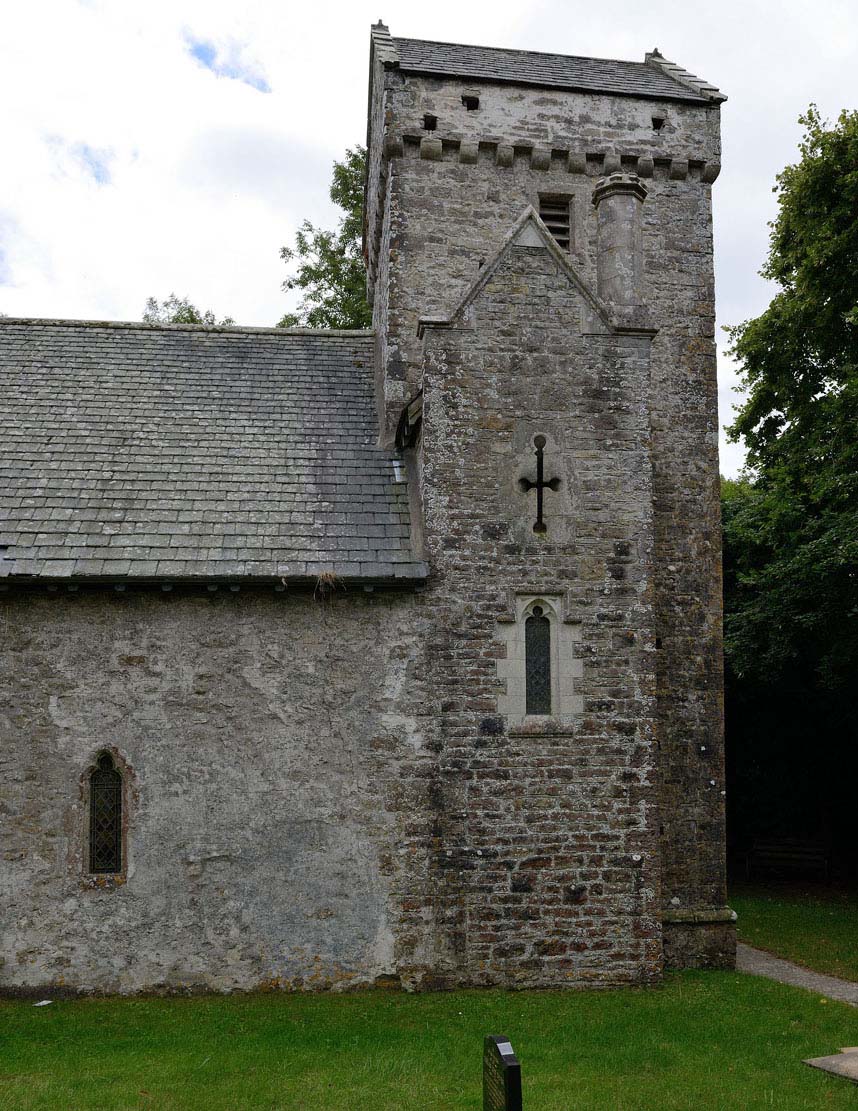
Church of St. Michael in Llanmihangel was built in the first half of the 13th century, likely as a knightly foundation for the owners of a nearby manor. The first record of it appeared in a tax register from 1254. In the 15th century, a tower was added to the church, and some of the architectural details were replaced with late Gothic ones. Minor renovations and adaptations to changing tastes also took place after the mid-16th century. The building’s condition must have deteriorated in the 18th and first half of the 19th centuries. In 1888-1889, the church underwent a thorough Victorian renovation, and in 1909, a small communications turret was added to the north side of the tower.
Architecture
The church was built on a gentle slope at the base of a hill, on which a grange and later a knight’s manor stood to the north. To the south, the churchyard was bordered by a small river, which was crossed on the western side, on the road leading uphill towards the manor. Possibly as early as the Middle Ages, fishponds and a mill canal leading from the river stretched southeast of the church. The terrain favored the church’s precise orientation to the cardinal sides of the world.
Initially, the church consisted of a rectangular nave and a short, quadrangular chancel on the eastern side. The southern entrance portal to the nave was originally unprotected by any annex. The windows illuminating the nave and chancel in the 13th and 14th centuries were narrow openings with trefoils, fitted with offsets to which wooden shutters were attached. In the 15th century and early 16th century, most of these openings were enlarged in the Late Gothic style. To improve lighting, two-light windows with cinquefoil tracery were likely installed, with the eastern window illuminating the main altar likely having the most impressive form (since the mid-16th century, a two-light window with segmental tracery).
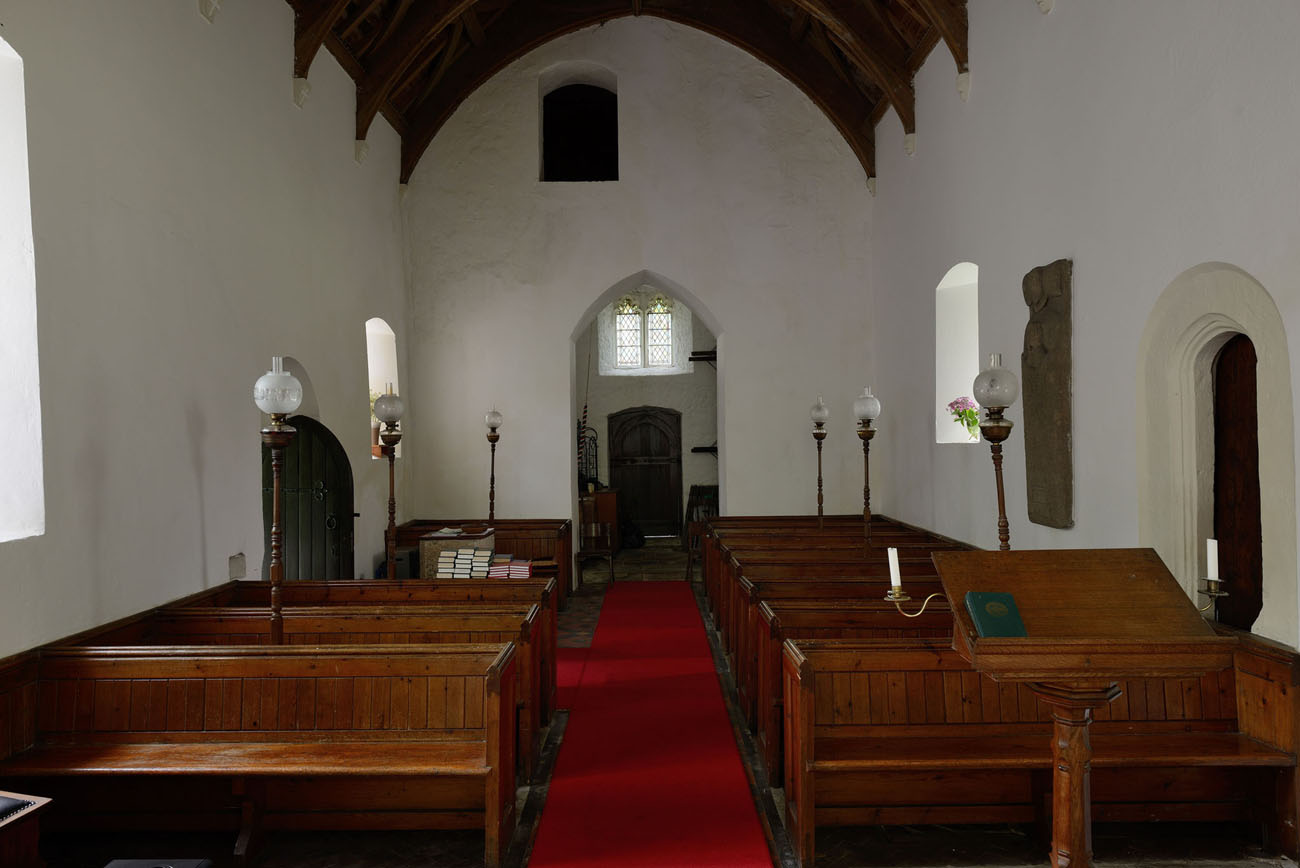
Inside the church, the nave was separated from the chancel by a very narrow and unadorned chancel arcade with a rounded arch. In the Late Middle Ages, a timber rood screen must have existed in front of it, with stairs piercing the thickness of the northern wall of the nave, leading to the upper loft. During the Late Middle Ages, a new roof truss was also installed, opened to the nave and likely to the chancel as well. It was formed of arch-braced collar beams and rafters, longitudinally reinforced on two levels with wind braces, arranged between the purlins, i.e., roof structural elements arranged parallel to the ridge.
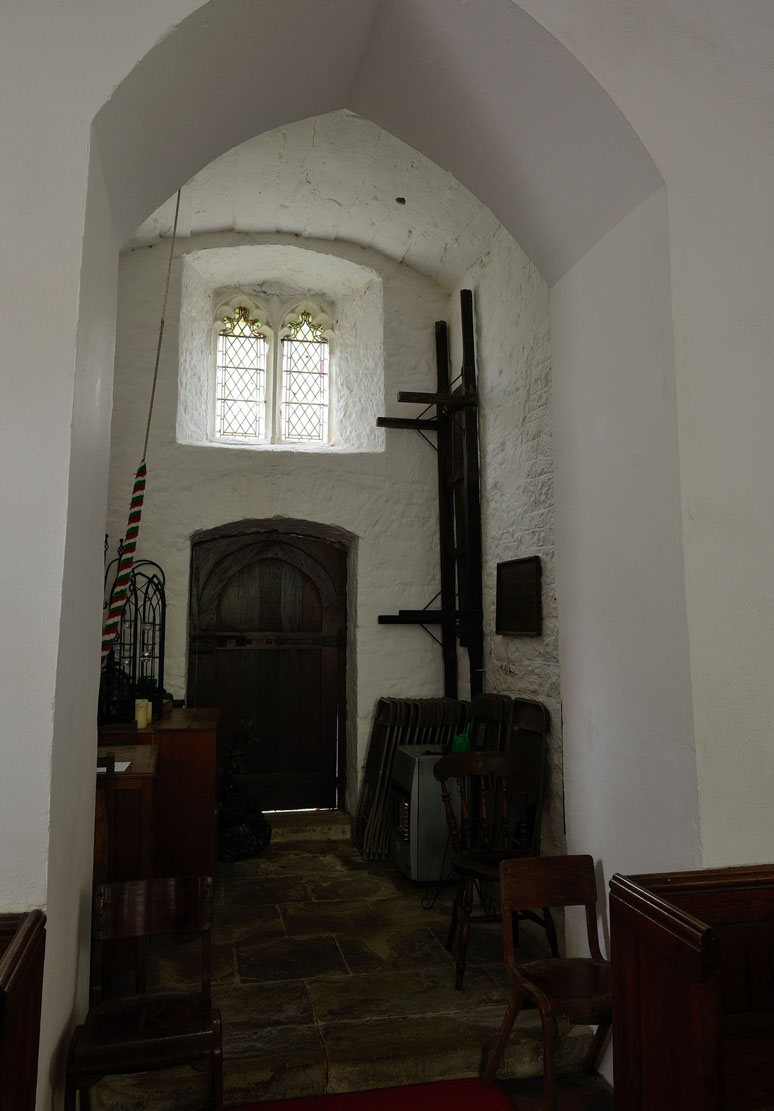
Since the 15th century, the western side of the church was preceded by a quadrangular tower, characterized by a slender form without buttresses. Its base was framed by a plinth with a moulded cornice, interrupted by the western portal. This portal was capped by a very faint pointed arch and double-chamfered along entire height on both sides of a groove. At the top of the walls, the tower was topped with a prominent parapet mounted on massive corbels, likely later covered with a hip roof. Although cross-shaped arrow slits with circular finials were inserted into the western and southern walls, and originally perhaps also the northern wall, these were more symbolic in nature, as above the western portal was a large, two-light window with cinquefoil tracery, significantly diminishing the tower’s defensive features.
Current state
The church has the medieval walls of the nave, chancel, and tower, but has undergone early modern transformations, the most striking of which are the addition of a porch and a neo-Gothic stair turret. Most of the windows have been rebuilt or renewed. The original early Gothic window is in the north wall of the nave. Before its Victorian renovation, the north window in the chancel was located in the east wall. Inside, the church retains the 15th-century oak roof truss of the nave, a late Romanesque piscina in the south wall of the chancel, and a 13th-century font in the nave. The churchyard contains the base of a medieval cross. Beyond the western end of the cemetery is St. Anne’s Well, a medieval well with steps leading down to the water and a carved female figure.
bibliography:
Newman J., The buildings of Wales, Glamorgan, London 1995.
Salter M., The old parish churches of Gwent, Glamorgan & Gower, Malvern 2002.