History
The church was erected in the 13th century and then thoroughly restored and probably expanded at the end of the 15th or the beginning of the 16th century. It was recorded for the first time in a document from 1254. In the 17th century, the porch and the belfry were added. The building underwent minor renovations in the 19th and 20th centuries, falling into a state of dilapidation after 1842, when a new church was built in the village. The medieval structure was restored in 1917 by Harold Hughes. Further renovations took place in 1970 and 2003.
Architecture
St. Celynnin’s Church was built on land sloping down to the sea, between the coastal trail to the east, which ran parallel to an elongated hill with steep slopes, and the coastal escarpments to the west. Due to the sloping terrain, the western wall of the church was reinforced at the batter, separated from the vertical section of the wall by a cornice. Such reinforcement was deemed unnecessary for the remaining walls, and no buttresses or pilasters were used.
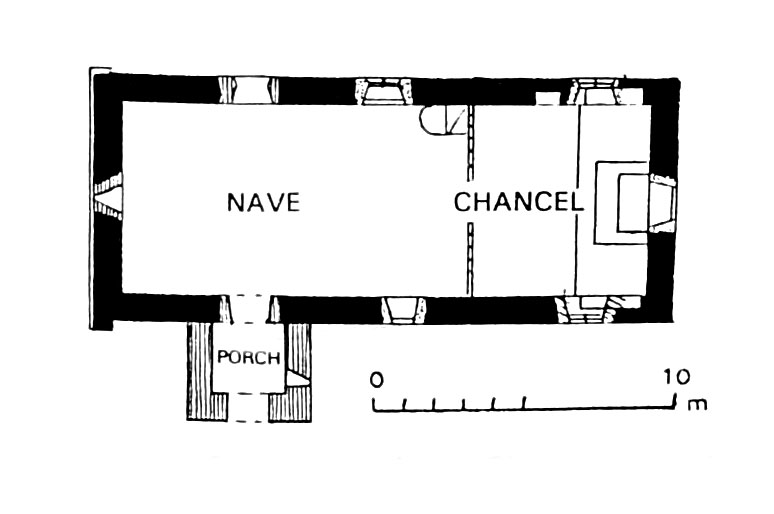
The original church was likely small, consisting of a rectangular nave and chancel, forming a single structure and covered by a common gable roof. It was therefore the simplest possible type, characteristic of a poor medieval village in north Wales. Entrance to the interior was through a simple, pointed-arched northern portal, and probably also the opposite southern portal. Lighting was likely provided by narrow, splayed windows, lancet or semicircular in shape, or even with completely straight heads.
In the 15th and 16th centuries, the church walls were raised, and the building was enlarged westward, reaching 27.4 meters in length and 6.4 meters in width. The windows were likely widened at this time, from narrow, almost slit-like ones to single-light and two-light, topped with trefoils, set into quadrangular jambs. The roof and roof trusses were also replaced, mounted on undecorated stone corbels. Inside, a wooden rood screen separated the nave from the chancel.
Current state
The porch on the south side of the current church is a modern addition, although some argue it has late medieval origins. Many of the windows were altered in the 18th and 19th centuries, but a late Gothic southern window and a slit-shaped western opening have survived, possibly from the 13th century. Inside, a late medieval roof truss is visible, dendrochronologically dated to 1502-1530. The currently preserved rood screen contains only a few medieval fragments.

bibliography:
Haslam R., Orbach J., Voelcker A., The buildings of Wales, Gwynedd, London 2009.
Kinross J., Discovering the smallest churches in Wales, Stroud 2007.
Salter M., The old parish churches of North Wales, Malvern 1993.
The Royal Commission on The Ancient and Historical Monuments and Constructions in Wales and Monmouthshire. An Inventory of the Ancient Monuments in Wales and Monmouthshire. County of Merioneth, London 1921.
Wooding J., Yates N., A Guide to the churches and chapels of Wales, Cardiff 2011.