History
The church, dedicated to Brynach, a sixth-century Irish saint, was built in the 12th or early 13th century, likely on the site of a much older temple dating from before the Anglo-Norman invasion. In the 15th century, it was enlarged with a tower, porch, and projection for the rood screen staircase. In the first half of the 16th century, it underwent significant renovation and construction works, including the installation of new windows and a renewed roof truss. An early modern renovation took place in 1629, documented by a commemorative plaque. The church fell into disuse in the late 17th century, when it became isolated from any nearby settlement. A Victorian renovation is said to have taken place in 1848, with modern repairs in 1932 and in the second half of the 20th century.
Architecture
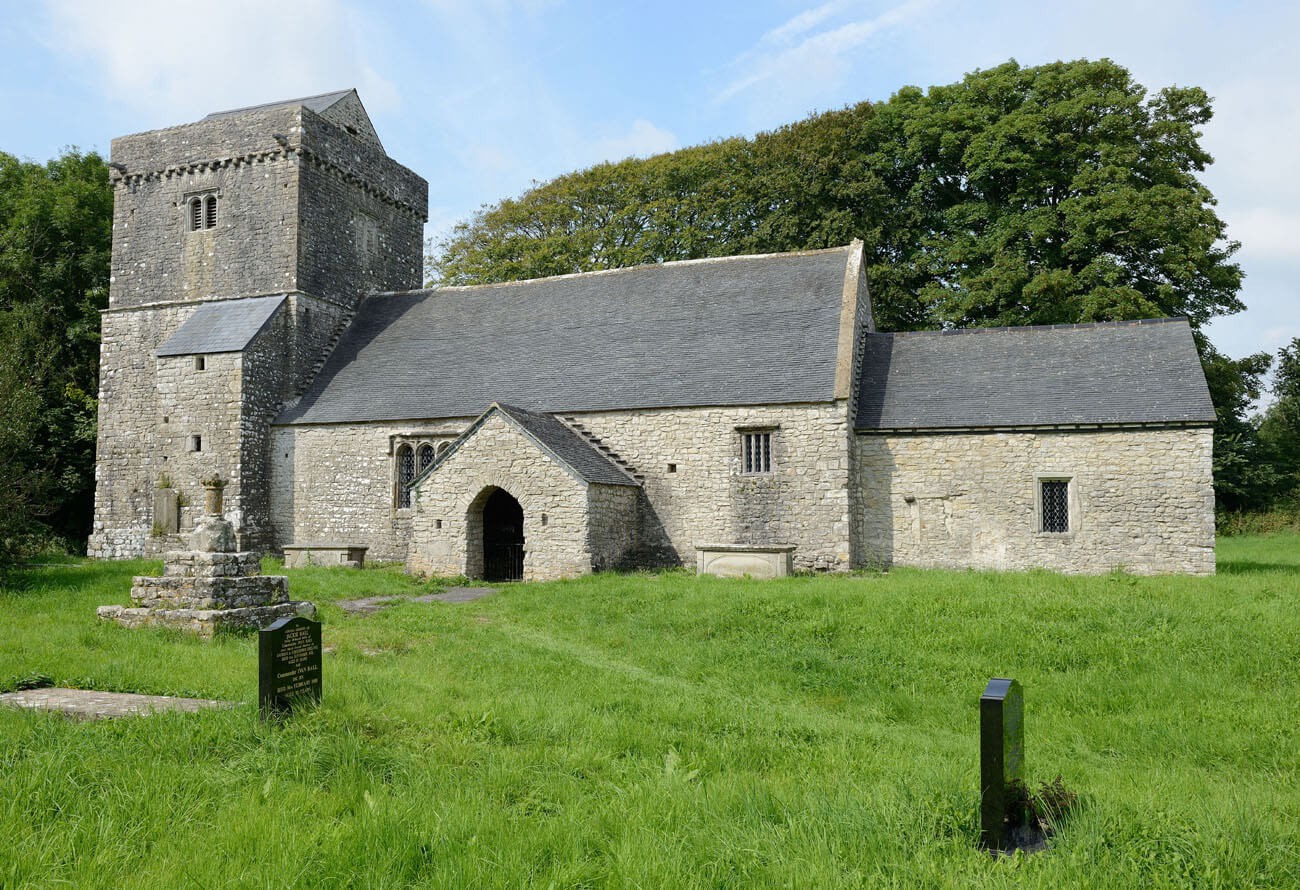
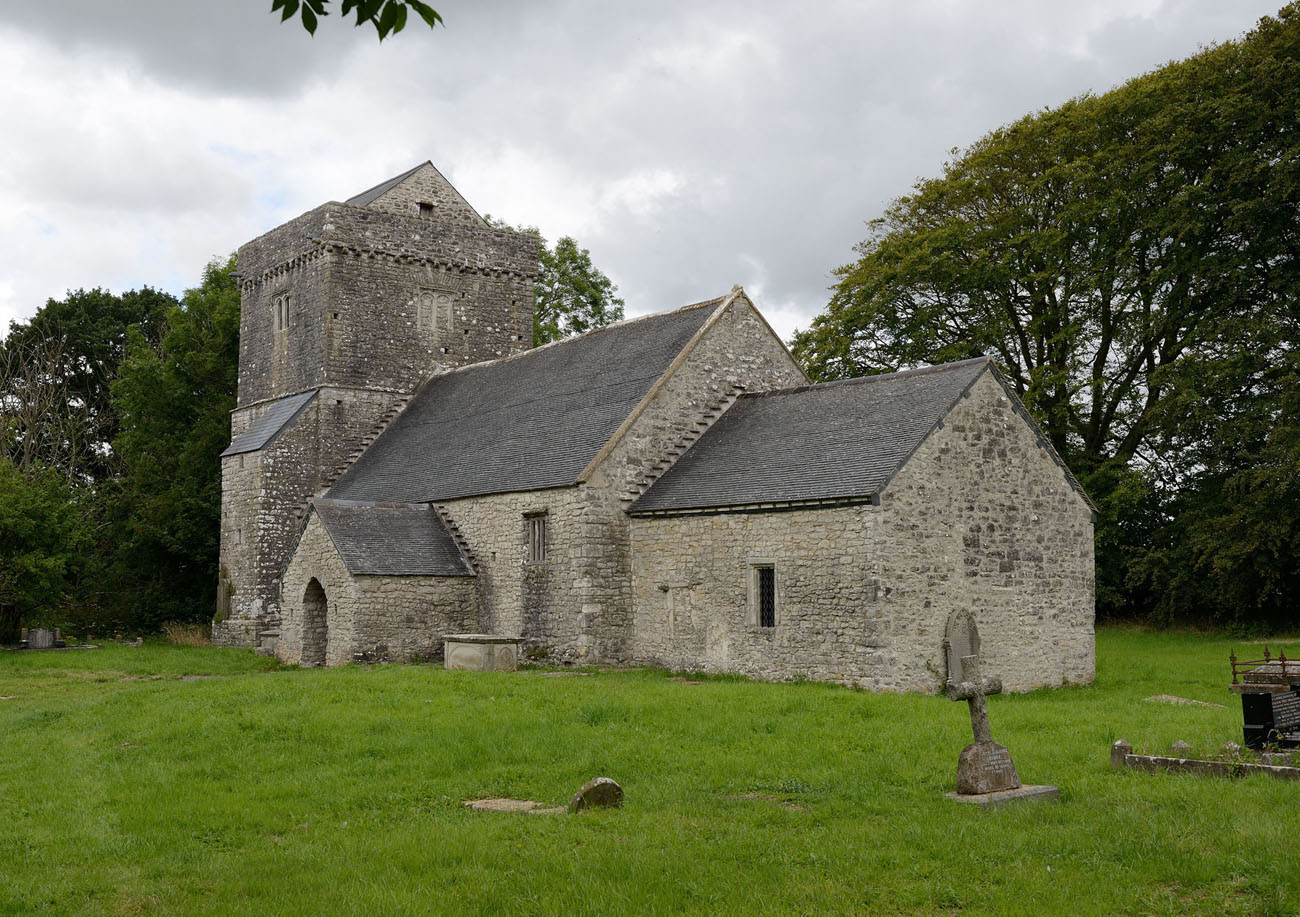
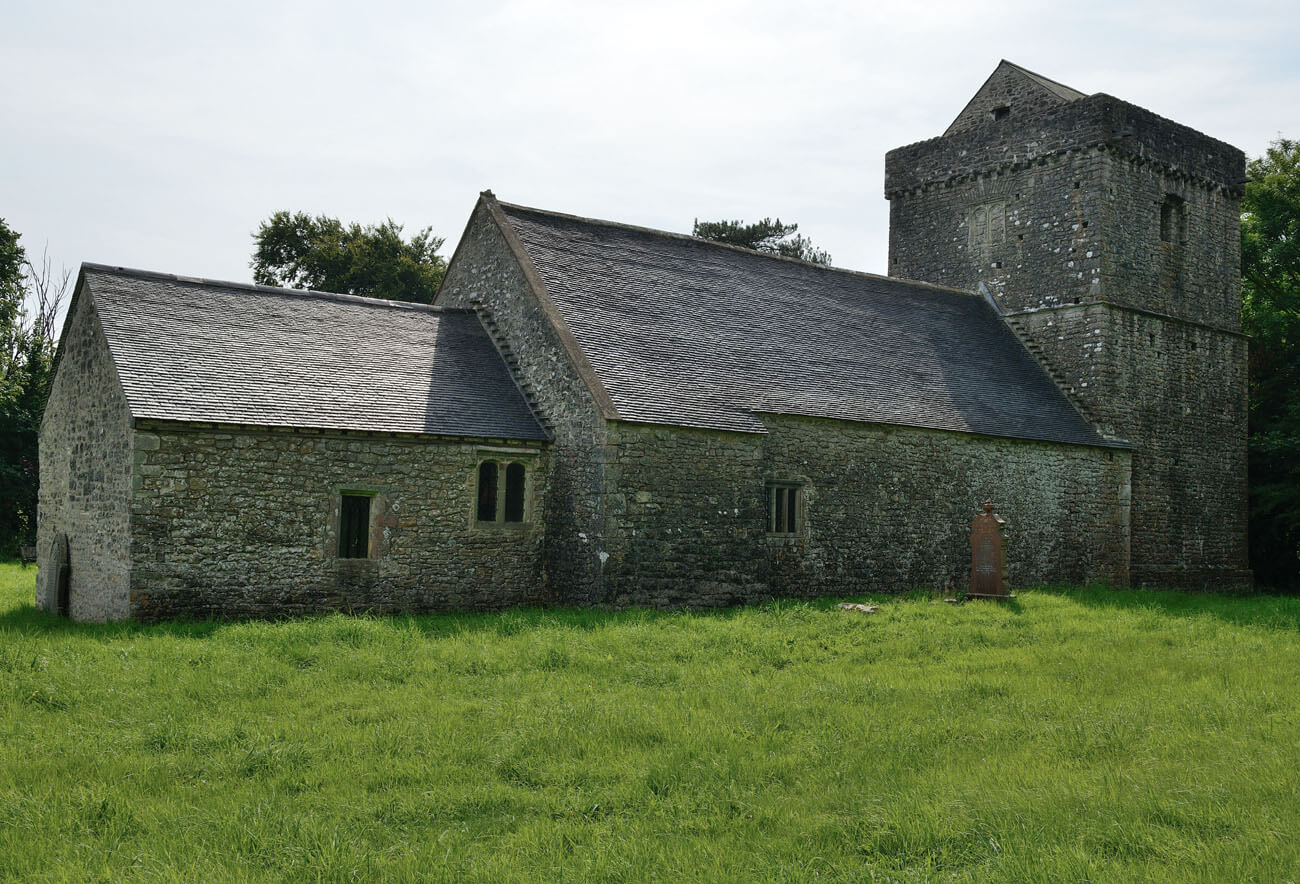
Church was built on relatively flat ground, on the north side of a small stream. Initially, the building consisted of a wide, rectangular nave, a much narrower and lower chancel on the eastern side, and towards the end of the Middle Ages, a squat, quadrangular tower on the western side. A porch was also then added to the southern wall of the nave, likewise the nave characterized by considerable width. The entire structure thus acquired a very popular layout for rural parish churches, with an axial gradation of height from the highest tower in the west to the lowest chancel in the east.
The austere facades of lightly worked, layered limestones lacked ornamentation and support in the form of buttresses or pilasters. There were no ashlars to reinforce the corners, except for a few larger stones. The nave was externally clasped at the base of part of the southern wall by a batter, but for unknown reasons, this was not the case along its entire length. The later porch and the northern projection of the rood screen acquired such a batter. The tower was surrounded by a plinth with a chamfered cornice, while its upper part was slightly offset by a string course. A shallow projection was built from the southern wall for the staircase. The tower’s parapet, traditional for the region, was set on corbels projecting from the wall face.
The church’s original windows must have been small, probably deeply splayed inward. The northern façade likely lacked openings entirely. In the Late Gothic period, larger pointed windows were added, including a three-light or four-light window in the eastern wall of the chancel. In the 16th century, windows in quadrangular frames with segmental tracery began to be used. Since the time of the church’s construction, the entrance opening was located in the southern wall of the nave, where a new portal with continuous molding along its entire height and a slightly flattened pointed arch was inserted in the 14th or 15th century. The entrance to the 15th-century porch was created very crude, without ashlar framing. Furthermore, a portal with a nearly gabled head was placed in the ground floor of the tower on the west side.
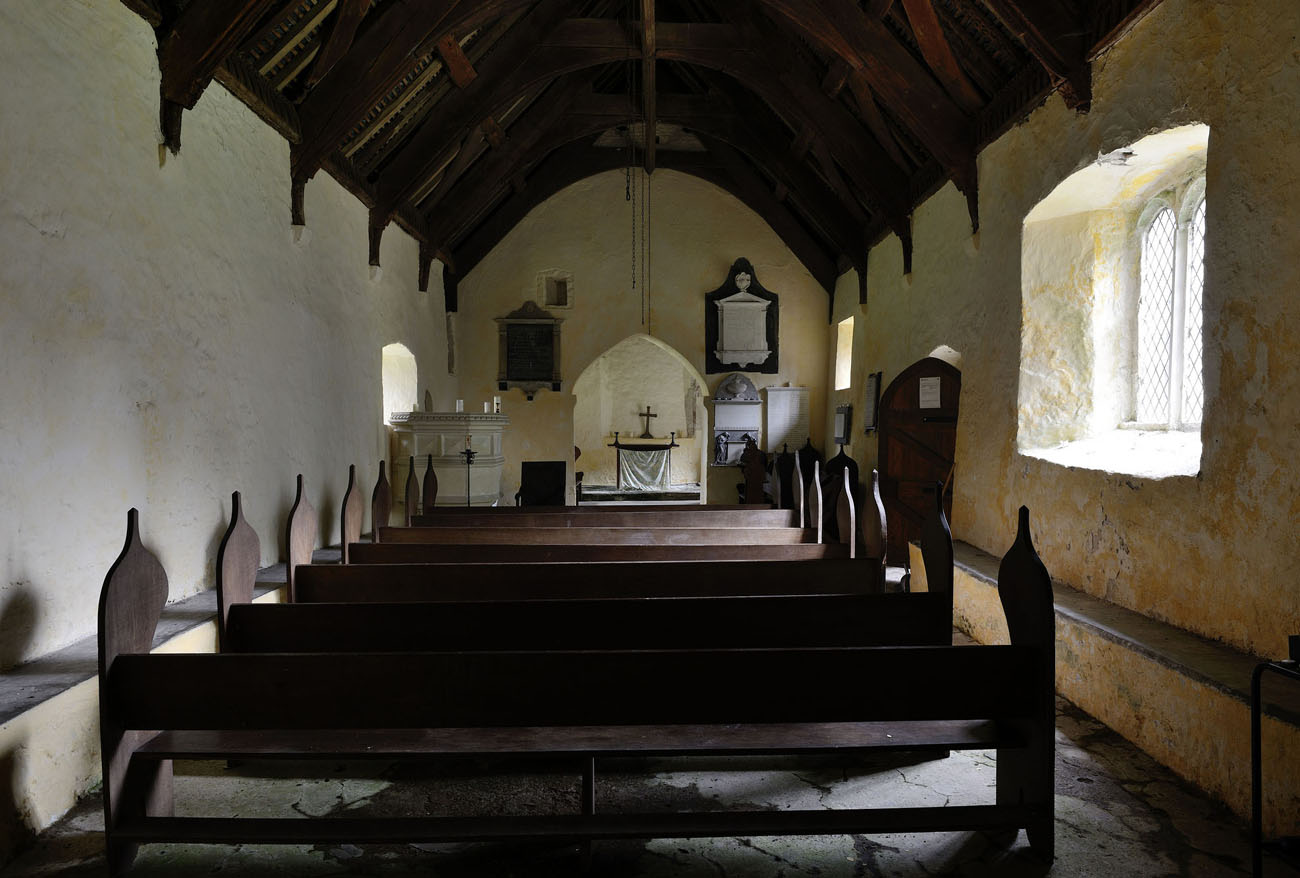
Inside the church, the chancel was separated from the nave by a narrow, low chancel arcade, capped by an irregular pointed arch set on very simple imposts. In the Middle Ages, the walls were covered with colorful polychromes and topped with an open roof truss. Their inner batter at the longitudinal elevations was characteristic of early sacral buildings. Stone pews were located on the north and south sides of the nave, while a square opening on the nave side, near the chancel arch, allowed parishioners to view the altar from behind the rood screen. This rood screen housed a loft, accessible by stairs located in the northern projection of the nave. In the chancel southern wall there was a piscina with a small square recess, which was probably a compartment for storing sacred vessels and liturgical vestments.
Current state
The church has escaped major modern alterations. Traces of medieval wall polychromes, a crude late Romanesque chancel arcade, a late medieval wooden roof truss, and rare stone pews in the nave, dating from the 12th century, have survived. A squint window is also visible, as is a 13th- or 14th-century piscina in the south wall of the chancel. The chancel floor is lined with 13th-century tombstones. Unfortunately, all the windows were altered in the first half of the 16th century or later.
bibliography:
Newman J., The buildings of Wales, Glamorgan, London 1995.
Orrin G.R., Medieval Churches of the Vale of Glamorgan, Cowbridge 1988.
Salter M., The old parish churches of Gwent, Glamorgan & Gower, Malvern 2002.
Wooding J., Yates N., A Guide to the churches and chapels of Wales, Cardiff 2011.