History
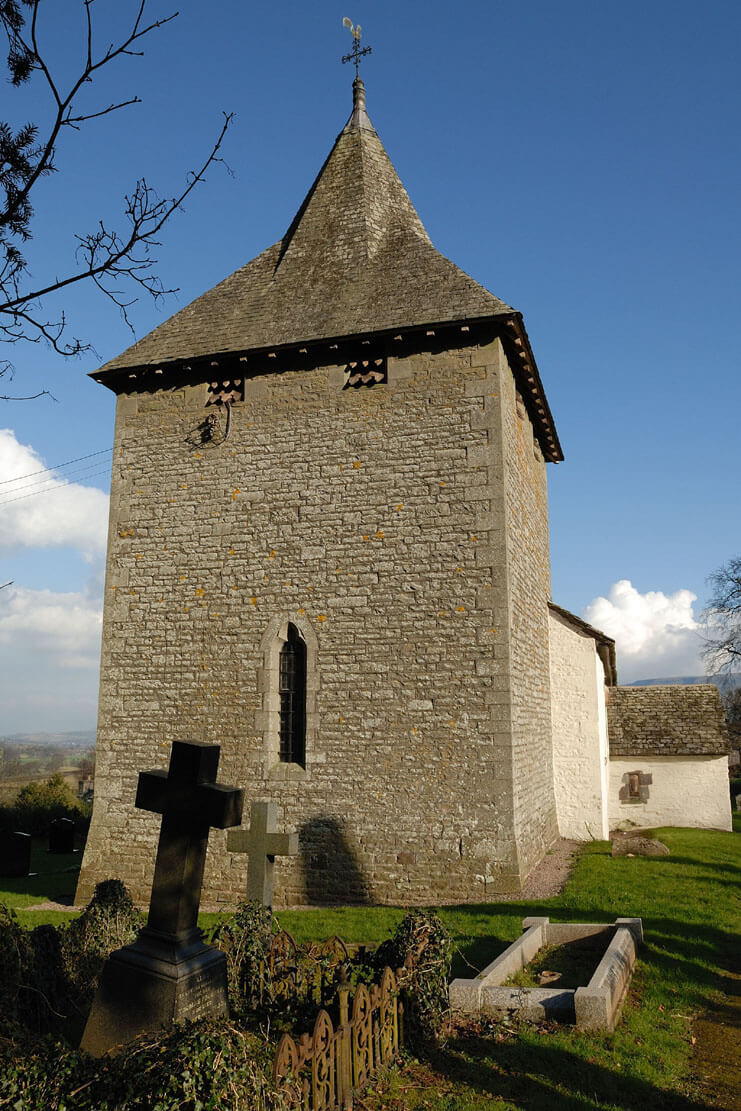
Built in the 12th or 13th century in Llanfilo, the church was dedicated to the local saint, Bilo or Beilo, but was also known as St. Milburga’s church, daughter of a 7th-century king of Mercia. It was rebuilt and enlarged in the 14th and 15th centuries. Early modern modernizations took place around 1680 (the nave windows) and again in 1710, when the chancel was rebuilt. In the 19th century, the western part of the building was partitioned off and used as a schoolroom. The western tower was rebuilt in 1851. A thorough renovation of the church began in 1913.
Architecture
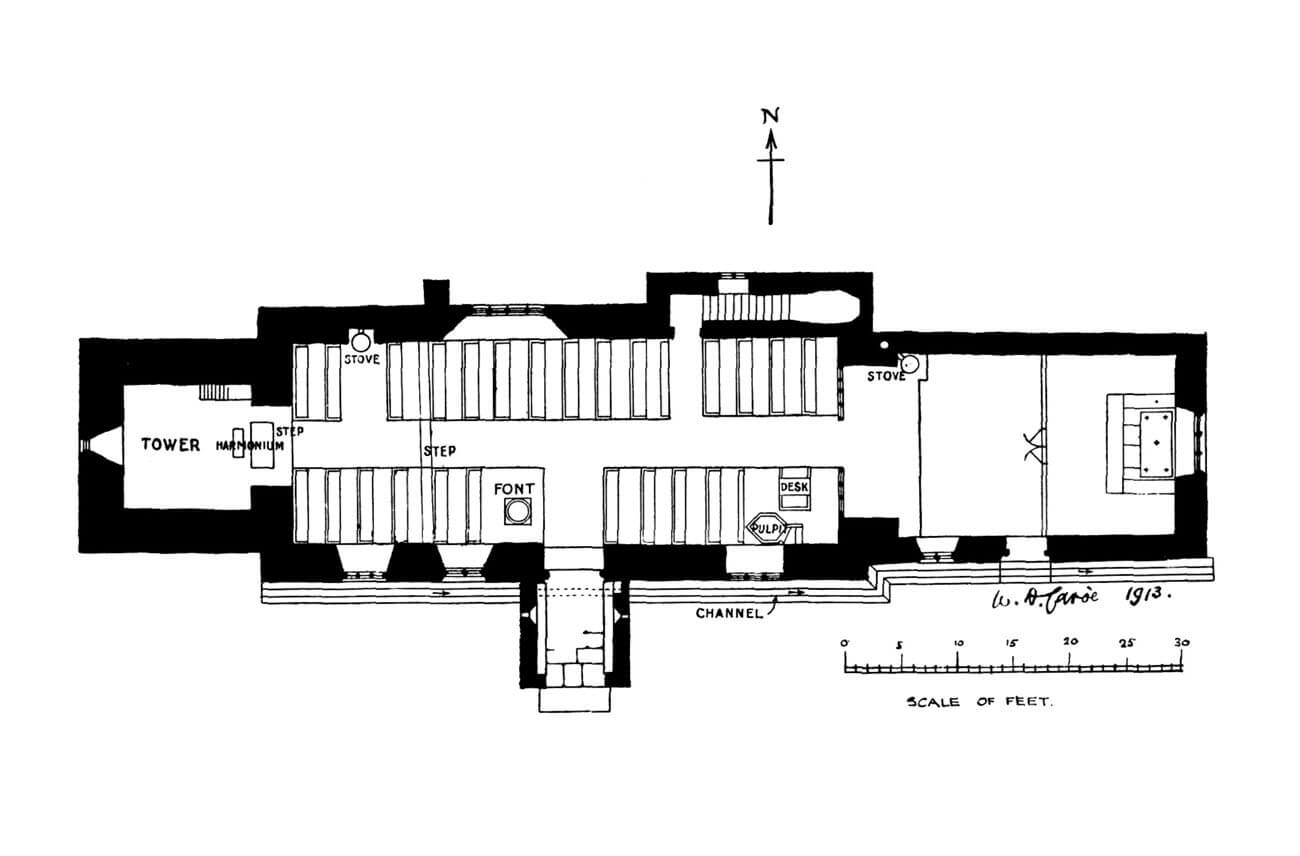
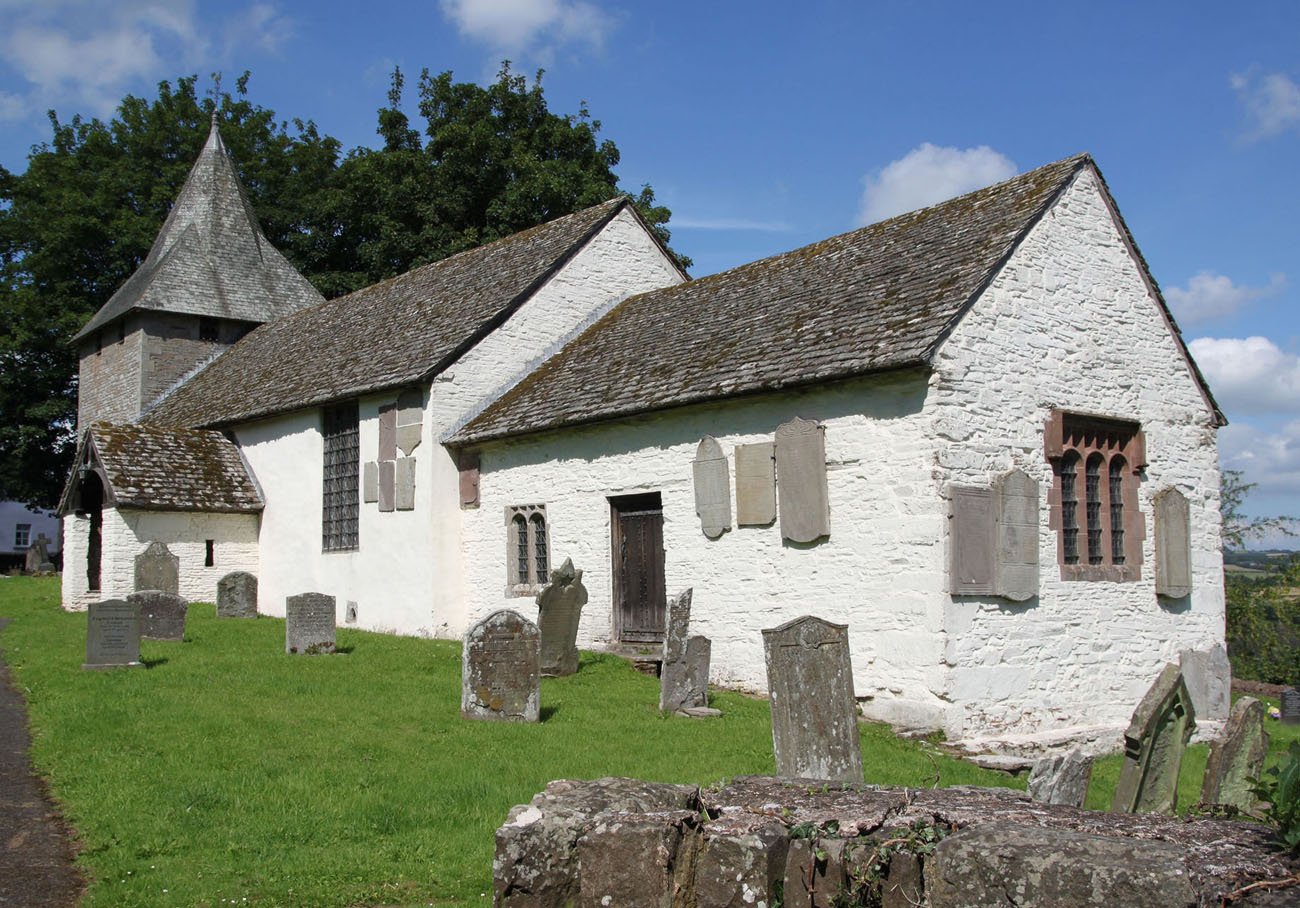
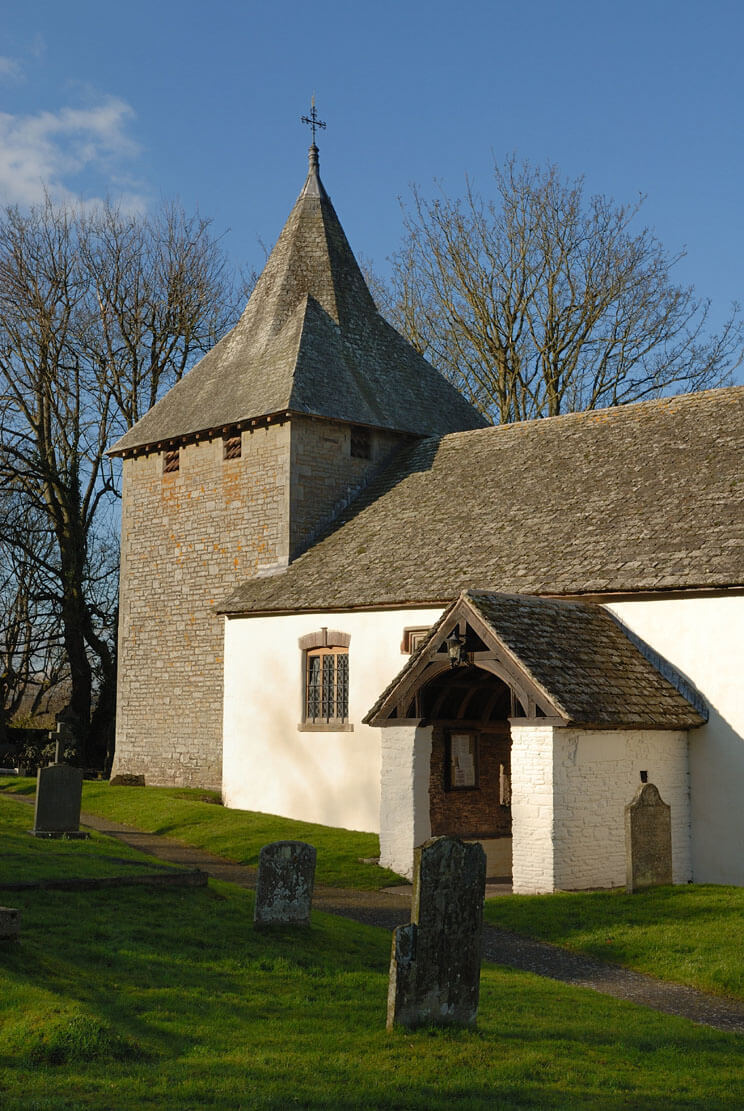
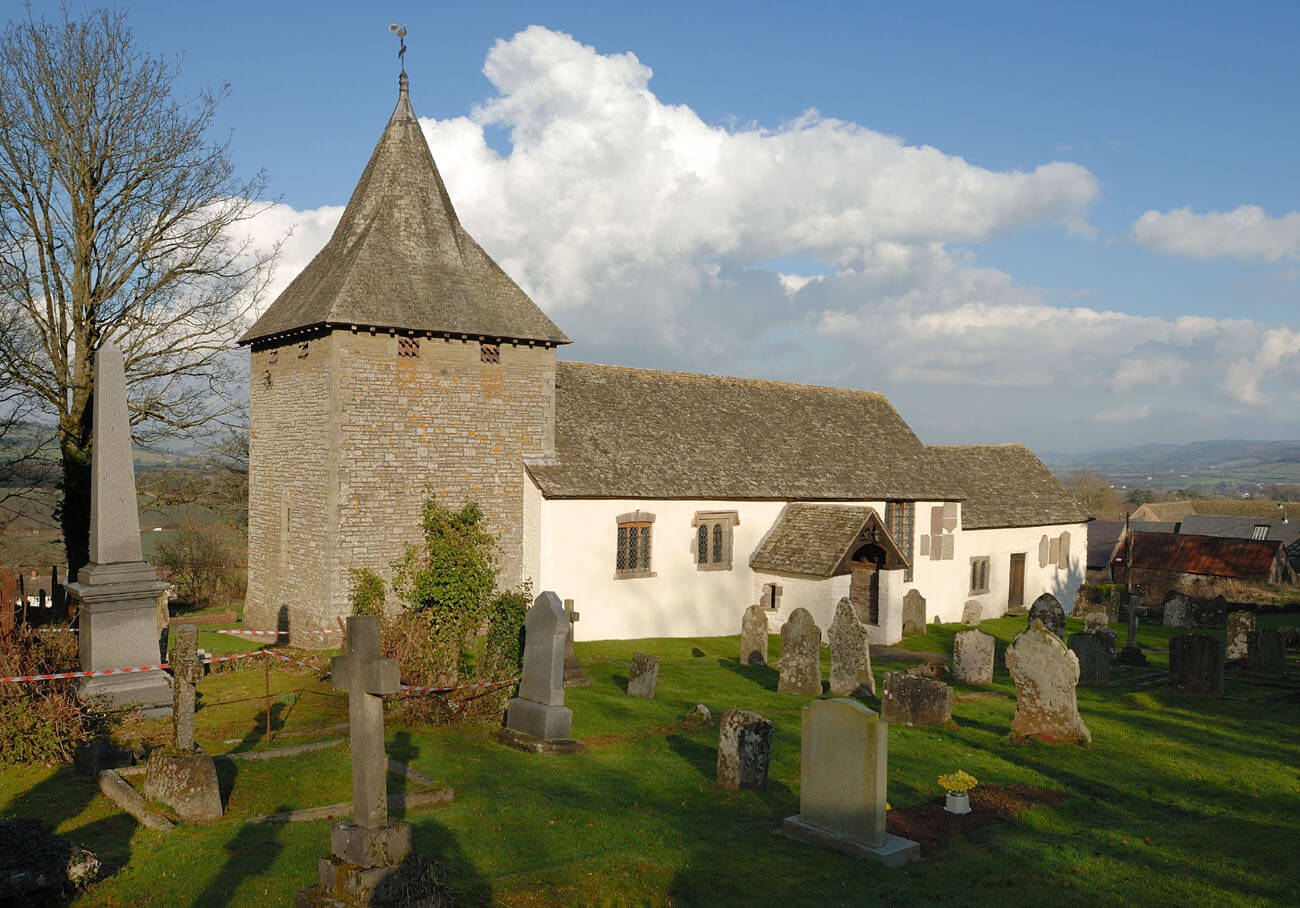
St. Bilo’s church was built on the lower part of the southeastern slope of a hill, on an oval-shaped cemetery, suggesting the Celtic roots of the original local sacral building. It was constructed using red and gray sandstone of irregularly shaped small slabs. Initially, it consisted of a rectangular, elongated nave and a narrower, lower, and shorter chancel on the eastern side, both characterized by relatively thick perimeter walls. Before the end of the Middle Ages, a low tower (possibly unfinished) was added on the western side of the nave. Additionally, the southern entrance portal was protected by a porch in the 15th century.
The church’s oldest doorways likely had Romanesque forms. The northern entrance was closed by a semicircular tympanum, and at least two of the portals had lintels decorated with diamonds motifs and dogtooths frizes. The original windows, like those of other 12th- and 13th-century buildings, must have been narrow, splayed and perhaps semicircular, like the northern portal. In the later Middle Ages, Gothic windows may have been inserted into the church walls. Among others, a small lancet opening was inserted into the southern wall, likely serving as the so-called leper’s window.
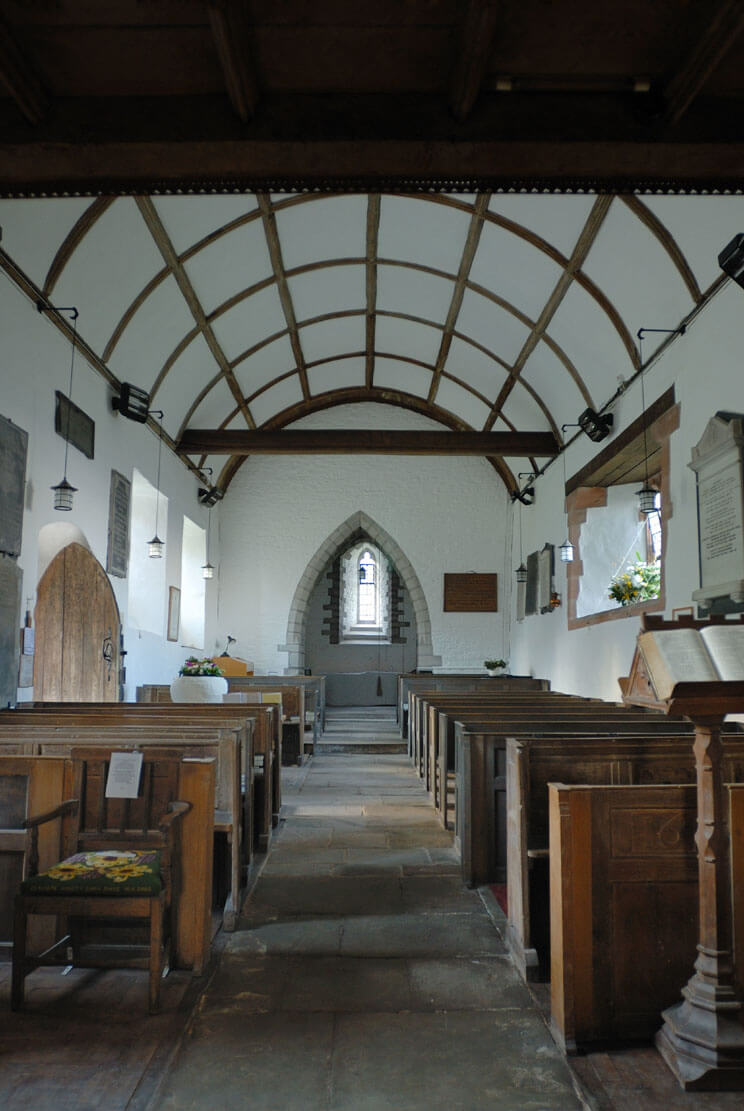
Inside, the nave was covered in the 15th century with a timber barrel vault. It was constructed of arched, moulded ribs, between which white plastered quadrangular panels were made, forming a regular pattern along entire length and width of the nave. The chancel may have originally been covered with a similar barrel vault, or possibly an open roof truss. The two parts of the church were connected by a semicircular arcade.
Since at least the early 16th century, the nave and chancel have been separated by a timber rood screen, equipped with a loft accessible by stairs placed within the thickness of the northern projection. On the ground floor, the rood screen was divided into six tracery screens with ogee arches and quatrefoil motifs, flanking the central entry. The main crossbeam, mounted on stone consoles, was decorated with a vine motif emerging from the dragon’s mouth on the north side. The lower part of the loft featured moulded wooden ribs, intersecting with bosses of floral motifs. The balustrade façade was adorned with six panels with carved figures, placed between triangular pilasters, each with a capital and base covered with carved floral decoration.
Current state
Despite the early modern repairs, the church retains its 15th-century porch roof truss and the barrel roof over the nave. A valuable late medieval rood screen from the early 16th century, renovated between 1926 and 1930, has also survived (the figures in the center of the front panels are modern). The oldest architectural details of the church are the 12th-century bas-relief lintels in the bricked-up northern portal and in the porch. A small opening on the eastern side of the porch is early Gothic. Early modern changes primarily led to the replacement or building of new window jambs (a large window in the southern wall of the nave at the rood screen, two two-light windows in the southern wall of the nave from the 17th century, a similar four-light northern window, the southern window of the chancel, and the eastern window from 1913). Furthermore, the tower’s roof and sections of its rebuilt walls are from 19th-century and the pulpit located within the nave is from 17th-century.

bibliography:
Caröe W.D., Llanfilo (St. Beilio), Breconshire, „Archaeologia Cambrensis”, 4/1924.
Haslam R., The buildings of Wales. Powys (Montgomeryshire, Radnorshire, Breconshire), London 1979.
Salter M., The old parish churches of Mid-Wales, Malvern 1997.