
History
Llanddew church was built in the thirteenth, or perhaps even in the twelfth century. According to a local legend, Saint Eluned, daughter of Brychan, escaped here from an unwanted competitor around 500 and led the life of a nun until rejected competitor found her and cut off her head. The head of the saint was supposed to roll down the slope and stop by the yew, next to which a miraculous spring appeared, which became a place of pilgrimage. This well exists to this day.
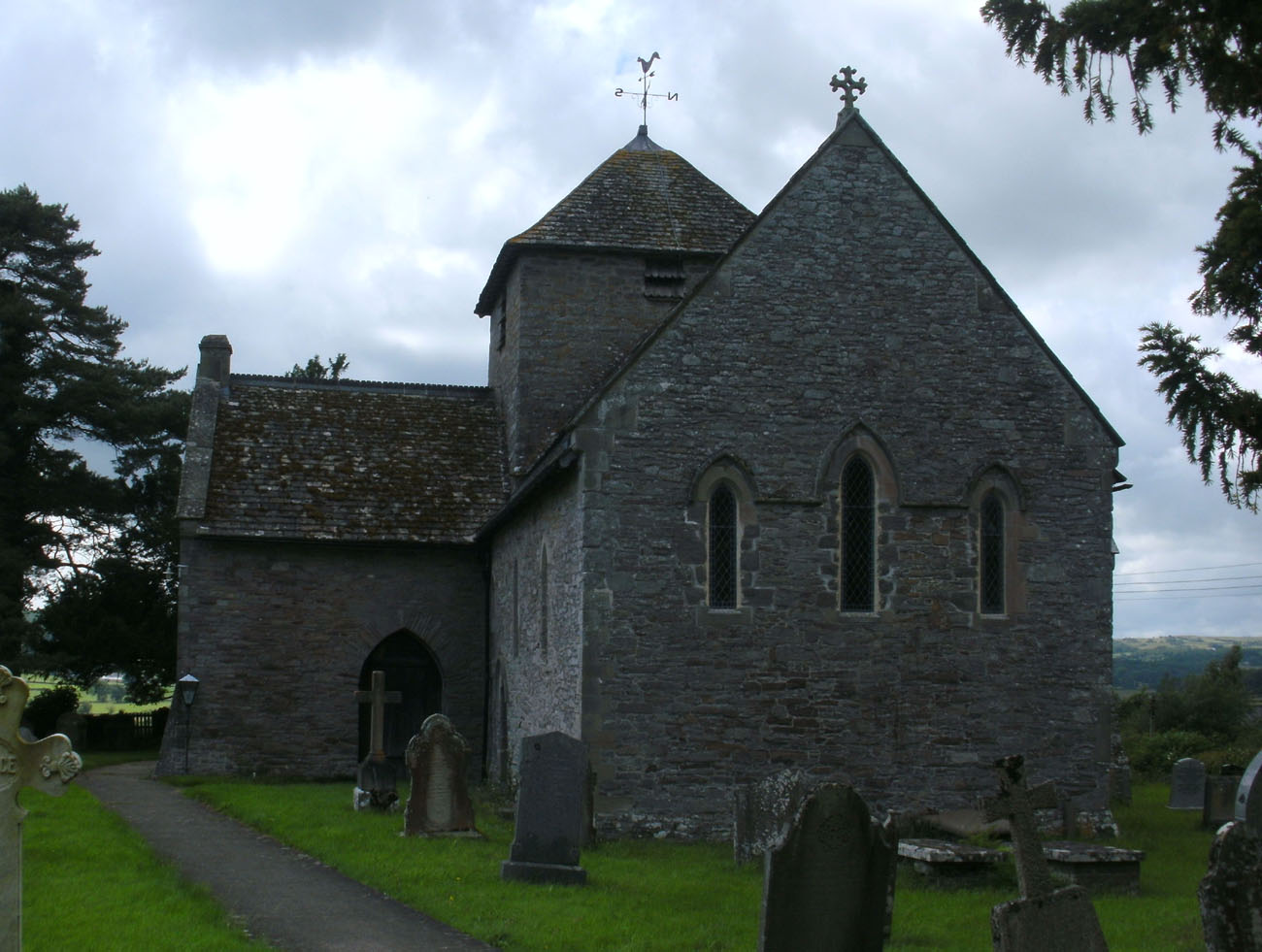
The church was rebuilt in the 1620s, when a tower was built or rebuilt at the crossing. Around 1780, a new roof was added to the tower, but after about a hundred years, church was largely in ruin, with only the nave remaining in use. Renovations, combined with partial reconstruction, primarily affecting the west façade wall, were carried out in 1884 and in the early 20th century. A porch was then built on the south side.
Architecture
St. David’s church was likely originally a small, simple, aisleless building, erected on a rectangular plan, situated on a slope gently descending towards the Honddu River to the west. As a result of expansions carried out in the 13th century, the building acquired a Latin cross plan, consisting of an older nave, two arms of a symmetrical transept, and a quadrangular chancel on the eastern side. The chancel was distinguished by its considerable length, almost as long as the nave.
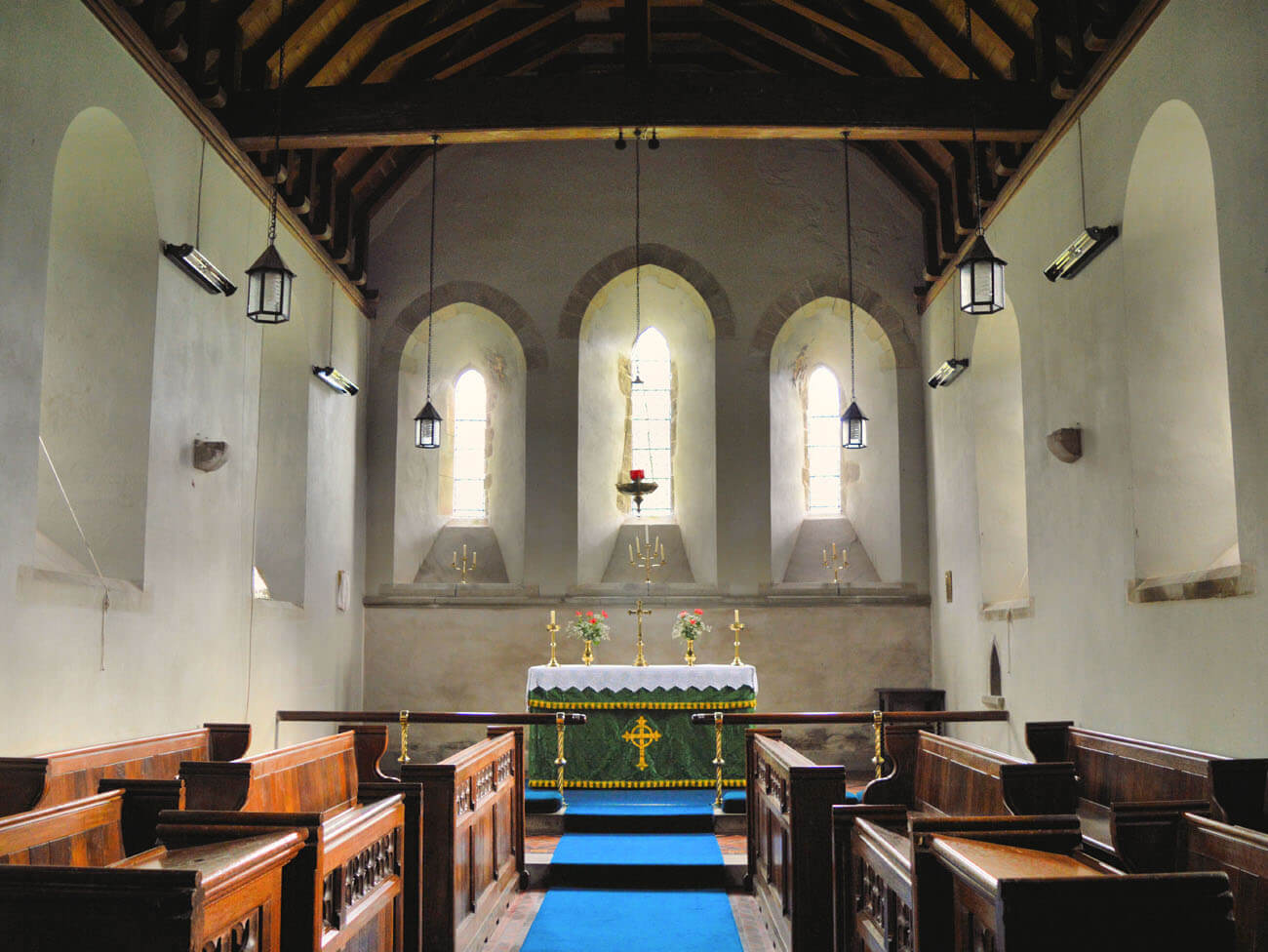
Since the 13th-century reconstruction, the church’s windows have been narrow, lancet, splayed inward and sometimes topped with trefoils. Even the windows in the gable walls of the transept were narrow. A distinctive feature was the triad of windows pierced through the eastern wall of the chancel (the central one being slightly higher than the side windows), with all the openings connected by a cornice that transitioned into the form of pointed, blind arcades above the archivolts. In keeping with medieval building tradition, the north wall of the nave was left completely unopened, but three windows were pierced in the north wall of the chancel. Three windows were also placed each on the south side of the nave and chancel, and perhaps on the west.
The church entrance was located in the western part of the south wall of the nave, in a simple portal without a ashlar jamb. A portal for the priest with a trefoil head was installed in the south wall of the chancel as early as the 13th century. The church interior at the the central bay was likely originally divided by a rood screen, as two diagonal openings were made in both longitudinal walls in the western part of the chancel, for viewing the main altar.
Current state
St. David’s church in Llanddew is today considered the oldest sacral building in Brecknockshire. Its earliest part is probably the nave, pierced, like the chancel and transept, with narrow, pointed-arched windows, mostly from the 13th century. The tower at the crossing was added or significantly rebuilt in 1629, but it matches the style of the rest of the building. The porch in front of the southern entrance to the nave is also early modern. Inside, the medieval details include two stoups, a font, a piscina and two lintels carved with geometric motifs (both not in their original places).
bibliography:
Haslam R., The buildings of Wales. Powys (Montgomeryshire, Radnorshire, Breconshire), London 1979.
Salter M., The old parish churches of Mid-Wales, Malvern 1997.
Wooding J., Yates N., A Guide to the churches and chapels of Wales, Cardiff 2011.