History
The church in the small settlement of Llanddetty was likely built in the 13th century. A 9th-century stone pillar was placed inside, which, along with a dedication referring to the name of an early Christian saint, the riverside location, and the morphology of the churchyard, suggests the church’s origins in the early Middle Ages, before the Anglo-Norman invasion. The church was first mentioned in records in 1291, in the tax register of the papal tithe (“Ecclesia de Landetten”). In the 15th or early 16th century, the building underwent a late Gothic reconstruction, focusing primarily on replacing architectural details and likely the furnishings. In 1878, the building underwent a thorough renovation, and in 1934 the roof was renewed.
Architecture
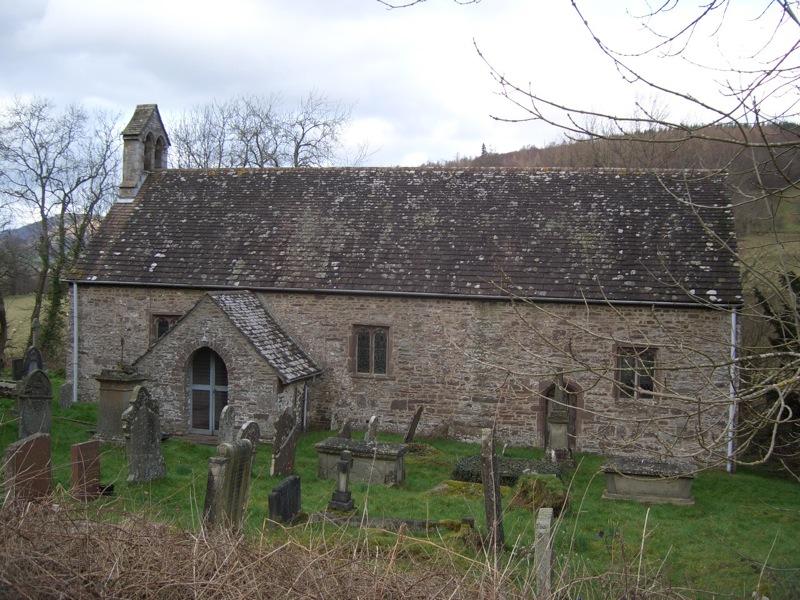
The church of St. Tetti’s was built as a simple, small, aisleless structure on a rectangular plan, without an externally separated chancel. It was constructed of dark red sandstone and sporadic erratic stones of varying sizes and irregular arrangement, without reinforced corners by ashlar. It was situated on the southern bank of the River Usk, in a narrow valley, in an area surrounded by a cemetery. A porch was added to the south entrance, facing the valley road, probably in the 15th or 16th century, and a second entrance for priests was pierced in the wall to the east.
The church’s original windows could have been nothing more than simple, inward-splayed slits, likely with rounded or lancet archivolts. They were not pierced in the western wall, and perhaps not originally in the northern wall overlooking the river. In the late 15th or early 16th century, almost all the 13th-century windows were replaced with late Gothic, two-light windows set in quadrangular frames with wide trefoils of tracery. Only the eastern wall was distinguished by a larger pointed window with three-light panel tracery.
The interior, as in most Welsh rural parish churches, was not vaulted but covered with an open roof truss or a timber barrel. The chancel was not separated from the nave by a rood arcade. It could only have been distinguished by a difference in floor level or a light timber rood screen. Both sections were likely very modest, perhaps only the furnishings introduced in the 15th/16th centuries were more ornate.
Current state
The church has medieval perimeter walls, but the bellcote on the west side is an early modern addition. The windows were also rebuilt or renewed in the early modern period, particularly those in the north wall. The western portal and baptismal font may date from the 13th century. The priest portal in the chancel is late Gothic. An early medieval pillar stone can be seen in a recess by the priest portal.
bibliography:
Haslam R., The buildings of Wales. Powys (Montgomeryshire, Radnorshire, Breconshire), London 1979.
Taxatio ecclesiastica Angliae et Walliae auctoritate P. Nicholai IV circa A.D. 1291, Munich 1802.