
History
Church of St. David in Laleston was built at the turn of the thirteenth and fourteenth centuries, when the nave and chancel were erected. It was likely built on the site of an older church, possibly timber one, as the first record of the local church dates back to 1173. This church may have been burned down during the Welsh attack of 1226. During the late Middle Ages, a tower and porch, designed by the same architect, were added to the early Gothic church, and some architectural details were altered. In 1871, the building underwent a Victorian renovation, which included replacing the nave and chancel windows.
Architecture
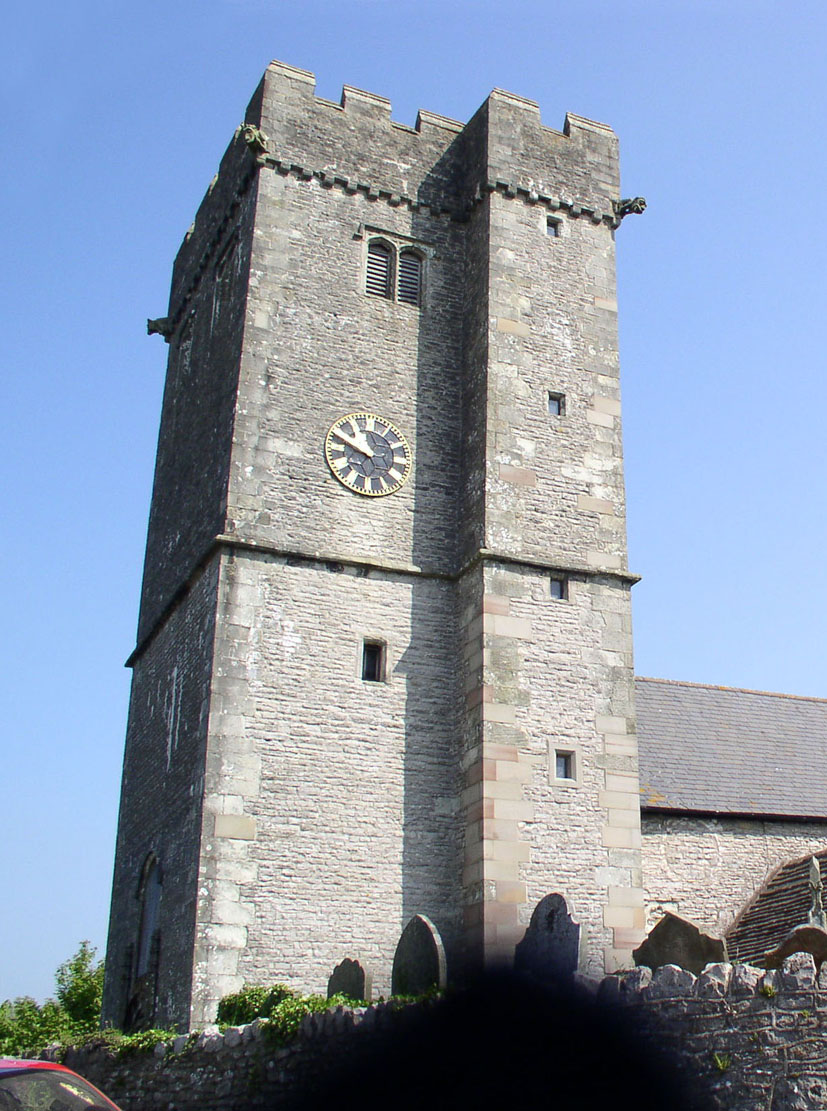
The 14th-century church consisted of a rectangular nave and a narrower, lower chancel, ended by a straight wall on the eastern side. It thus presented a simple yet functional spatial layout, typical of early Gothic rural parish churches. In the 15th or early 16th century, a quadrangular tower was added on the western side, disproportionately large in relation to the rest of the building. A porch was also built on the southern side. The entire structure was situated within a circular cemetery, slightly raised above the surrounding area, on the northern side of the Roman road that ran through the village from Newcastle Castle in the east to Swansea in the west.
The external facades of the nave and chancel were simple, unadorned, constructed of predominantly flat and elongated stone. The northern facade was particularly austere, devoid of any openings in either part of the church. The windows, located on the south, east, and perhaps west, were likely narrow, splayed inward, and topped with lancets or trefoils, popular in the 14th century. The eastern window or group of windows, providing light to the main altar, likely had the most elaborate form. In the late Gothic period, the windows may have been enlarged, topped with pointed arches, and filled with tracery.
The tower was framed at the base by a chamfered plinth and a slightly higher, moulded cornice, interrupted on the west elevation at the portal and encompassing the staircase turret in the southeast corner. Another similar cornice bisected the tower’s facades approximately halfway up. At the crown, the tower was crowned with a battlemented parapet typical of late medieval Wales, set on corbels projecting from the wall face and featuring corner gargoyles. The top floor was lit by two-light windows with chamfered jambs and Tudor arches. One such window was placed on the north and south sides, and, rather unusually, two on the east and west sides. The staircase and lower floors were illuminated by simpler quadrangular openings.
The entrance to the church likely led since its construction through the western part of the south wall of the nave, where, in the late Middle Ages, a new, handsomely moulded portal with a prominent ogee arch was added, of which the outer part of the archivolt was set on bas-relief corbels. The second entrance to the church may have been from the west. Access from that side was certainly retained after the addition of the tower, whose western wall featured a stepped portal with a significantly low pointed arch.
Inside the church, the nave and chancel were separated by an arcade with two chamfers springing from the imposts. The passage through it was divided by a rood screen, a feature very common in rural parish churches in Wales and England. The rood screen was of wooden construction, with a balcony or loft on the first floor, accessible by stairs set into the thickness of the northern projection in the wall. Both the nave and the chancel were covered with a wooden roof truss. Only the late medieval ground floor of the tower was vaulted with stone.
Current state
St. David’s Church in Laleston is today one of the most valuable medieval sacral monuments in the region. Unfortunately, all the existing windows in the nave and chancel are Victorian replicas. The late Gothic south and west portals are original, as are probably the gargoyles on the tower parapet. Inside the church, the medieval roof trusses of the nave and porch, as well as the vault in the ground floor of the tower, have been preserved. The chancel arcade is the oldest surviving architectural detail, dating from the 14th century.
bibliography:
Barrett D., Land north of the A48 Laleston, Bridgend, [no place] 2018.
Newman J., The buildings of Wales, Glamorgan, London 1995.
Salter M., The old parish churches of Gwent, Glamorgan & Gower, Malvern 2002.