History
The church in Crickadarn was built in the 13th century, as a small village parish church. It was rebuilt in the 15th and early 16th centuries, when a porch and then a tower were added. After the Reformation, the building likely began to deteriorate, although in the 17th century, paintings were created in the interior and new pews were purchased. By the early 19th century, the church was in a very poor state. It was restored twice in the 19th century (in 1867 and 1895), and again in the 1910s, when its leaning walls had to be strengthened.
Architecture
The church was built in the middle of a small valley surrounded by low hills, southwest of the Wye River. Originally, in the 13th and 14th centuries, it was a simple, aisleless structure, rectangular in plan, measuring approximately 17.1 x 7 meters, without an externally separated chancel. It was covered with a gable roof over the entire building. In the late Middle Ages, a stone and timber porch was added to the south of the nave and a tower to the west. The entire structure was oriented toward the cardinal sides of the world, but with the eastern part of the church slightly tilted northward.
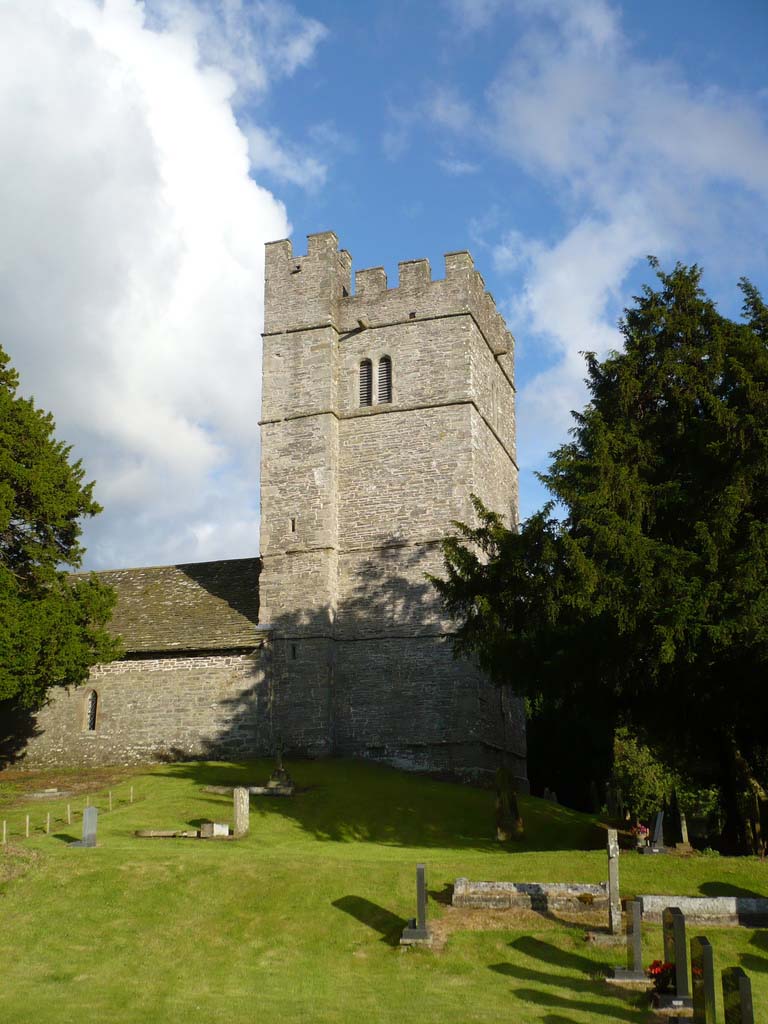
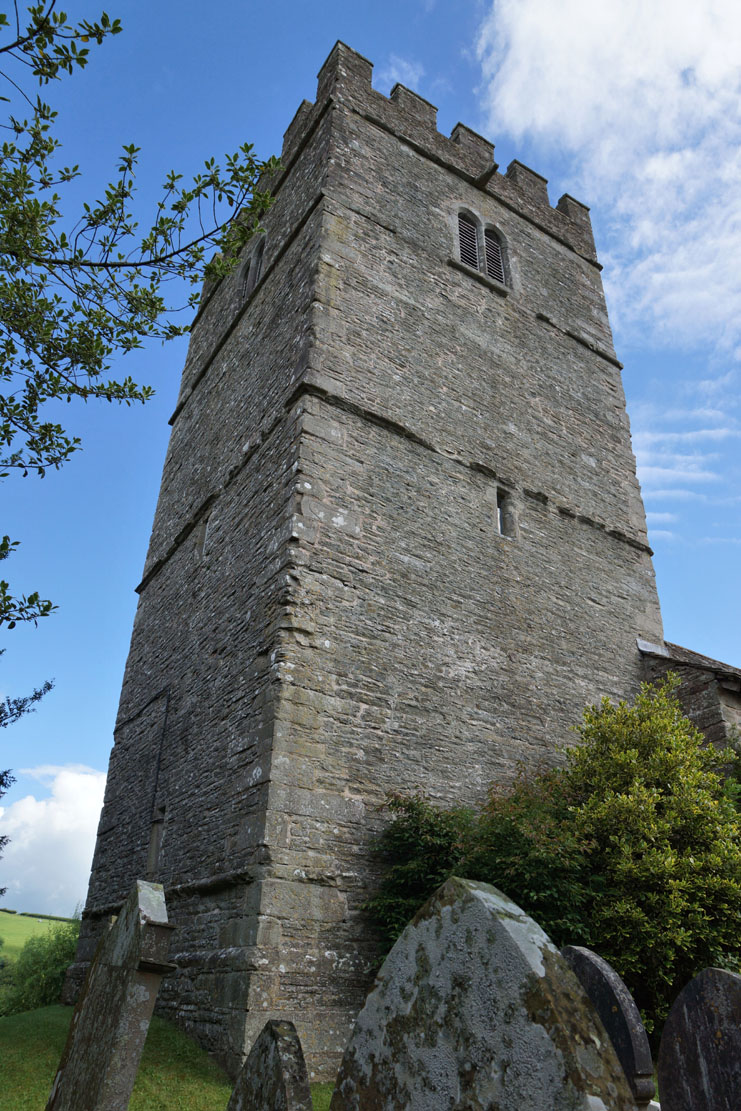
The tower was built on a quadrangular plan, with a slightly projecting, one-story-higher stairwell turret, located in the northeastern corner. The tower was set on a high batter, and its facades were horizontally divided by string courses. At the top of the wall, the tower was crowned with a decorative and symbolic battlemented parapet, though without the typical row of supporting corbels, only a simple cornice. Inside, the ground floor of the tower opened onto the nave with an arcade with a Tudor-style pointed arch.
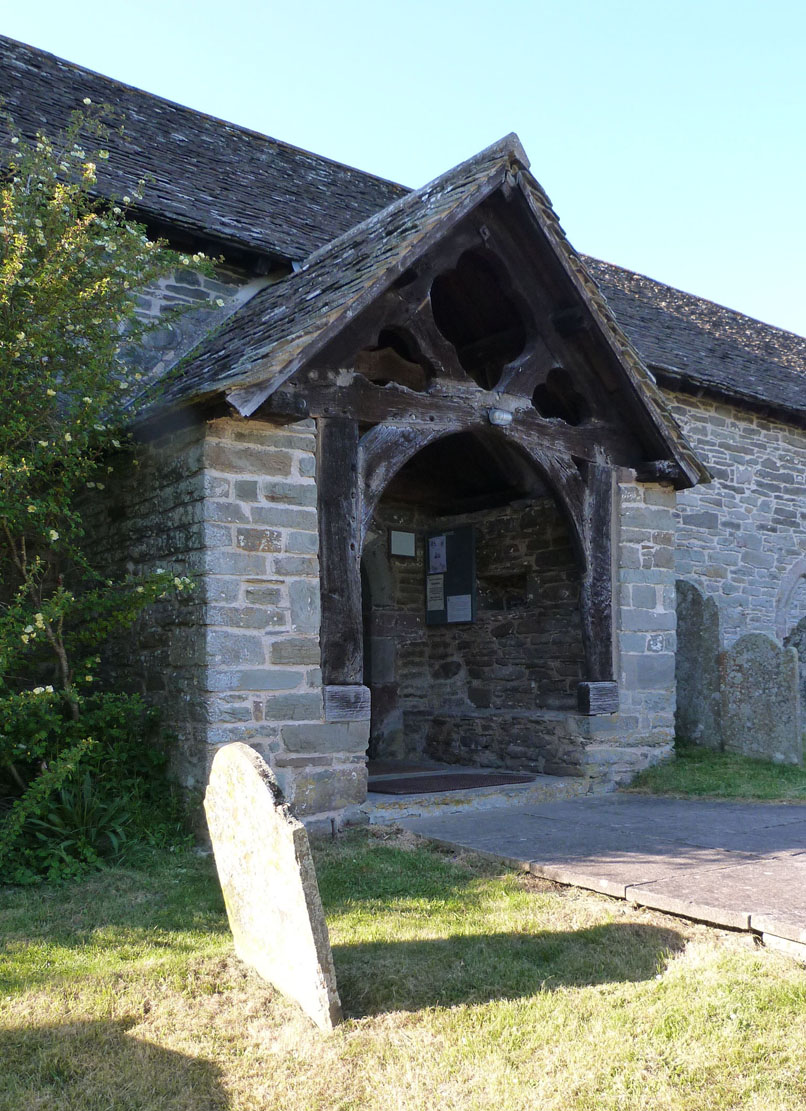
The main entrance to the church led from the south, through a pointed portal in the western part of the nave. Since the 15th century, it was preceded by the aforementioned vestibule, constructed in the style of Wye Valley porches (e.g., Aberedw). It was covered with a wooden roof truss, the braces of which, thanks to appropriate cutouts, created a pointed arcade and decorative trefoils and quatrefoils facing those entering the church. Inside, stone pews were placed on the sides of the porch. A second portal, intended for the priest’s use, was also set into the south wall of the church. It was closed with a pointed arch and chamfered.
The church interior, at least since the late Middle Ages, was divided into a nave and a chancel by a wooden rood screen with an upper loft. Both sections of the building were likely covered by an open roof truss or a timber wagon roof. Sunlight originally entered through narrow, lancet windows, framed in red sandstone, arranged singly and grouped in pairs. Later, larger, two-light windows were introduced, with quadrangular frames and ogee tracery. The most impressive window, from as early as the 13th/14th century, must have been located in the eastern wall, where a three-light tracery window with a flattened archivolt was installed at the beginning of the 16th century.
Current state
The church in Crickadarn, despite numerous early modern renovations, has retained its medieval body with a magnificent late-Gothic tower, and moreover a valuable porch with 15th-century wooden elements. Two 13th-century windows in the north wall and a 16th-century east window have survived. The south windows have been renewed. The south portal in the porch and the now bricked-up south portal in the chancel are partially original. To the southwest of the church, about two hundred meters away, you can see the earth ramparts of a medieval fort or small castle.
bibliography:
Haslam R., The buildings of Wales. Powys (Montgomeryshire, Radnorshire, Breconshire), London 1979.
Salter M., The old parish churches of Mid-Wales, Malvern 1997.