
History
Church of St. Crallo in Coychurch (Welsh: Llangrallo) was built in the second half of the 13th century, and its first record was in a tax register from 1254. Its exceptionally impressive form for a rural parish building may have been due to its connection with St. Crallo, who, according to tradition, founded the first church in Coychurch in the 6th century, and its location on the pilgrimage route to St. Davids. From the Middle Ages until the second half of the 19th century, it underwent no major modernization. Only in 1877 did renovation and partial reconstruction become necessary, caused by the collapse of the tower, which in turn destroyed the south and part of the north transepts. This work was carried out in 1888 by Welsh architect John Prichard, based on surviving illustrations of the church from before the collapse.
Architecture
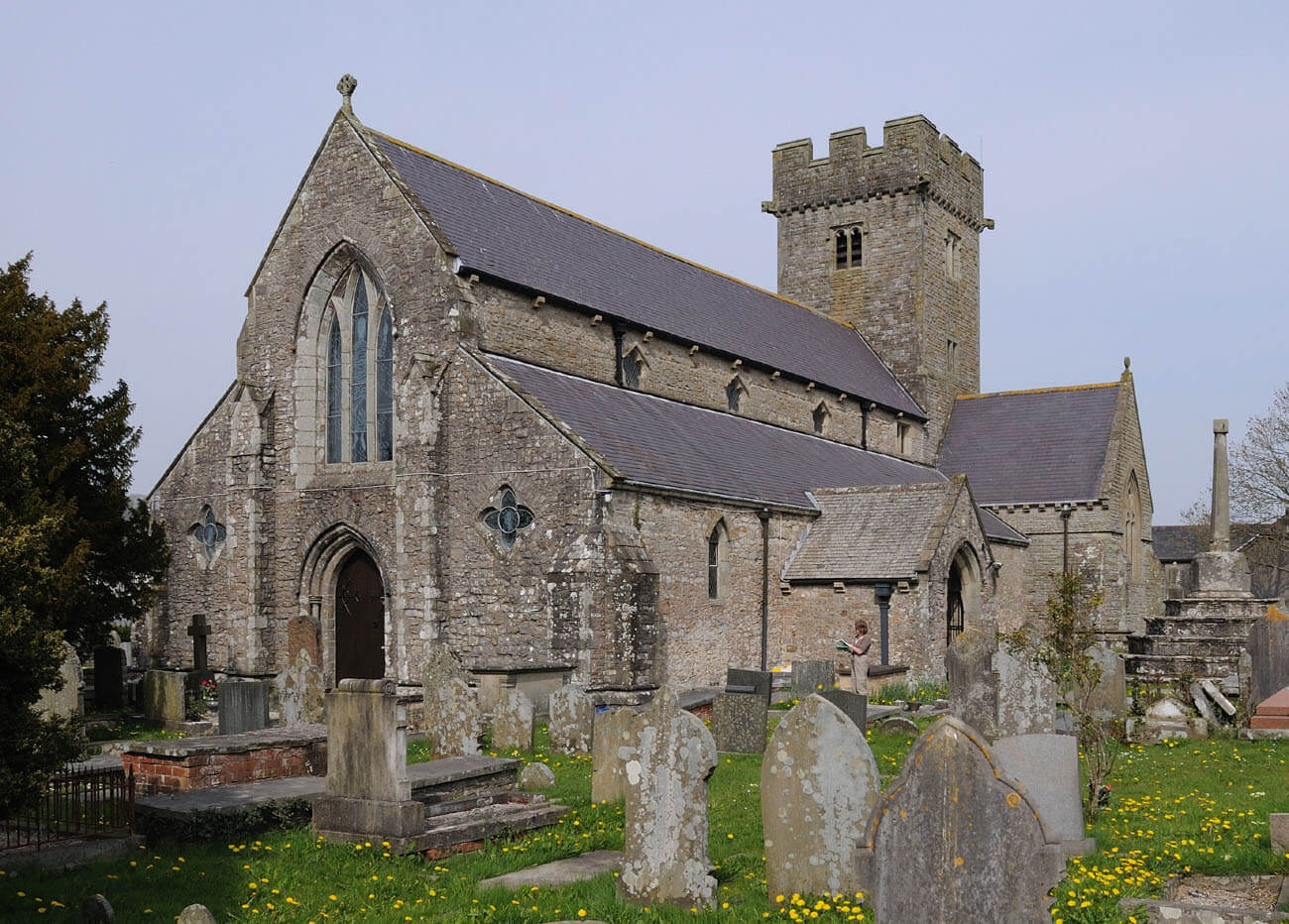
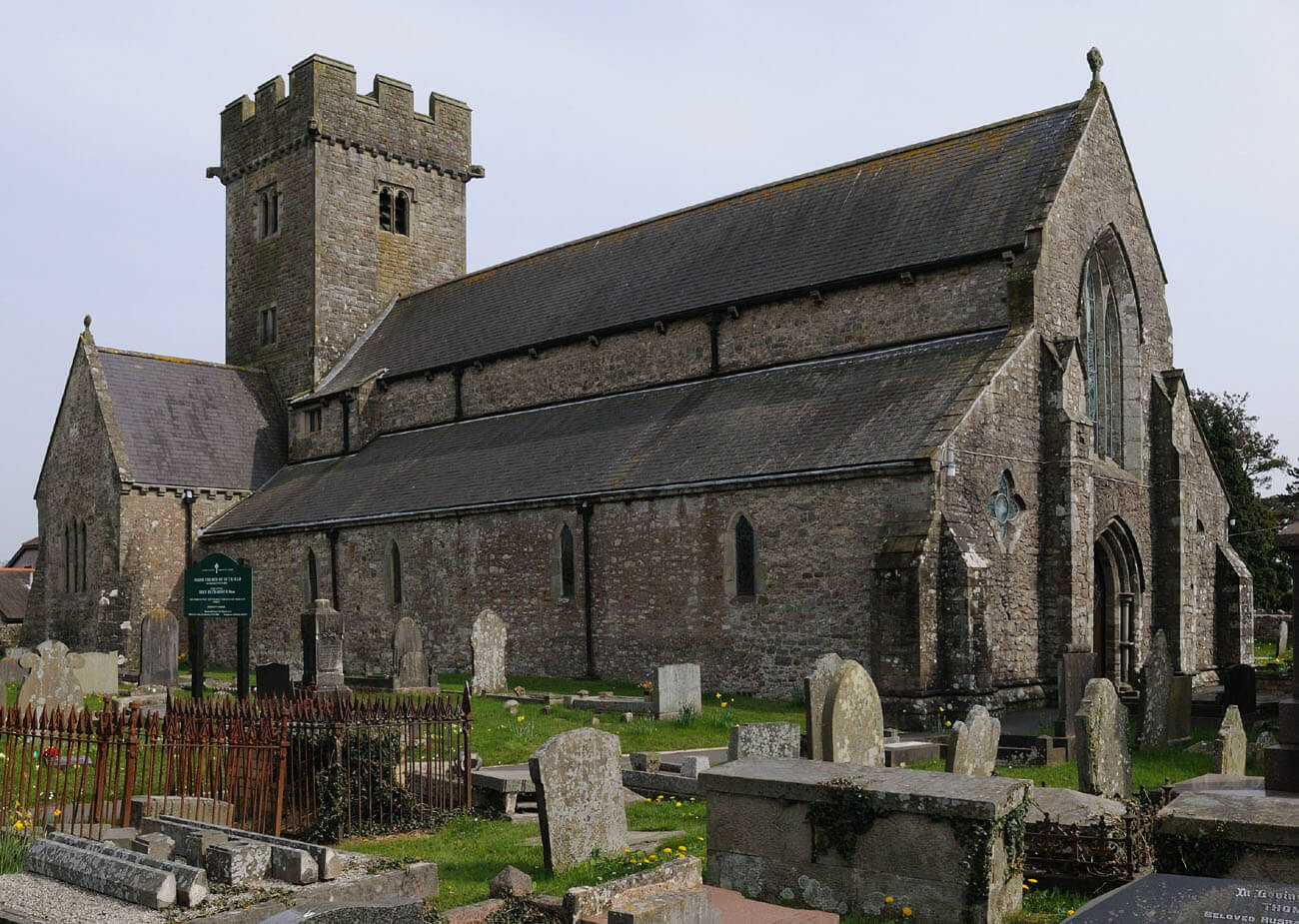
The church was built as an impressive four-bay basilica on a Latin cross plan, with a rectangular chancel on the eastern side, small in proportion to the nave, northern and southern transepts, and a quadrangular tower at the crossing. On the southern side, the nave entrance was preceded by a porch, but the church’s most important façade was undoubtedly the western wall, distinguished by two buttresses extending the central nave and framed by a plinth with a moulded cornice. The transept and chancel were supported by buttresses placed at an angle in the corners.
The church was lit by early Gothic windows of various shapes. In the central nave, these were shaped like cinquefoil rosettes, but only on the southern side, as the northern wall of the clerestory was left without openings. The windows of the side aisles, transept, and chancel were narrow, relatively high, and topped with slightly developed trefoils. In the transept gable walls, windows were grouped into triads, while in the longitudinal walls of the chancel were connected by a common cornice with curves around the archivolts. The western façade was decorated with a large pointed window with simple three-light tracery, flanked by two rare quatrefoil windows in the aisles. A large pointed window with three-light tracery was also placed in the eastern wall of the chancel, where it likely replaced a triad of older, narrower early Gothic windows. The tower on the highest level, was pierced on each side by a two-light window with quadrangular frame and trefoil tracery.
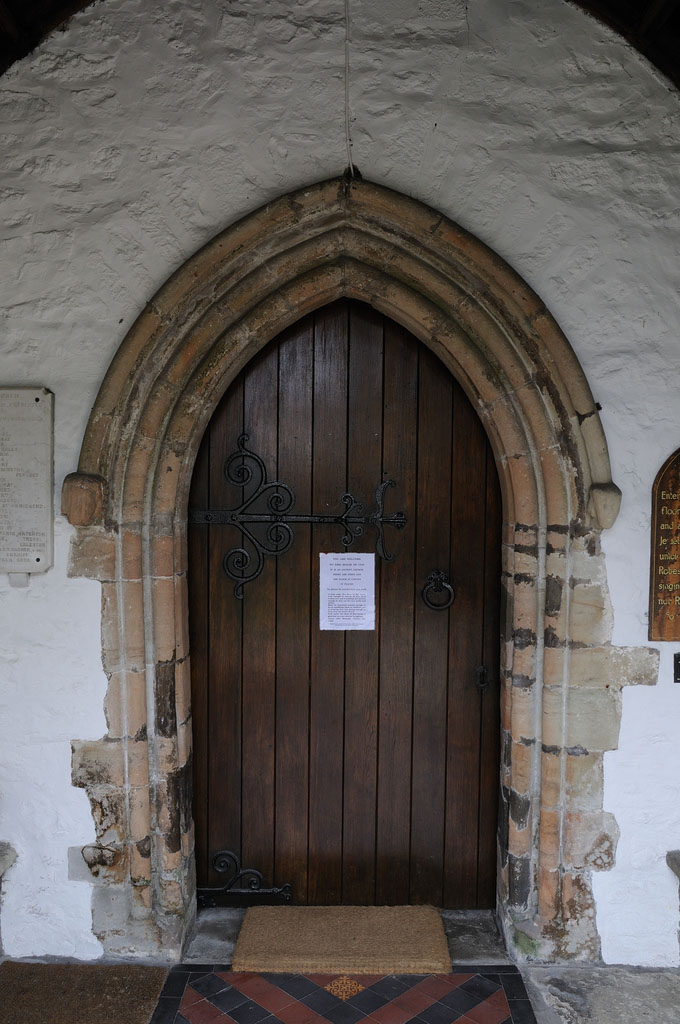
The main, processional entrance to the church led from the west, through a large pointed-arch portal in the central nave. Its archivolt was triple-chamfered, with each order separated by a wide recess. The outer and inner chamfers were extended without interruption to the plinth, while the central chamfer rested on the moulded capitals of two small columns. The southern entrance, although preceded by a porch, acquired a more modest form and smaller dimensions. It was moulded along its entire height with two shafts, and above the pointed archivolt, a third shaft was built, mounted on two corbels in the shape of human heads.
Inside the nave, the open roof trusses of the aisles and the timber wagon roof of the central nave were supported by pointed arcades springing from the octagonal pillars. The wooden elements of the late medieval wagon roof in the tall, narrow central nave were connected by angels holding heraldic shields and bosses with floral motifs. The arcades between the nave and aisles were double-chamfered on both sides and set on flat, moulded capitals. In the eastern part of the nave, a rood screen was placed, accessible by stairs in the thickness of the northern wall of the central nave. Behind it, the ground floor of the tower opened onto the nave with a broadly chamfered arcade disappearing into the side walls.
In the chancel, the longitudinal elevations were largely occupied by wide recesses of splayed windows, placed side by side, with segmental heads and connected by a common cornice above the archivolts. The eastern, three-light, pointed-arch window was not incorporated into this composition, so it may have been built in the later Middle Ages. In the southern wall, the gabled piscina and the triple recess for the sedilia were unusually incorporated into the window zone. Each was closed with a pointed arch and chamfered. The piscina niche was created slightly shorter, but at the same level as the sedilia. On the opposite side, in the northern wall, a pointed recess with a stepped frame was placed, which was originally closed by a wooden or metal door.
Current state
The church in Coychurch is now known as the “Cathedral of the Vale”, due to its imposing and elaborate form. It has retained original layout to this day, with no early modern additions, although the tower and south transept required reconstruction after a colllapse. Inside the central nave, the 15th-century roof truss, 13th-century arcades and a late medieval font remain. A 14th-century monk’s tomb can be seen in the north transept, while the chancel contains a sedilia, a piscina, and a northern wall recess. Also worth noting are the two entrance portals to the church and the windows of the aisles and the central nave. To the south of the church, one can see the ruins of a medieval rectory and a tall stone cross on an octagonal base with five steps.
bibliography:
Newman J., The buildings of Wales, Glamorgan, London 1995.
Salter M., The old parish churches of Gwent, Glamorgan & Gower, Malvern 2002.
Wooding J., Yates N., A Guide to the churches and chapels of Wales, Cardiff 2011.