History
The church of the Holy Cross was built along with the town of Cowbridge in the late 13th century, initially as a chapel of ease of the church in Llanblethian, although from the outset it was characterized by an elaborate spatial layout and imposing structure. Over the following centuries, as the town grew, the church was expanded and enlarged, with the largest addition of a side aisle and chapel reportedly carried out in the 1470s at the initiative of Lady Anne Neville. Shortly thereafter, in 1480, the church tower was struck by lightning, which may have destroyed the spire.
In 1484, King Richard III, as Lord of Glamorgan, granted a petition from the townpeople of Cowbridge to provide a separate priest for the church of the Holy Cross, which until then likely still belonged to the Llanblethian parish. The royal decision was apparently still in effect in 1550, when a certain Richard Eles received a salary of £100 per year for his priestly duties. Two years earlier, the position of chantry priest had been abolished and his salary transferred to the Crown. A chapel, built in the 15th century and endowed by the burgher William Prior, was likely intended for him.
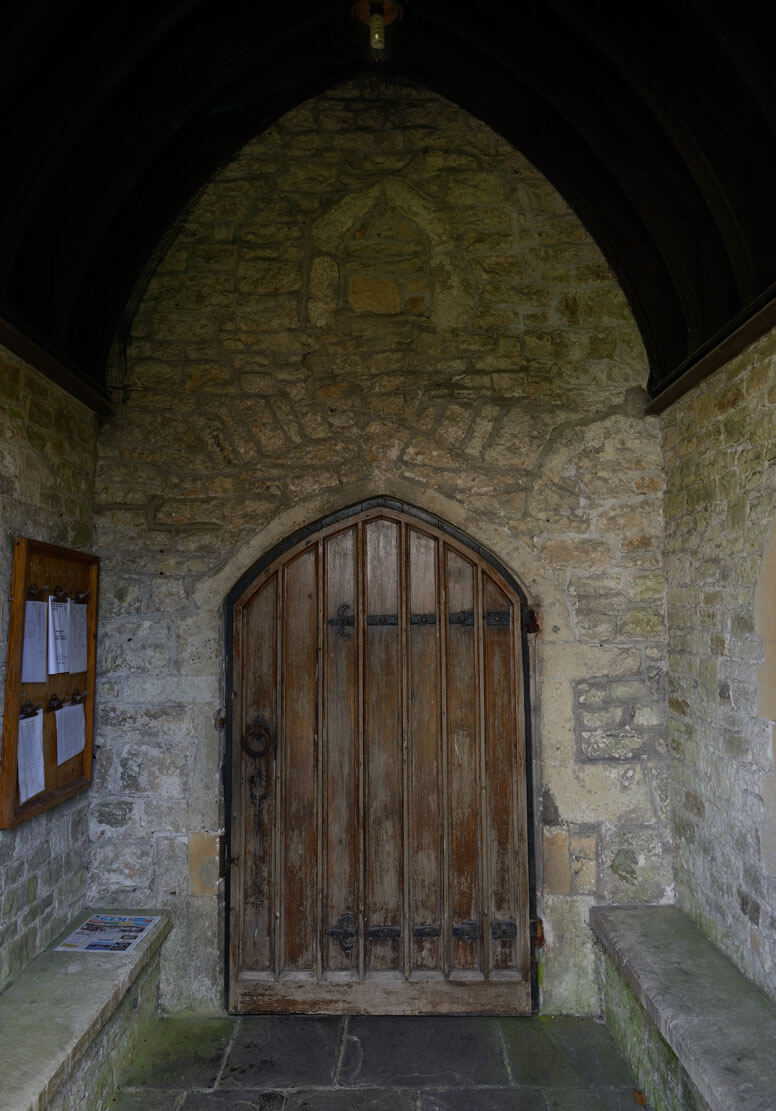
By the early 18th century, the church was reportedly in poor condition. Necessary repairs were carried out, including to the tower in 1722 and the nave roof in 1766, but major renovations did not take place until the mid-19th century. In early 1848, the tracery of some of the old chancel windows was restored, which had been bricked up for several years. The building was then renovated between 1850 and 1852, when unfortunately new windows were inserted into the walls of the south aisle. In 1858 or 1859, the north porch was added or completely rebuilt, in 1893 the tower was renovated, and in 1926 the nave roof was renewed.
Architecture
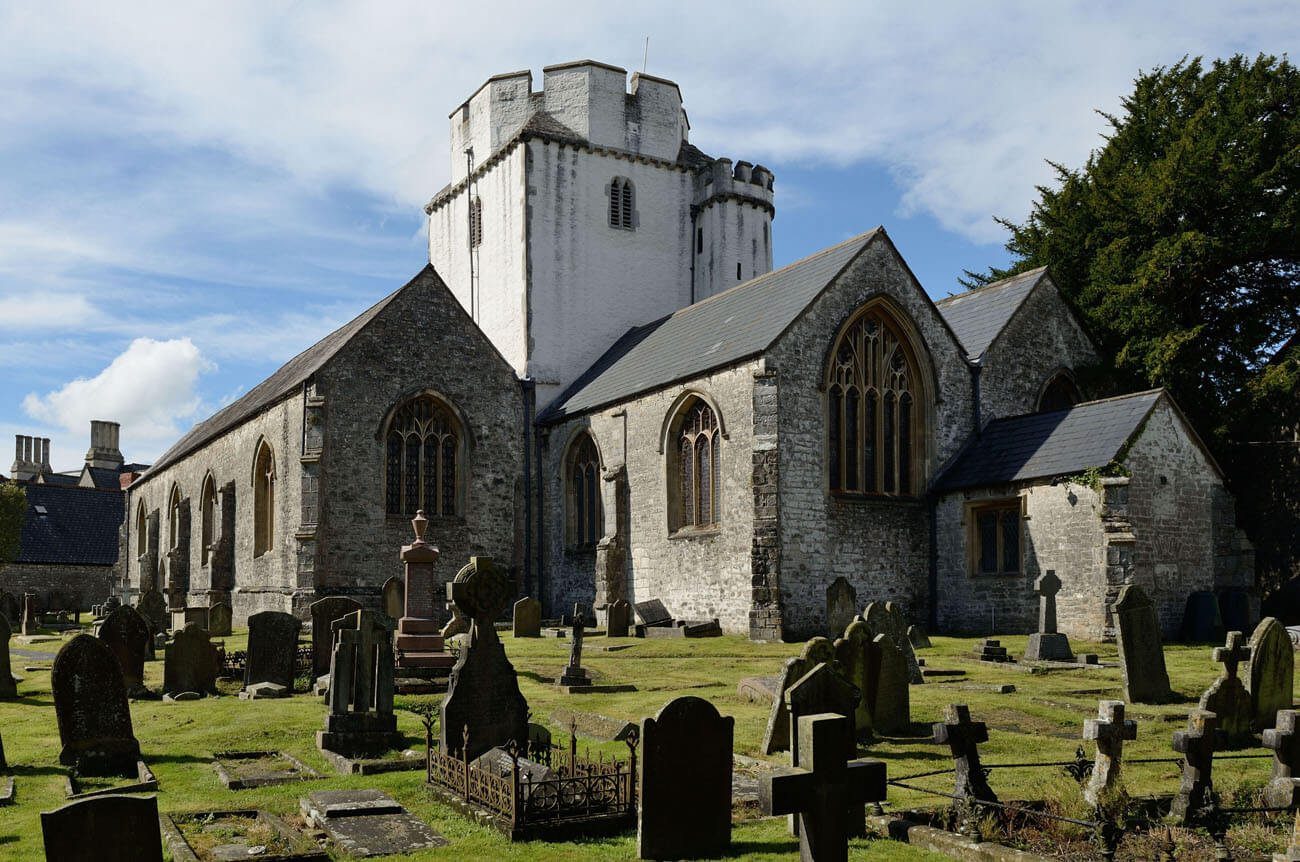
The late 13th-century church was built of local limestone and gray-white conglomerate stone from Sutton, used for architectural details. It was situated in the southern part of the town, within the town walls, which bounded the churchyard to the south. A road ran adjacent to the church to the northwest, leading to the nearby town gate in the southwest. Narrow town plots bordered the church to the east and west.
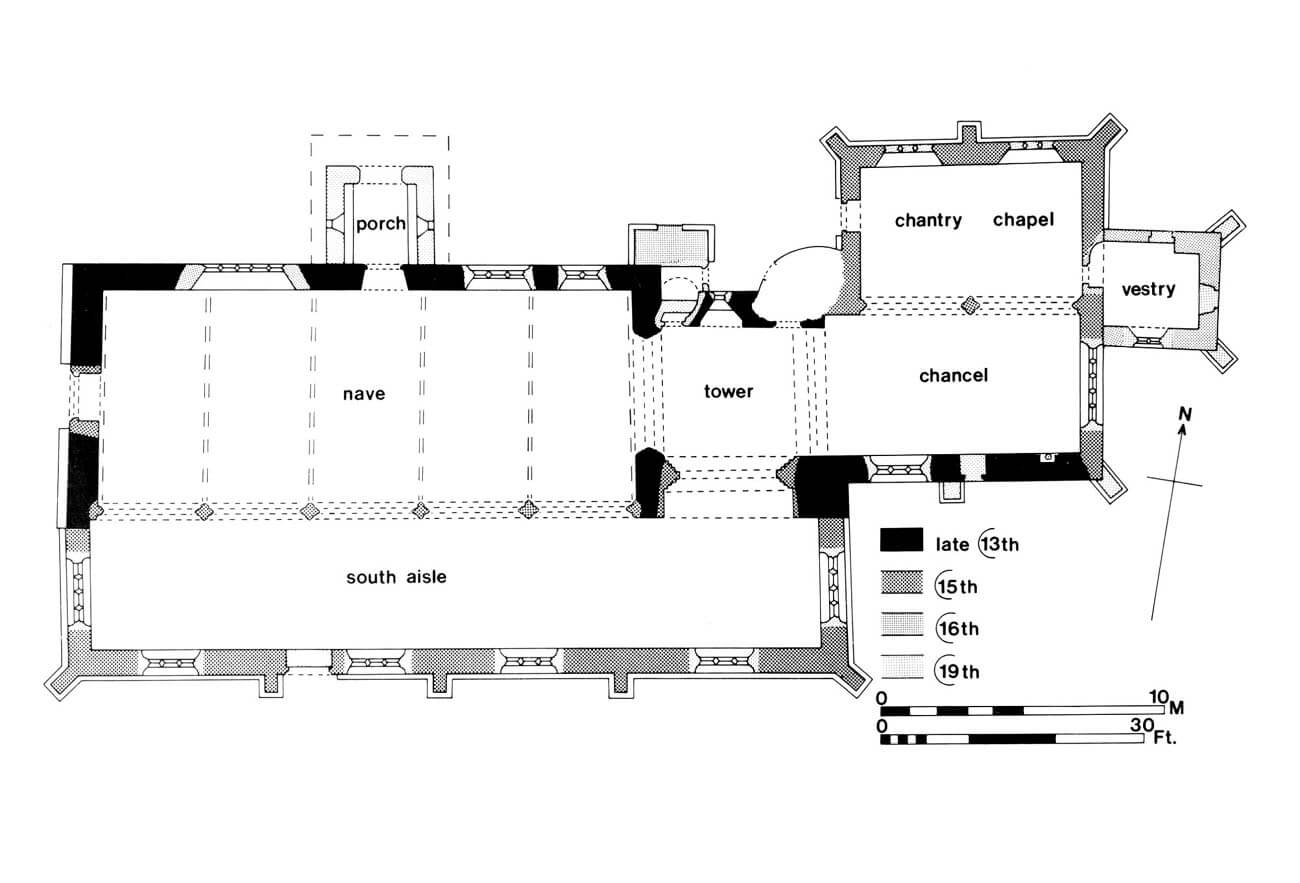
The building initially consisted of a single, yet spacious and significantly elongated nave, a quadrangular tower on its eastern side, and a rectangular chancel enclosing the church to the east. The entire structure was orientated to the cardinal directions, although with a slight deviation of the eastern façade to the northeast and the western façade to the southwest. The building was exceptionally impressive for a chapel of ease, and even for a parish church, reaching a total length of approximately 36 meters. The tower arrangement between the nave and chancel was rare, but in Glamorgan it was known from St. Cadoc’s church in Cheriton and the parish church in Coity. Perhaps like the latter example, a transept was also planned in Cowbridge to balance the elongated structure, but ultimately, the cruciform plan was never implemented.
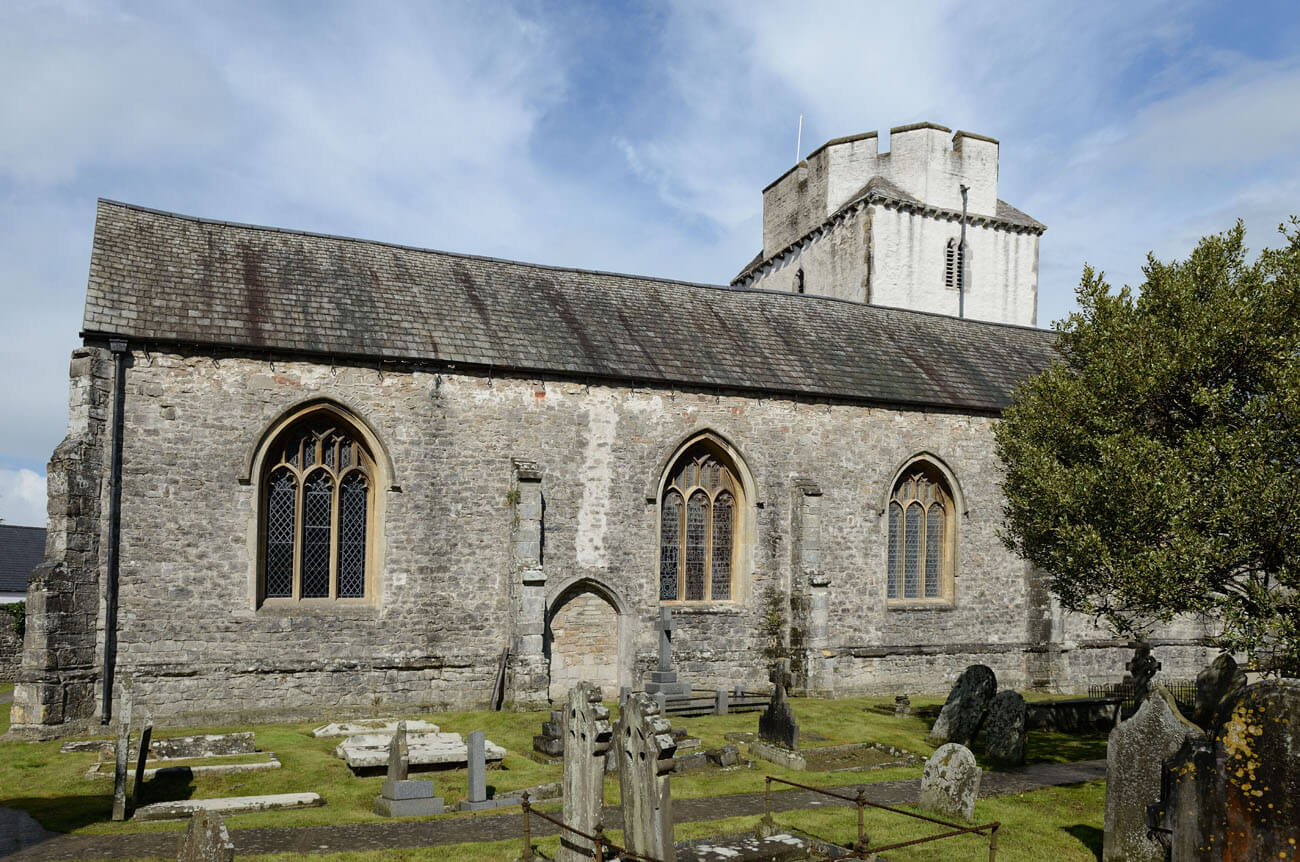
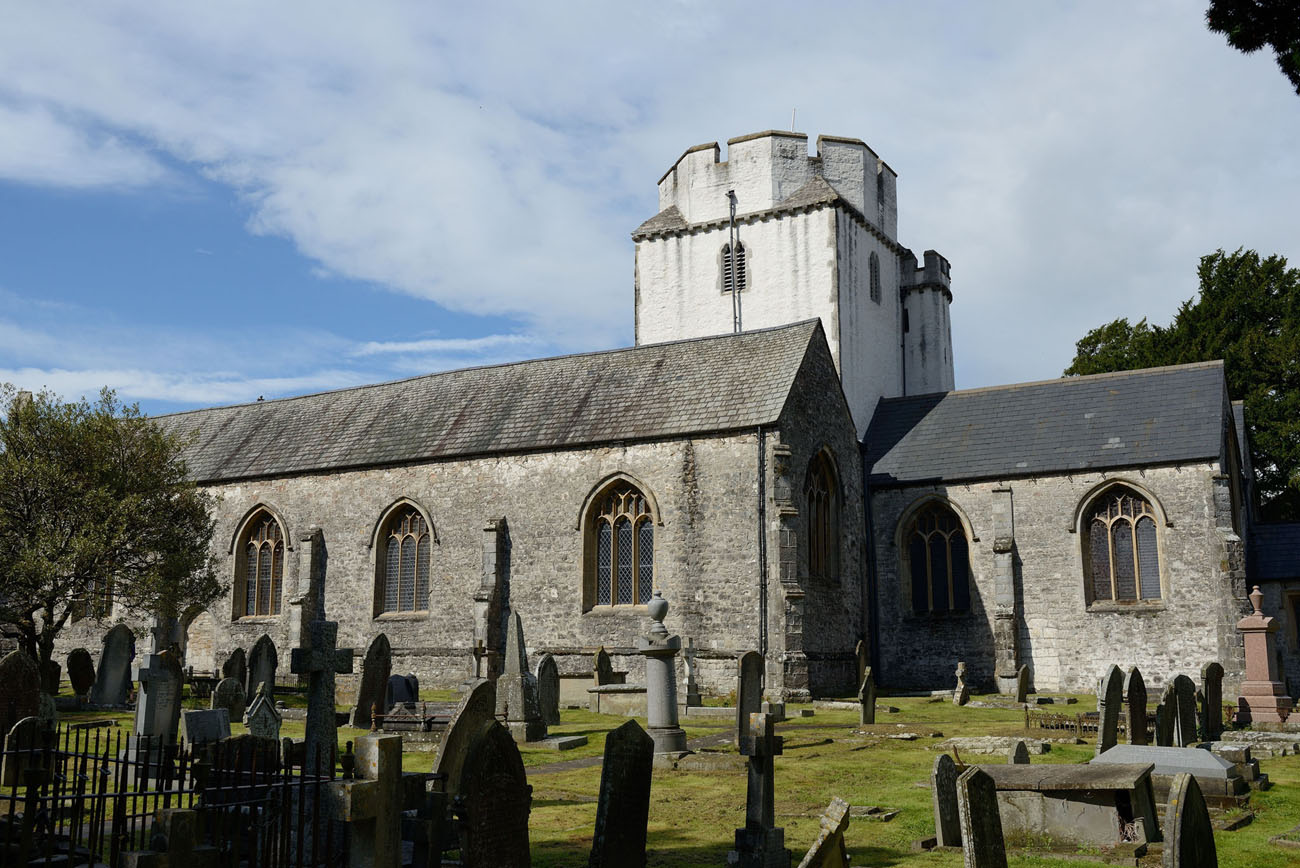
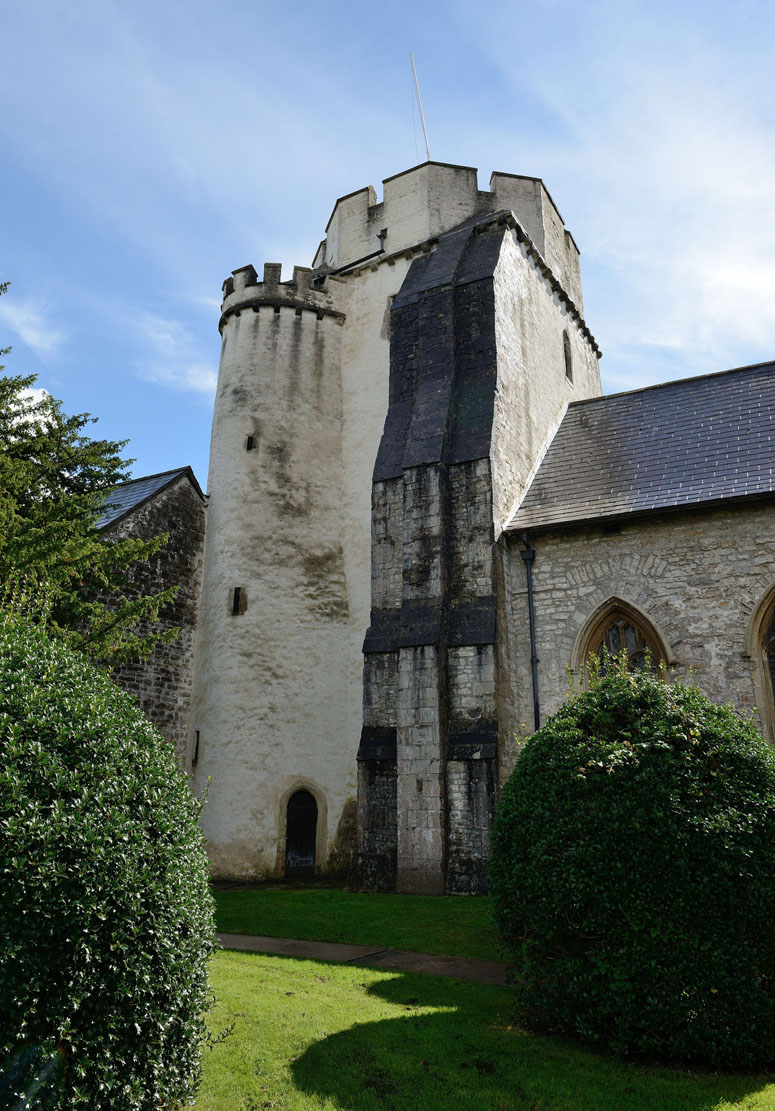
In the 14th century, the tower was raised or completed. It received a polygonal finial on a quadrangular base, unusual for Wales, set on corbels projecting from the wall face and topped with a crenellated parapet. Originally, it supported, or was intended for a medieval spire, but it had no defensive significance, as the tower was not equipped with arrowslits. Below, the bell floor was pierced on each side by a two-light windows with trefoil heads. The polygonal tier, however, may have served as an observation platform. A stair turret was later added to the northeast, while the northwest corner was supported by a massive buttress in the 16th century. This reinforcement was likely necessary due to structural problems caused by the placement of stairs to a late medieval rood screen within the wall.
In the second half of the 15th century, a four-bay southern aisle and a two-bay chapel on the north side of the chancel were built. Both were reinforced externally with buttresses, set at an angle at the corners. The aisle, together with the nave, formed a straight western façade, while in the east aisle reached the southeast corner of the tower, which it partially obscured. It was therefore one bay longer than the nave, similar in height, and covered by a separate gable roof. On the ground floor, its exterior façade was framed by a prominent base cornice, which also encompassed the buttresses.
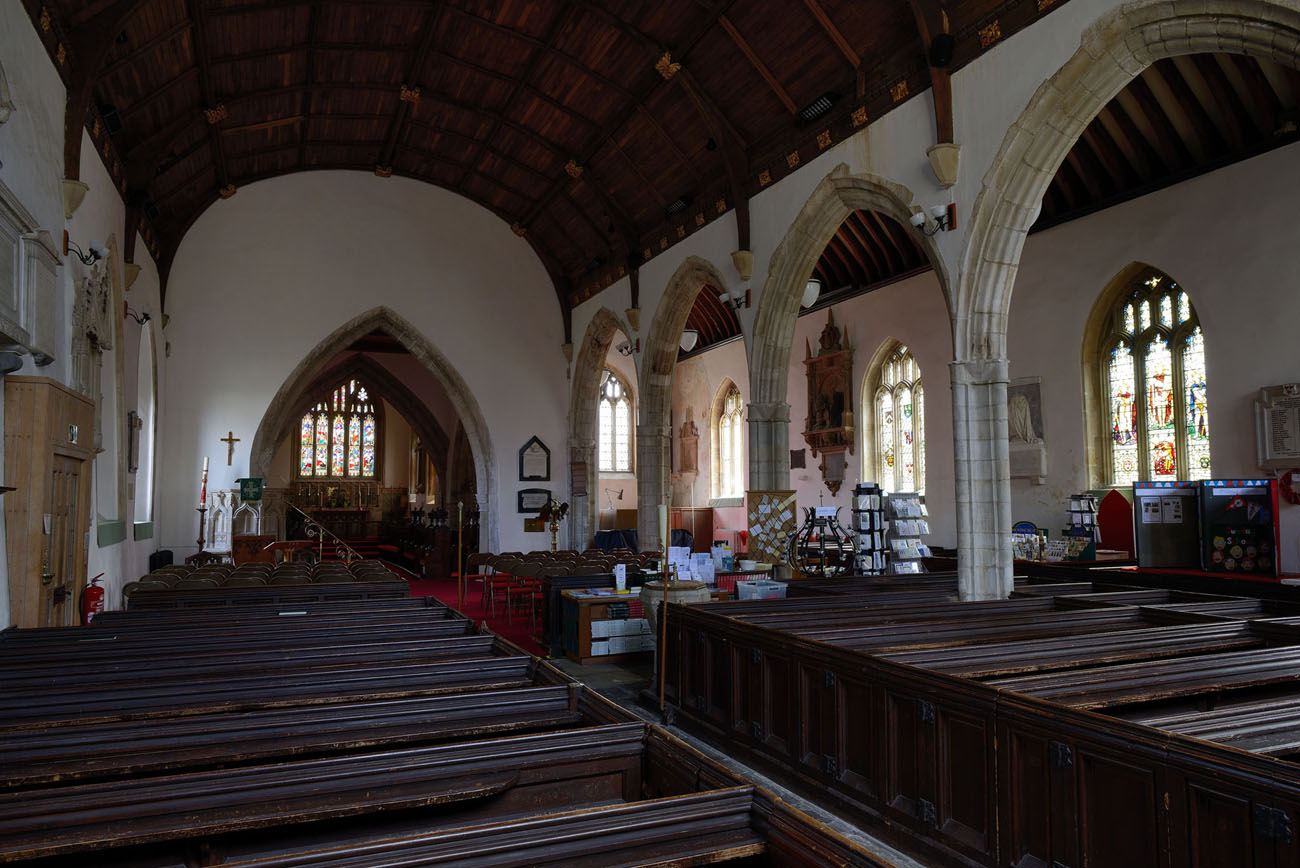
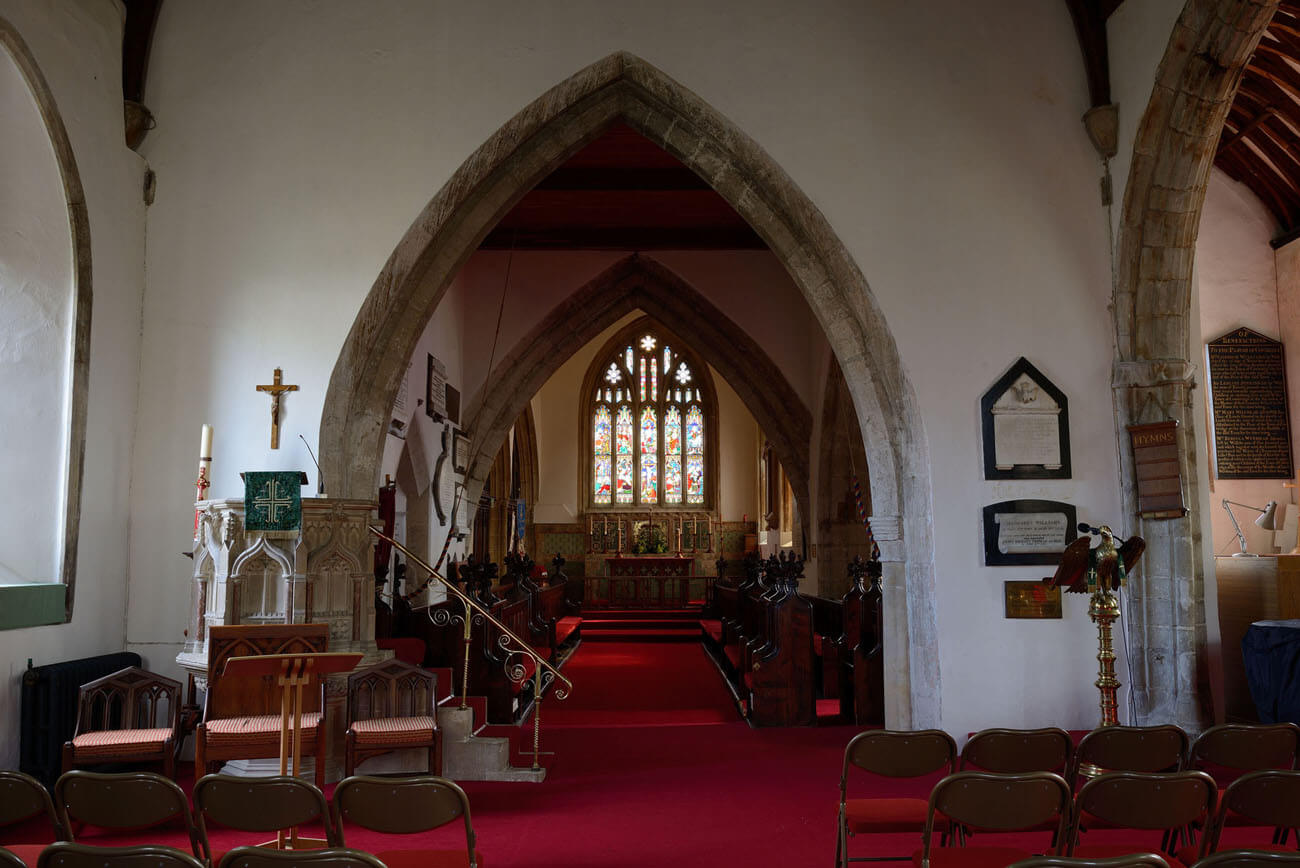
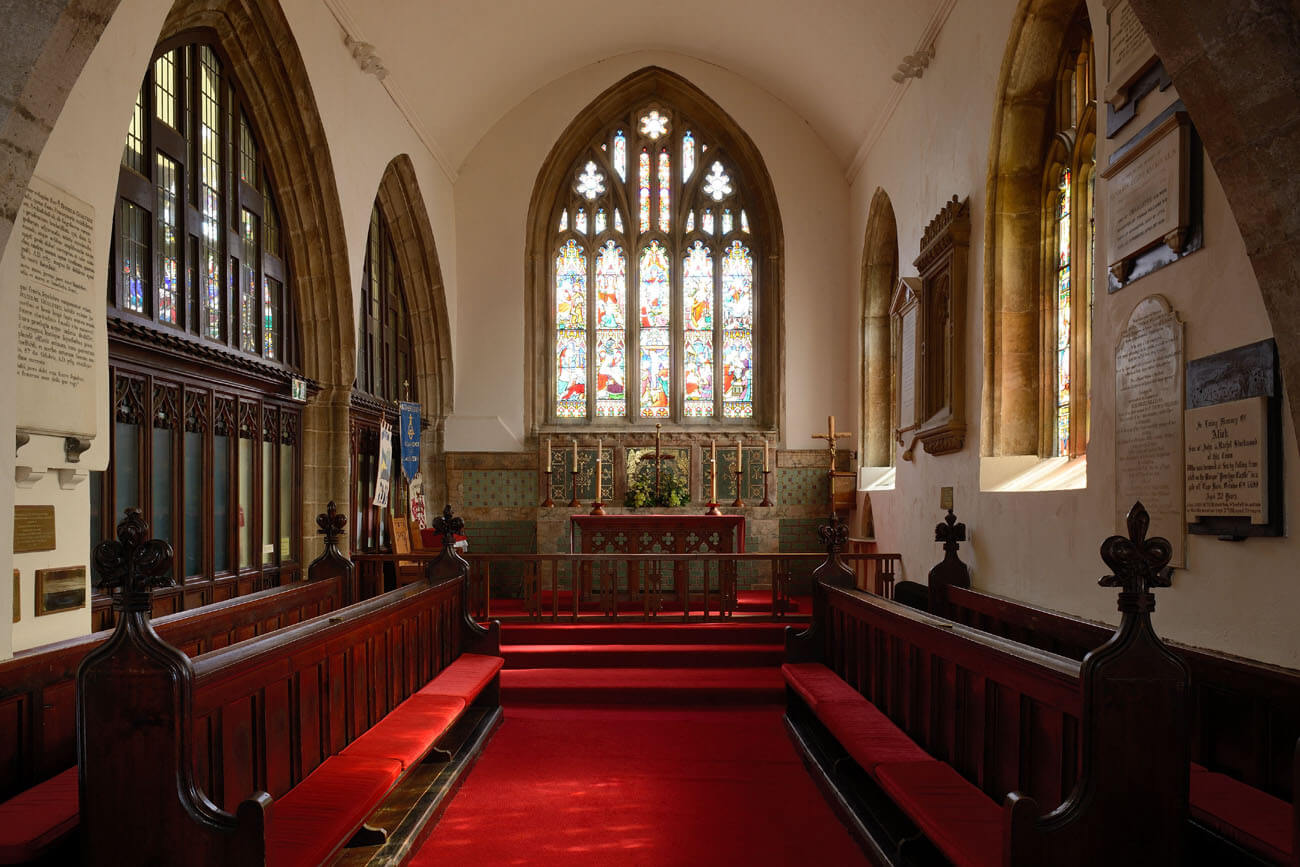
Inside the church, the ground floor of the tower was connected to the nave and chancel by pointed arcades, one double-chamfered, the other triple-chamfered, with grooves separating the chamfers. The western arcade was additionally supported by low triple half-columns with smooth capitals and moulded imposts. The late Gothic aisle opened onto the older part with five arcades supported by four pillars at the nave and an additional arcade at the ground floor of the tower. In the aisle the arcades were set on slender pillars, each framed by four half-shafts and four concaves, with the shafts set on rounded bases, and the whole on quadrangular plinths. The archivolts of the arcades were created with pointed arches, moulded and chamfered, in a style familiar from the western regions of England. Two similar arcades connected the chancel to the north chapel.
In the 16th century, a quadrangular annex was built to the east of the chancel and chapel, with three walls adjoining the older wall. Originally, it was likely unsupported on the eastern side by buttresses, while on the western side it was connected to the chapel by a passage. This room was likely originally used for the distribution of alms, which were passed through two openings (hatches) in the eastern wall. Later, it may also have been used as a sacristy.
Curennt state
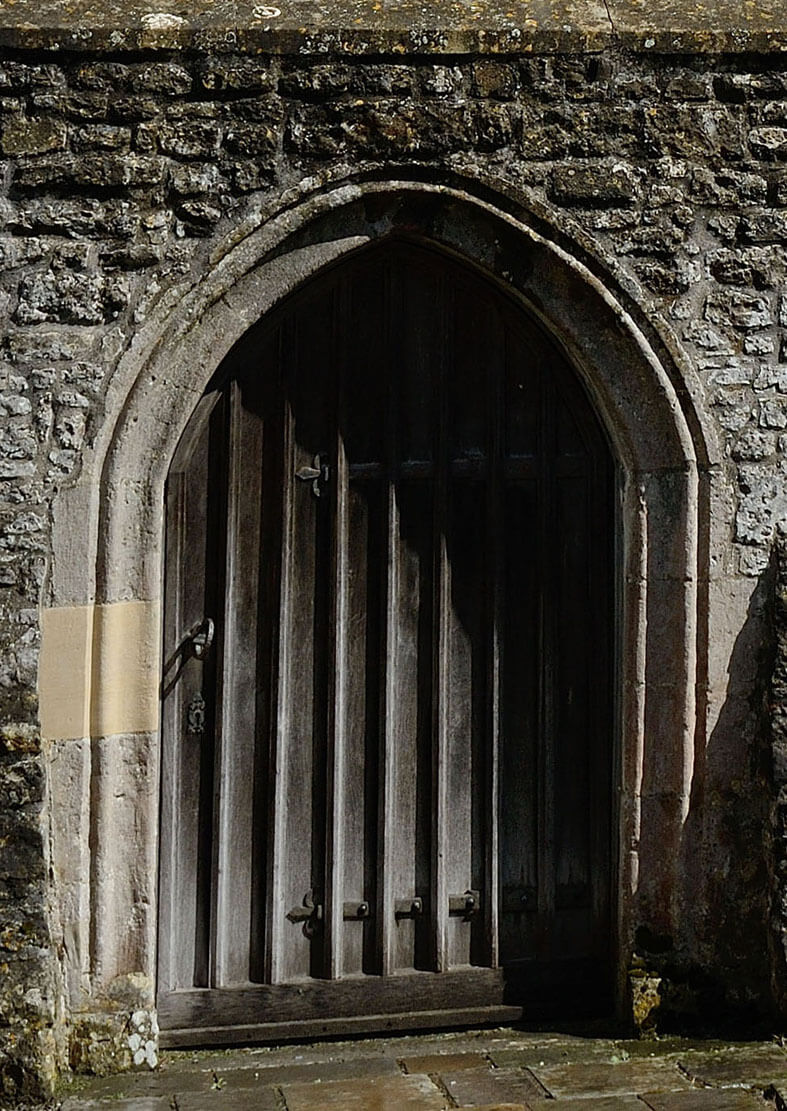
Despite Victorian renovation (which included the addition of a north porch and the installation or restoration of large windows in nave, aisle and chancel), as well as works on the nave arcades in the 1920s (with the use of original elements), the church is now one of the most valuable examples of medieval architecture in Glamorgan, designated number one in the three-tier catalogue of classified Welsh monuments. Inside, original features include a 13th century piscina in the chancel, 13th century arcades under the towers, 15th century inter-nave pillars and chapel arcades, a 14th century font, and two rare alms hatches in the east wall of the 16th century century annex.
bibliography:
Hopkin-James L.J., Old Cowbridge, borough, church, and school, Cardiff 1922.
Newman J., The buildings of Wales, Glamorgan, London 1995.
Orrin G.R., Medieval Churches of the Vale of Glamorgan, Cowbridge 1988.
Robinson D.M., Cowbridge. The archeology and topography of a small market town in the Vale of Glamorgan, Swansea 1980.
Salter M., The old parish churches of Gwent, Glamorgan & Gower, Malvern 2002.