History
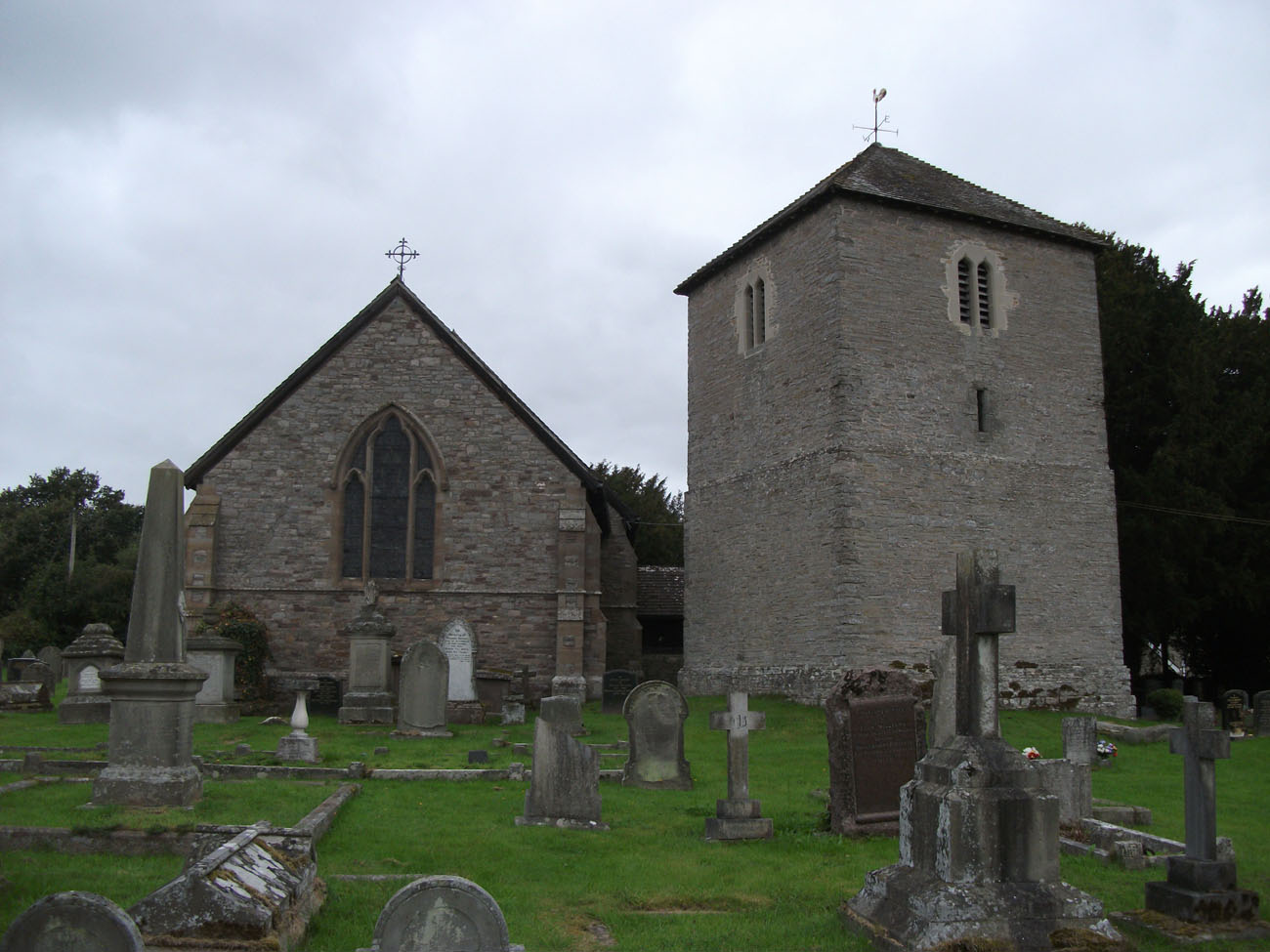
Church of St. Mary in Bronllys was built in the 12th or 13th century, likely by the powerful Clifford family, who also built the nearby castle. The church was later granted to Clifford Priory in Herefordshire, which owned it until the Reformation. The building was first recorded in 1291, when it was listed as “Ecclesia de Brentles” on the papal tithe taxation. In the 14th century, the church was rebuilt, and the first mention of a vicarage appears in 1400, when David Gomod was appointed to the position. In 1887, the church underwent a major reconstruction, retaining only a few fragments of the original walls. The roof and furnishings were also replaced, giving the building a Victorian character. Fortunately, the freestanding tower has survived the reconstruction, only being renewed in 1938.
Architecture
The church was built from small and medium-sized fragments of gray and brown sandstone, sometimes chipped into narrow, long slabs. It was situated on the northern and northwestern sides of a slope descending towards the Afon Llynfi River valley. To the north, the churchyard, probably enclosed by a fence or wall, adjoined the settlement’s residential and economic buildings, which in the Middle Ages likely extended southeastward toward the castle.
From the 13th or 14th century, the church consisted of a single rectangular nave and a narrower, shorter chancel on the eastern side, also built on a rectangular plan. On the northern side, a wooden porch on a stone base was added in the 15th or 16th century. A freestanding bell tower, unusually positioned at an angle to the church axis, was built on the northeastern side of the chancel. It had a hip roof and two-stage walls, divided by a setback, built on a square plan.
The church walls were originally not supported by buttresses. The entrance was on the north side, likely due to the church’s location in relation to the settlement’s buildings. The main portal must have been located in the north wall of the nave, and unusually, a narrower portal for the priest was also created in the north wall of the chancel. The 13th/14th-century windows may have been narrow, lancet or pointed. Some of them may have been replaced with larger ones in the late Middle Ages. Inside, the nave and chancel were separated by a narrow rood arcade.
Current state
Only the western wall of the nave, the lower section of the northern wall of the chancel, and a small section of the southern wall of the chancel have survived the 19th-century reconstruction of the original building. However, the spatial layout likely follows the original medieval outline of the walls, which served as the basis for the Victorian reconstruction. The original priestly portal from the 14th century remains in the northern wall of the chancel, and a chancel arcade in the interior. Medieval furnishings include a 13th-century font and a rood screen from around 1450-1500, three segments of which are repositioned to separate the sacristy. Late medieval wooden elements of the roof truss are located in the porch. Due to its unusual location, the tower has sometimes been considered early modern, but its upper windows suggest medieval origins.
bibliography:
Haslam R., The buildings of Wales. Powys (Montgomeryshire, Radnorshire, Breconshire), London 1979.
Salter M., The old parish churches of Mid-Wales, Malvern 1997.
Taxatio ecclesiastica Angliae et Walliae auctoritate P. Nicholai IV circa A.D. 1291, Munich 1802.