History
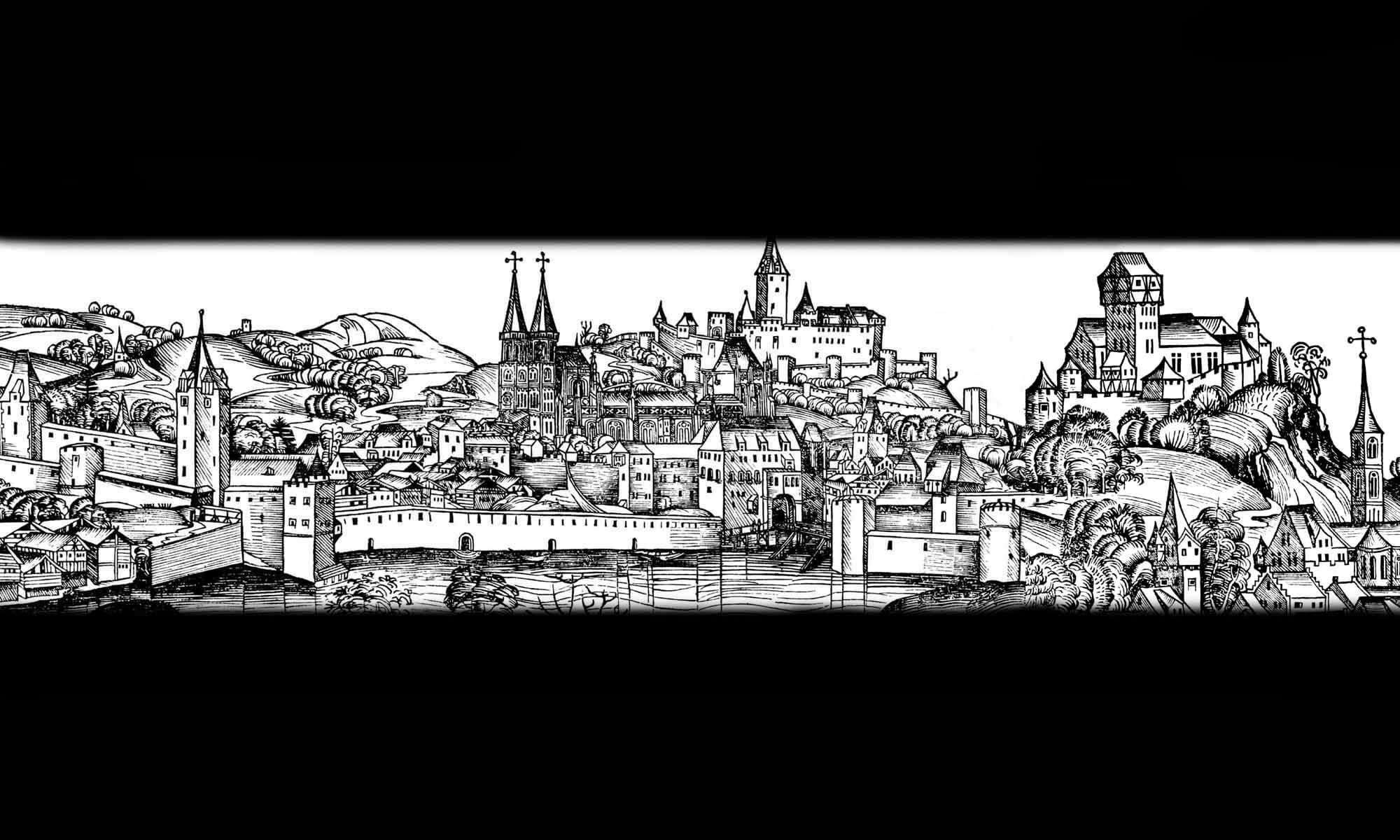
It is assumed that the construction of the castle took place in the times of King Casimir the Great, however, the chroniclers Janko from Czarnków and Jan Długosz did not mention anything about this investment, and the oldest traces of human presence on the castle hill would indicate its settlement already in the 13th century. The first wood and earth fortifications could have been built in the times of prince Leszek the White and the Hungarian king Andrew II, whose son Coloman married Leszek’s daughter, and then, thanks to a Polish-Hungarian expedition in 1214, was crowned King of Galicia.
The reconstruction of the castle into a stone one took place in the 14th century, probably in the second half of that century, probably from a royal foundation. In 1372, Elizabeth, daughter of Władysław the Elbow-high and wife of the Hungarian King Charles Robert, issued a document “in Soban” for the Poor Clares in Stary Sącz. Since there was no settlement of that name in the Kingdom of Poland at the time, it must have been issued at a castle, then royal property, or more likely, at the settlement of Sobanya near Prešov. The first undisputed record of the castle was in 1415, when it was in the hands of Piotr Lunak Kmita. Sobień may have passed to the Kmita family during the lifetime of Piotr’s father, the castellan of Lublin, at the end of the 14th century.
In the 15th century, Sobień served as the private residence of the Kmita family. In 1474, it was allegedly damaged during a Hungarian invasion, but actually the Hungarian troops reached the Krosno area at that time furthest. The castle was allegedly damaged again during the Polish-Hungarian fighting in 1512. If this happened, it was repaired in the following years and functioned until the end of the 16th century. It was last mentioned in 1585. It was probably abandoned shortly thereafter and began to fall into ruin when the Kmita family moved their residence to nearby Lesko.
Architecture
Sobień was situated on a high hill in the San River Valley, on the northern side of the riverbed, where it bent from south to west. The most inaccessible and steep slopes, approximately 69 meters above the valley floor, faced the river and the small Sobienka stream, which fed it from the east. The slopes also provided significant protection from the west and north, due to the depression separating the castle hill from the rest of the massif on the northern side.
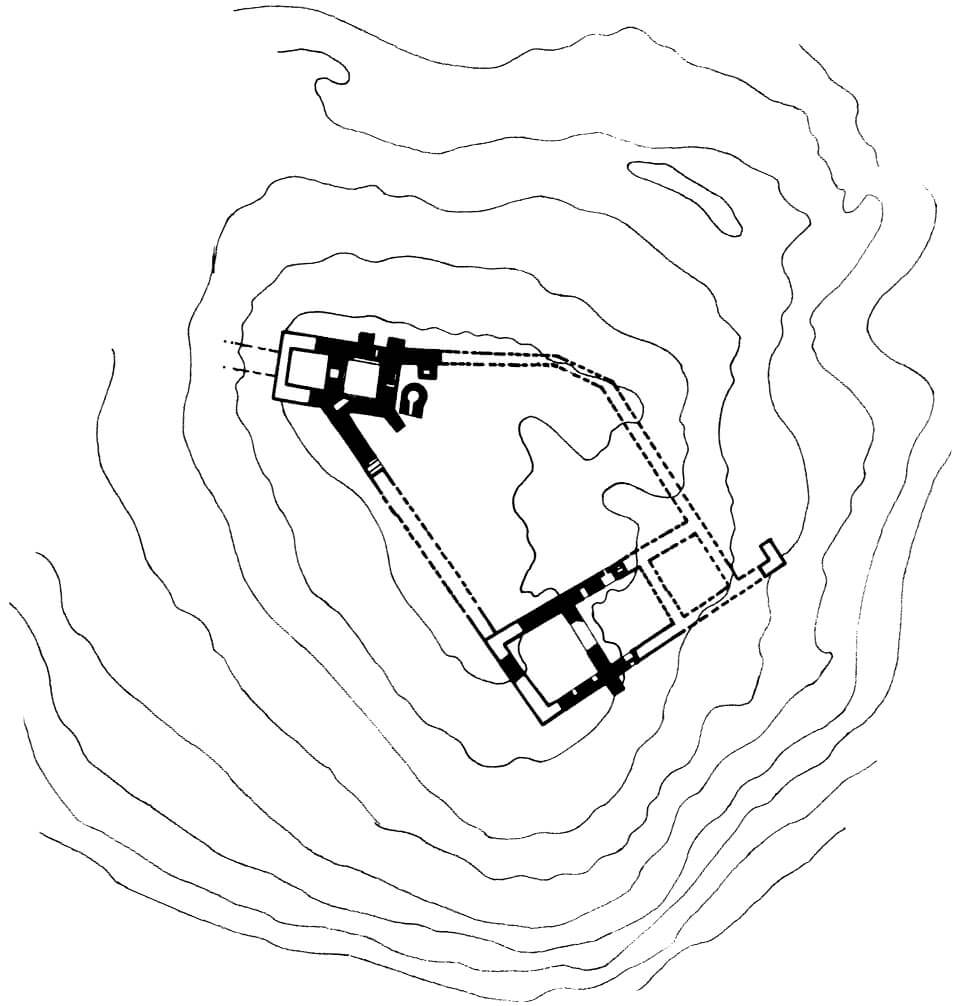
The castle was built of local stone on an irregular quadrangle, measuring 49 x 29 x 28 x 31 meters, narrowing towards the northwest. The courtyard was surrounded by a defensive wall, 1.8 to 2 meters thick at the ground level. The entrance gate must have been located on the northern side, in line with the longest curtain. It may have been reinforced by a gatehouse, partially projecting into the foreground. Access to the castle led from the northwest, through a timber outer bailey, separated by a moat and an earth rampart, likely crowned by a palisade. The outer bailey’s courtyard may have been roughly triangular in plan, perhaps with a tower-like building in the western corner.
The residential house, measuring 12 x 31 meters, was located in the most protected part of the castle, opposite the gate, on the southeast side. It was divided into two or three rooms on the ground floor, filling the entire width of the courtyard. The three-spatial division, traditional for the Middle Ages, could also have existed on the first floor. Typically, the rooms on the lowest floor served utility and economic functions, while the residential and representative chambers were located on the upper floors. A quadrangular annex, serving as a vestibule with an entrance, adjoined the western section of the northern wall.
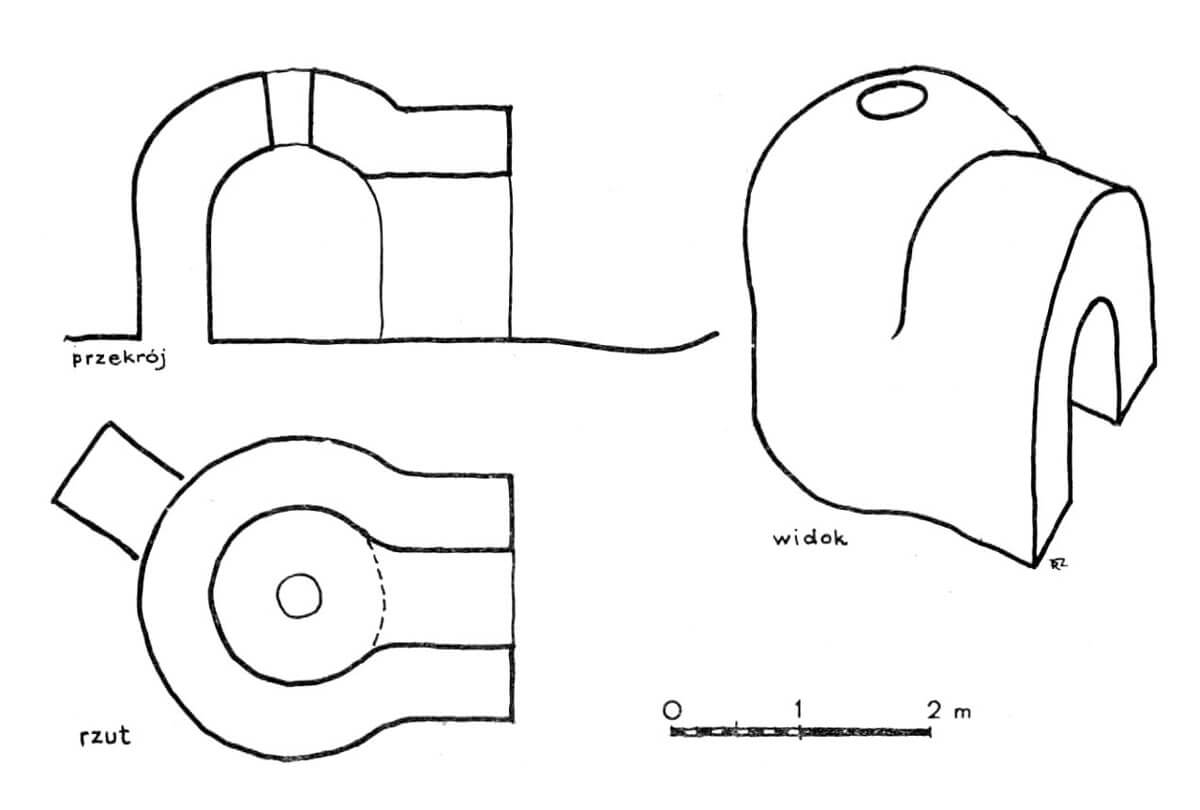
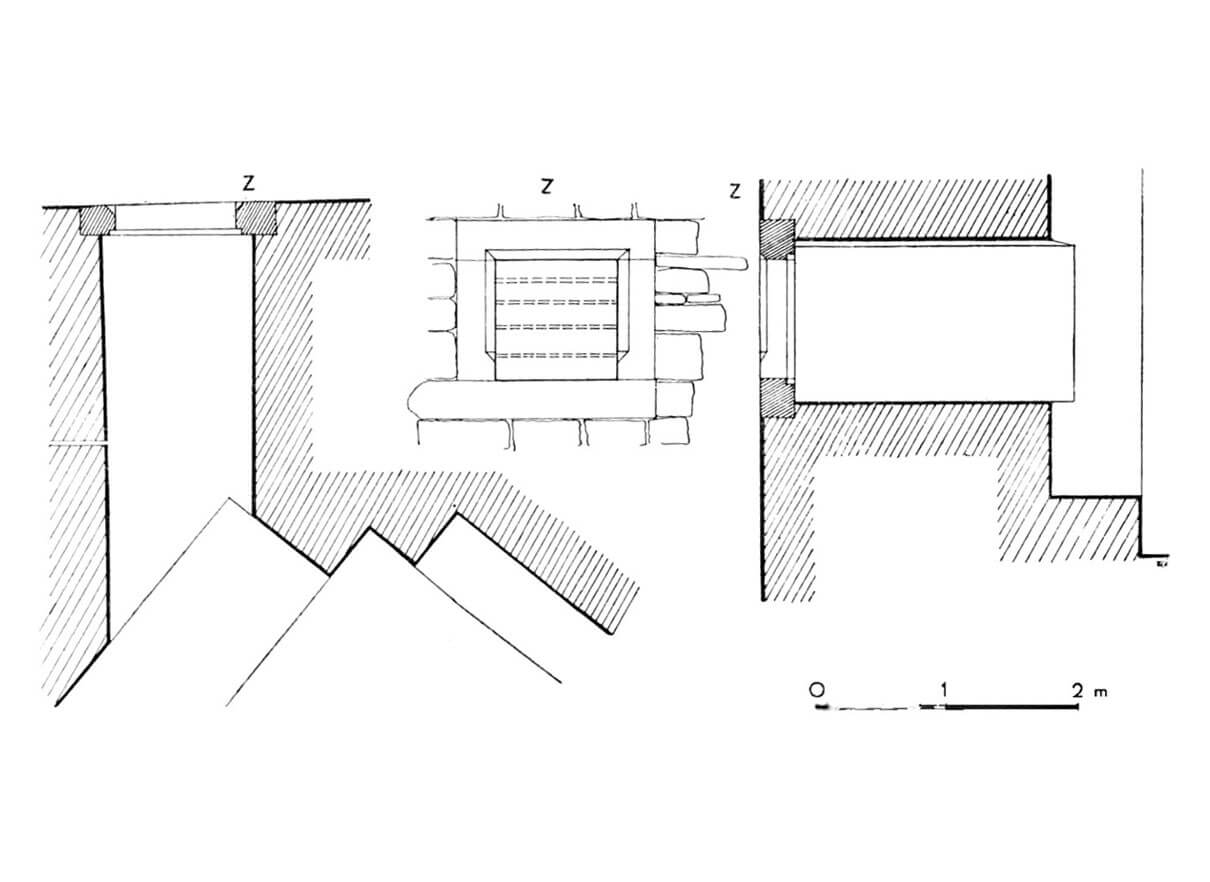
In the northwestern corner of the castle courtyard stood a quadrangular tower, flanking the gateway and the castle’s access road. Initially, it was small, measuring 4.5 x 7 meters and projecting 5 meters in front of the perimeter of the walls. After a late 14th-century reconstruction, it was advanced deeper into the courtyard, having dimensions 7.1 x 7.8 meters. Probably in the 15th century it was reinforced externally with several buttresses, and its interior was covered with vaults. In front of the tower, on its eastern side, near the curtain wall, was a small quadrangular oven. In the 14th century this was replaced by a larger, horseshoe-shaped oven, built of stone and Gothic brick. The second oven, despite its considerable dimensions, was used for cooking and probably baking.
Current state
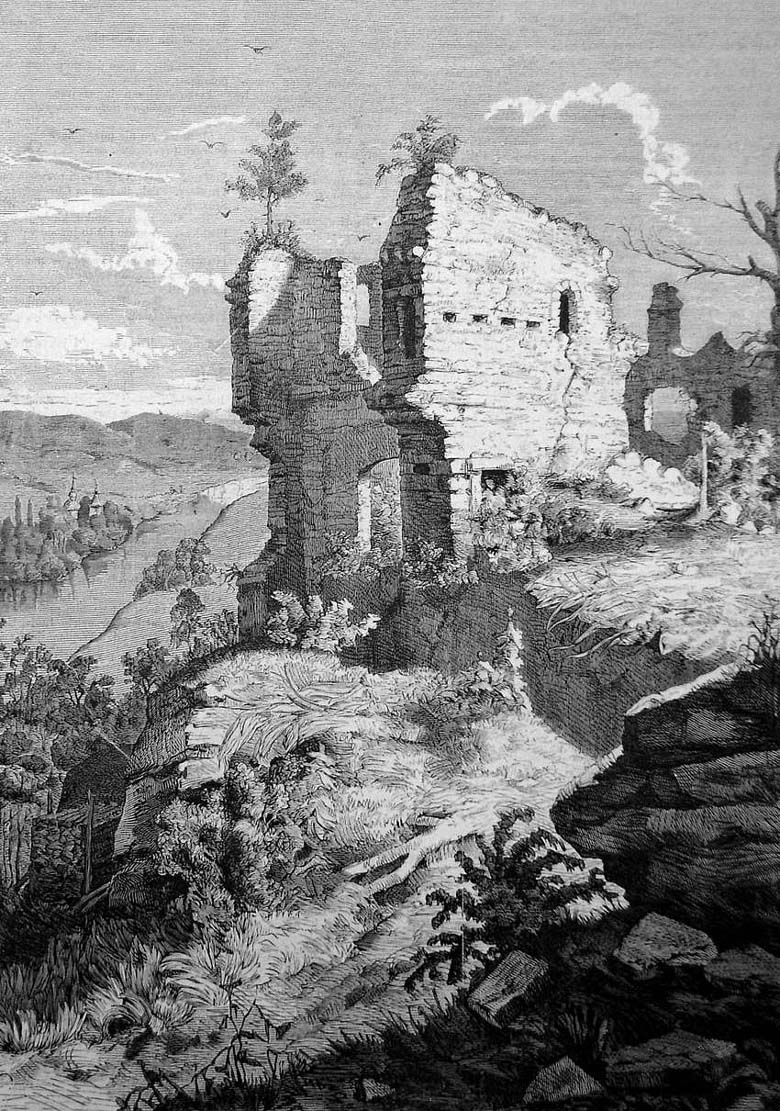
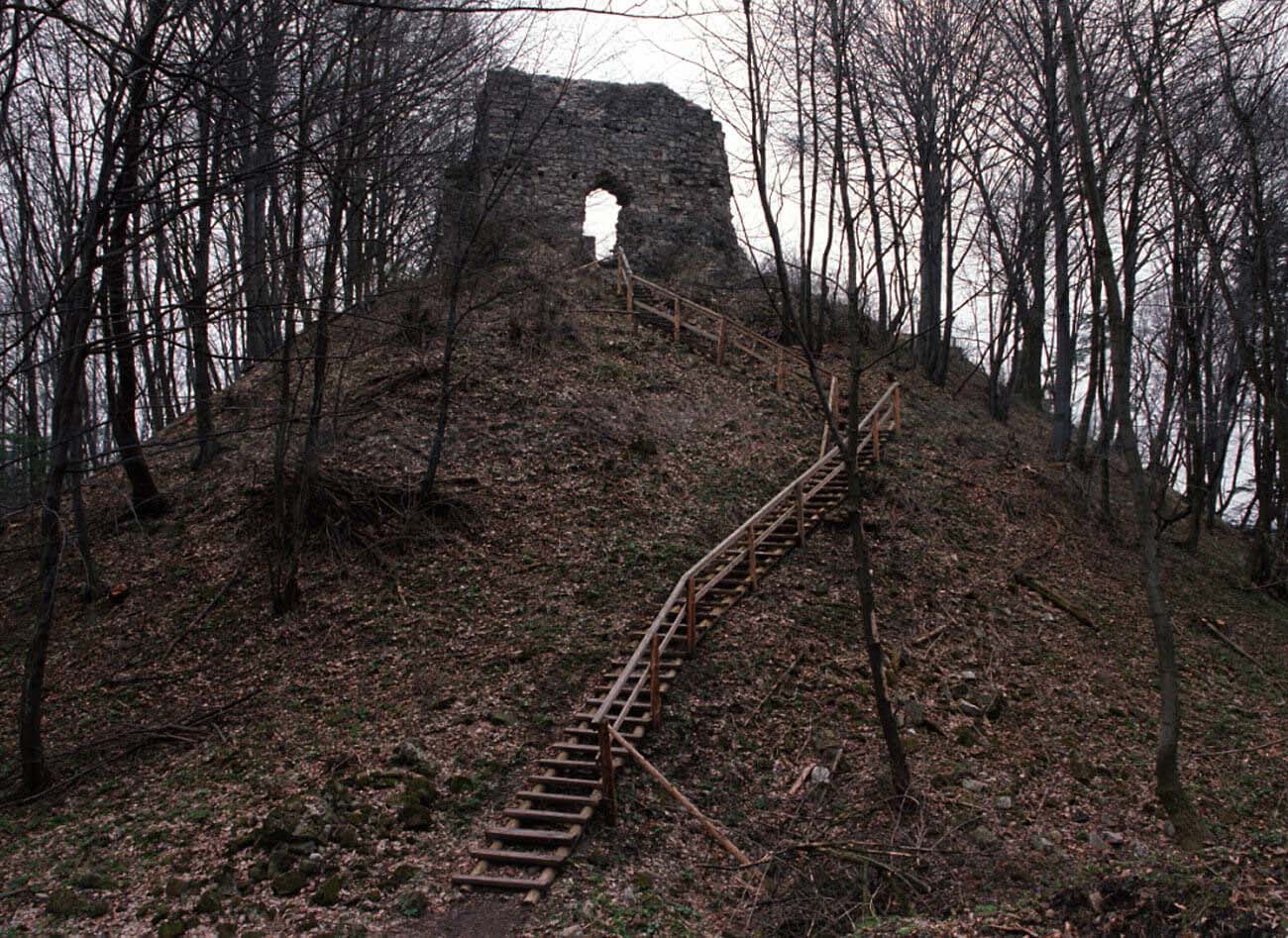
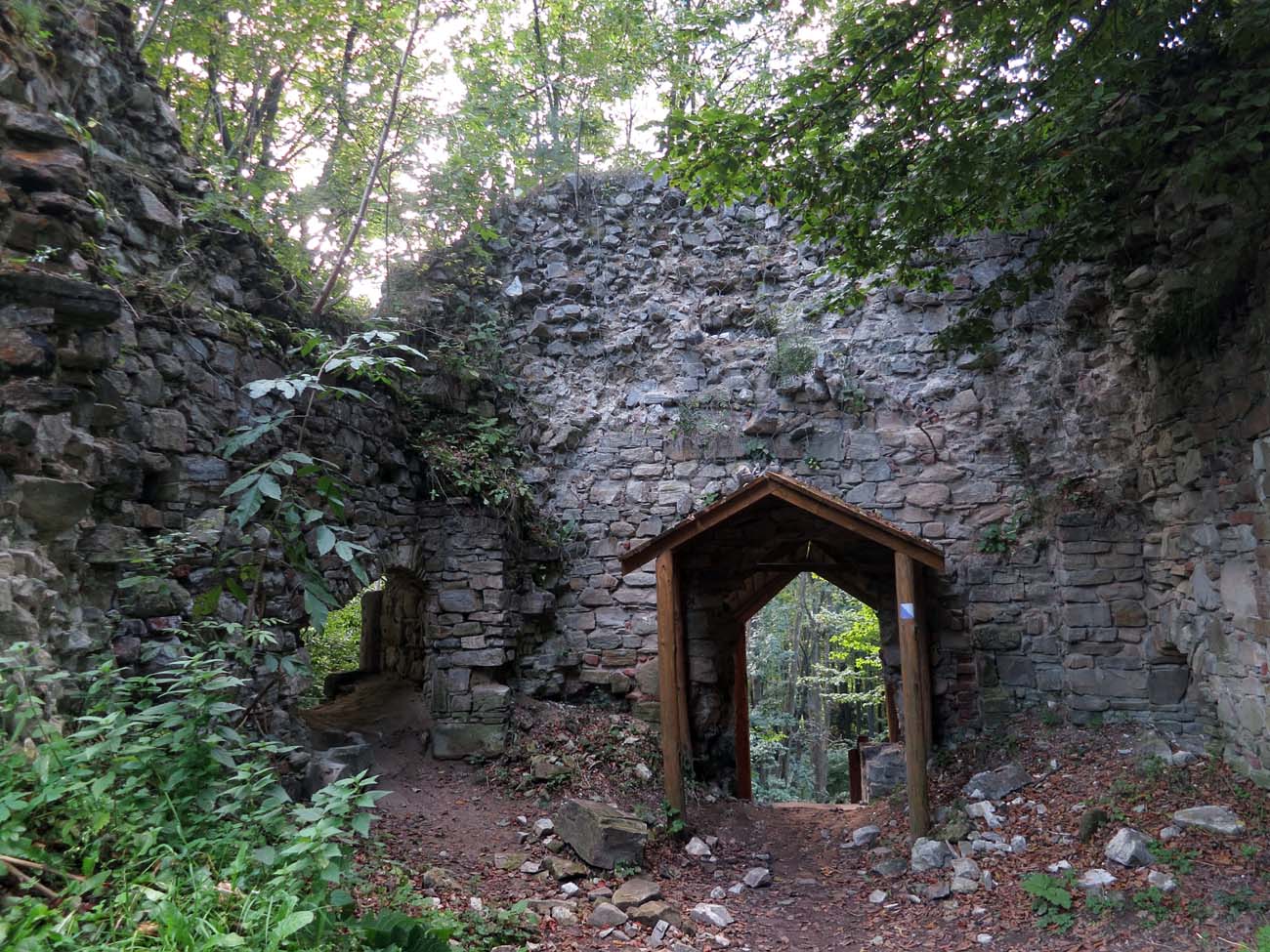
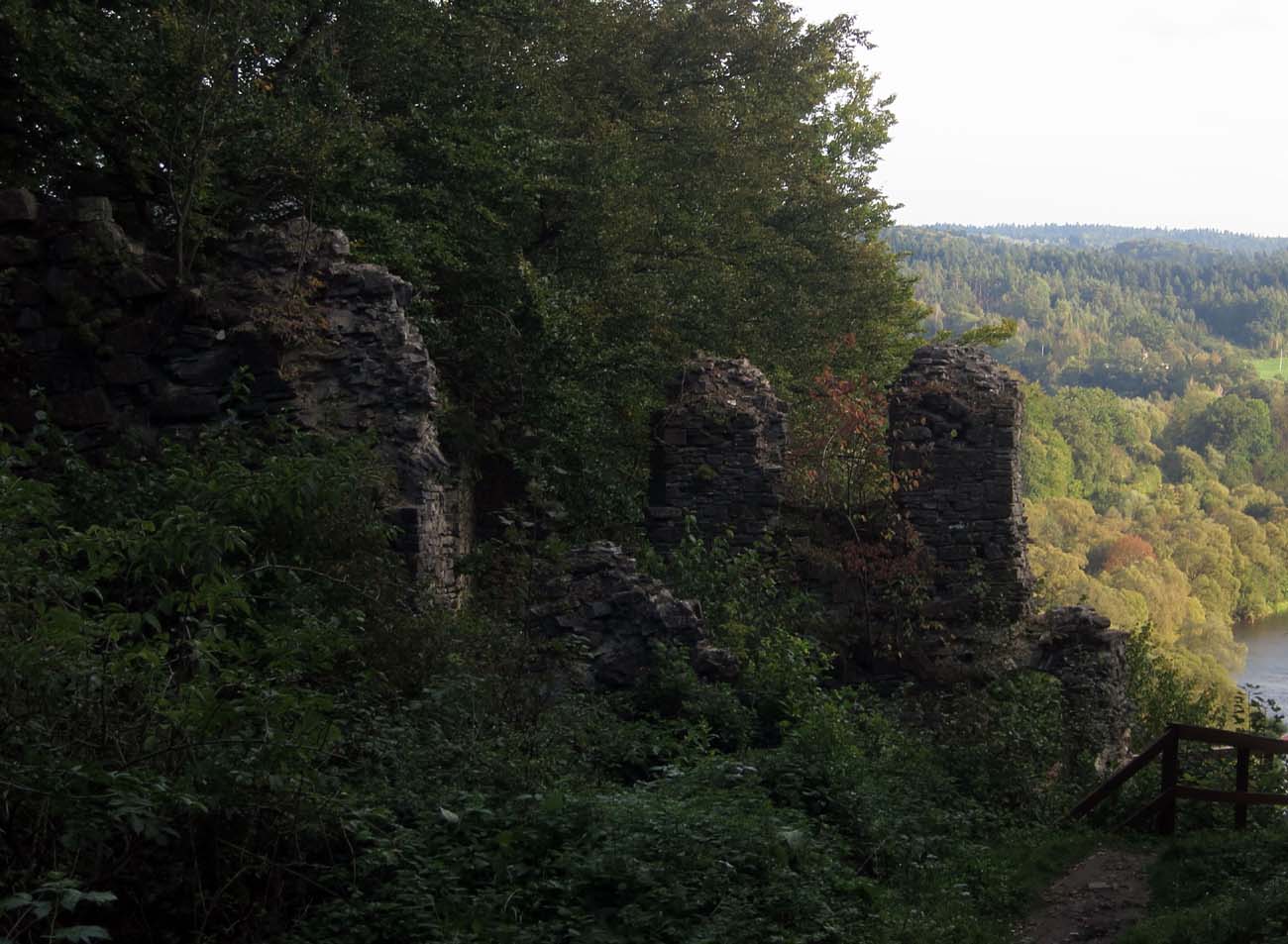
In the overgrown forest of the hill the ruins of the north-west tower with the adjacent section of the wall curtain, as well as the relics of a residential building in the south-eastern part of the complex, and traces of the ramparts of the outer bailey have survived to this day. The northern and north-eastern parts of the castle walls are almost completely destroyed, and in some sections slipped down the slope along with the foundations. The castle is suitable for sightseeing, it has, among others, a viewing platform on the High Bieszczady Mountains, located on a slope in front of the former residential building.
bibliography:
Glinianowicz M., Sprawozdanie z badań archeologicznych i prac odgruzowujących w obrębie ruin zamku Sobień, stanowisko archeologiczne Manasterzec 1, gm. Lesko w 2025 roku, Sanok 2025.
Leksykon zamków w Polsce, red. L.Kajzer, Warszawa 2003.
Żurowski T.R., Sobień nad Sanem. Prace archeologiczne i konserwatorskie w 1966 r., “Materiały i sprawozdania rzeszowskiego ośrodka archeologicznego za 1966 rok”, tom 6, Rzeszów 1968.