History
The village of Pastuchów (German: Puschkau) was founded in the early Middle Ages, before 1149, when Maria, wife of Comes Piotr Włost, and their son Świętosław, founded the Augustinian monastery on Piasek in Wrocław and granted the monks tithes from, among other places, Pastuchów (“Pastuchow”). By the 13th century at the latest, the village had become the property of the princes and, before 1259, was re-founded under German law. From the early 14th century, the princely estates in Pastuchów began to pass into private ownership (in 1313 Prince Bernard transferred the patronage of the Pastuchów church to Conrad von Mogis). The stone tower house in Pastuchów was likely built in the first half of the 14th century, perhaps at the initiative of Hermann, Zydelmann’s father, an imperial notary, who died before 1341. He wrote from Pastuchów (“genannt von Puschow”), meaning he had a permanent residence in the settlement.
In the fourth quarter of the 14th century, the von Mogis lords successively divided and sold off individual parts of the Pastuchów estate, resulting in the creation of at least three separate knightly estates in the settlement. In 1389, the Junge brothers, Heinrich and Conrad, sold the farm and stone building to Heinrich Bolz von Grunau (“vorwerk zu Puschkow mit dem steynwerke genant”). After 1390, under unspecified circumstances, the estate was acquired by Bolz’s relative, Sander Bolcz, who in 1393 sold the tower and manor known as Obirhof to Potho of the Kalkreuth family. In 1402, the brothers Bernard and Puta Kalkreuth were recorded as owners of the Upper estate, along with the stone tower (“steynnenthurme”).
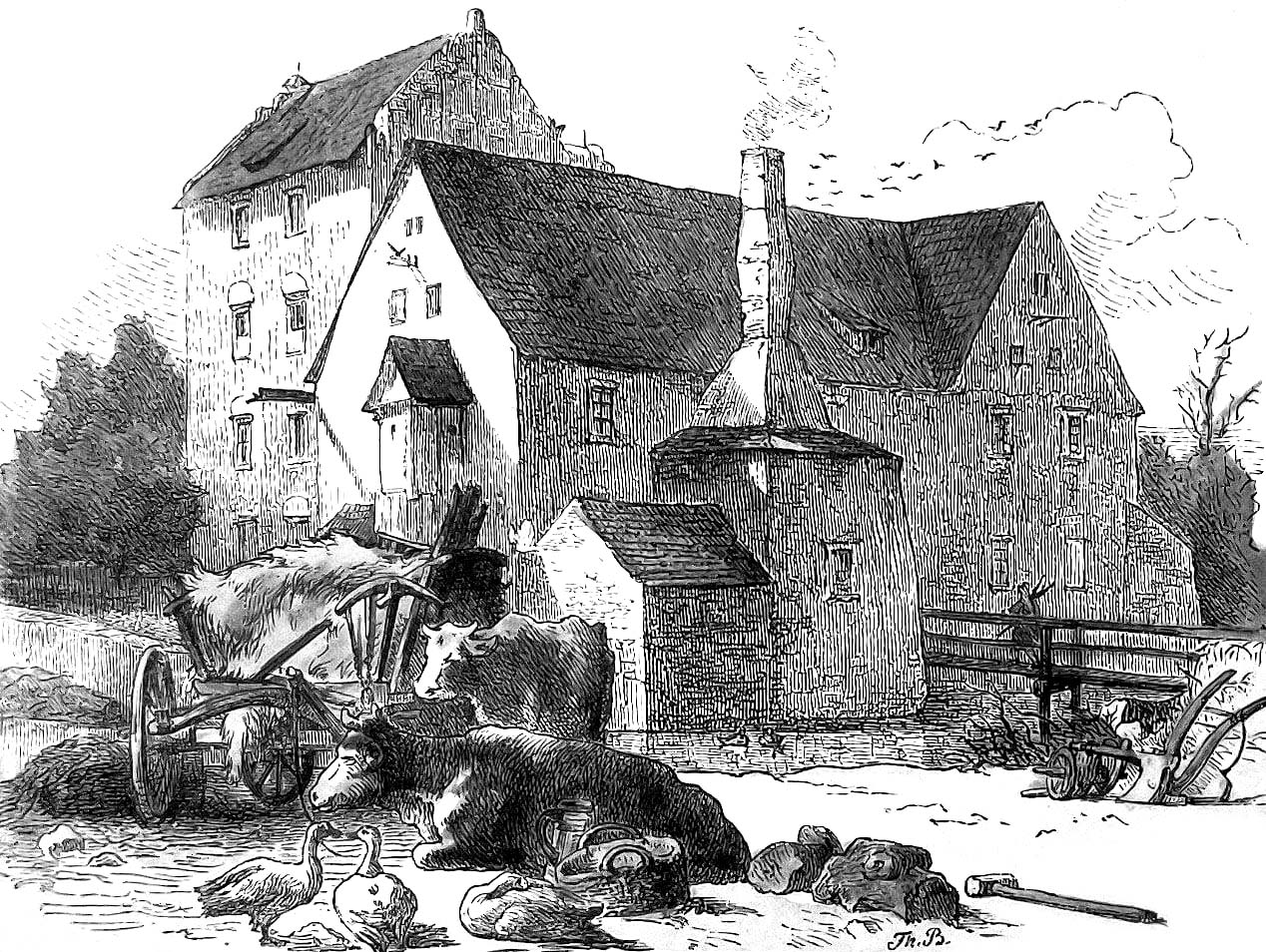
In the 15th century, there were two estates in the Pastuchów area. One likely remained in the hands of the Kalkreuth family permanently, while the other changed hands several times. The merger of the estates took place no later than the first half of the 16th century. In 1540, Kaspar Kalckreutter zu Puschke and his wife, Barbara Zedlitz, were recorded as owners. In 1546, Georg Kalkreuth zu Puschke and his minor cousin Caspar Kalkreuth were recorded, both included in the military duty list of 1550 and the tax list of 1576. Caspar Kalkreuth, owner of 9 peasants and 14 lans, founded new manor buildings near the tower in the 1560s and rebuilt the tower itself in the Renaissance style.
During the Thirty Years’ War, the Lower estate of Pastuchów (Niederhof) was plundered and burned. Under unspecified circumstances, both estates were taken over by Hans von der Dahm, and before 1690 by his heirs, the brothers Hans Adam and Daniel Ferdinand von der Dahm. In 1699, Pastuchów was purchased by Baron Karl Julius von Zedlitz, lord of Krasków, which ultimately led to the tower and the adjacent manor buildings losing their residential function. In 1724, the Pastuchów estate became part of the Hochbergs estate of Książ, after which it was owned by the newly ennobled von Kramst family from 1835 to 1945. After World War II, the tower remained in constant use, thus avoiding falling into ruin.
Architecture
The tower was built in the center of a square, surrounded by a moat courtyard, 30 x 30 meters, on the southern side of the Strzegomka River, several hundred meters away. It occupied the Upper Estate, situated in the center of the village, while the Lower Estate was located on the right bank of the Strzegomka. In the southern part of the village, in a fenced cemetery, stood the parish church of St. Barbara. The courtyard area near the tower was likely originally filled with auxiliary and economic buildings of wooden or half-timbered construction.
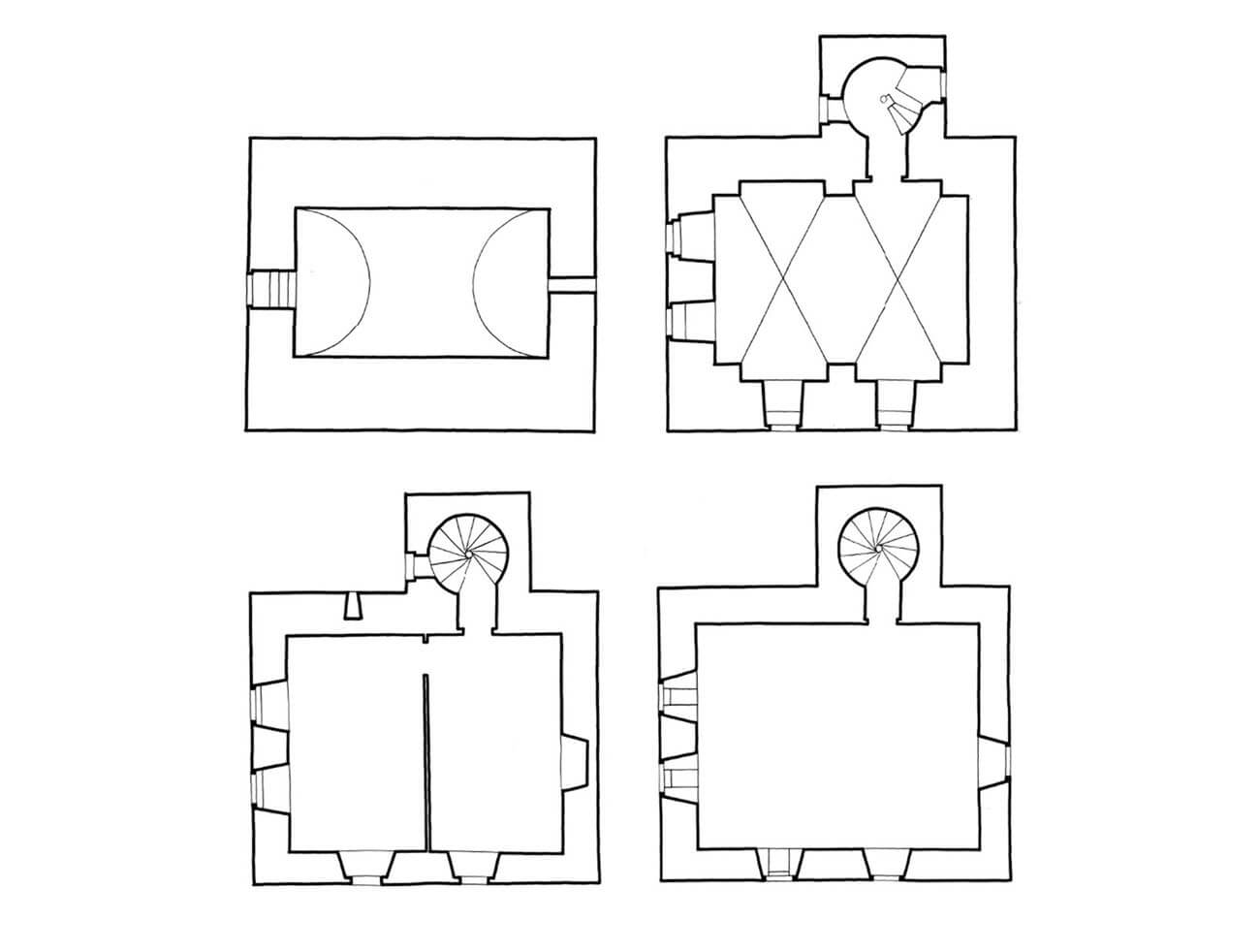
The tower house was built on a rectangular plan, measuring about 8.6 x 10.5 meters, slightly elongated on the east-west axis, with a small turret housing a staircase from the north side, likely added in the second half of the 16th century. The tower’s shape was slender and of considerable height relative to its dimensions. The approximately 28-meter-high walls were constructed of unworked stones, without ashlar reinforced corners. They were likely initially crowned with a crenellated parapet, with a wall-walk hidden behind it.
The tower’s interior was divided into a secondarily vaulted basement and four above-ground levels, originally likely separated by wooden ceilings and connected by ladders or wooden stairs. The lower floors were lit by simple quadrangular slit openings and possibly small windows of unknown shape. For defensive purposes, larger window openings may have been located only on the upper floors. Furthermore, the second and fourth floors housed latrines, overhanging on the western façade.
Current state
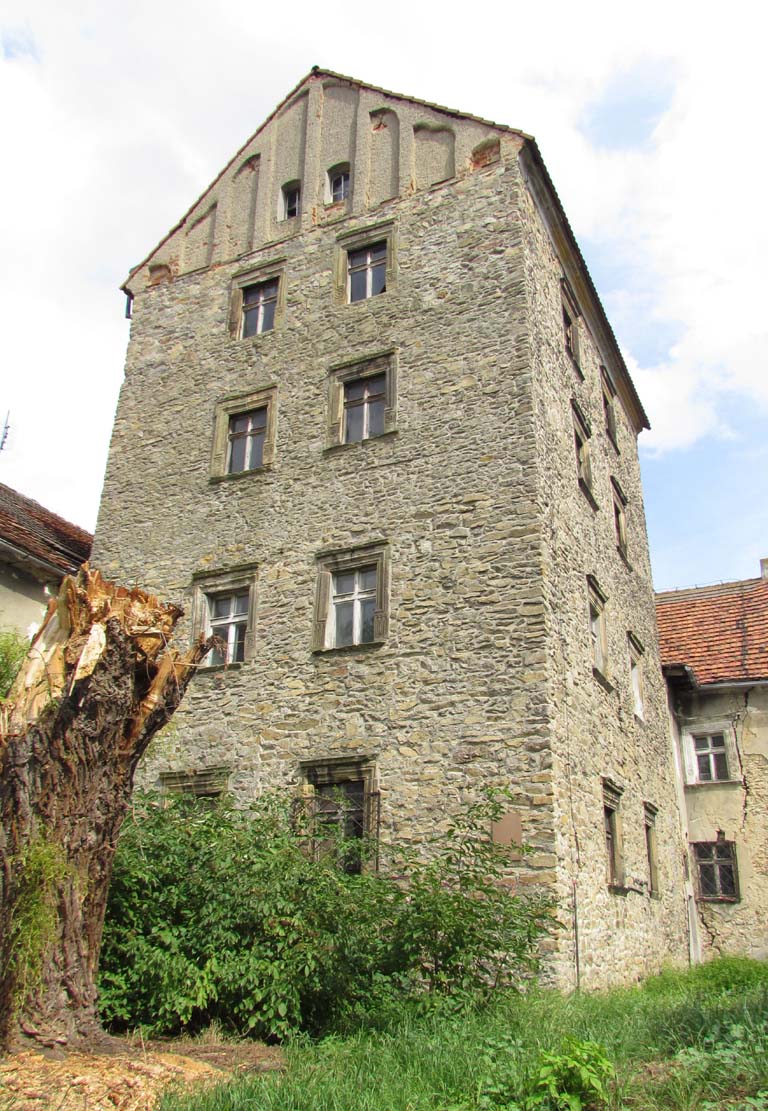
The tower has today the full height of the original perimeter walls, but has lost all of its late late-medieval architectural details, replaced by Renaissance window and portal stonework. The two brick gables with blendes, turret of the spiral staircase and the vault at ground level are also associated with the Renaissance period. A slit, probably original opening is visible on one of the longer elevations. Another slit opening still illuminate the cellar. The monument is currently unused.
bibliography:
Adamska D., Błoniewski P., Boguszewicz A., Chorowska M., Dudziak T., Kwaśniewski A., Zamki i dwory obronne na Śląsku, tom 1, księstwo świdnickie, Wrocław 2026.
Chorowska M., Rezydencje średniowieczne na Śląsku, Wrocław 2003.
Leksykon zamków w Polsce, red. L.Kajzer, Warszawa 2003.