History
Castle was built at the earliest in the late 14th century, so it was not connected with the building activities of King Kazimierz the Great, nor, most likely, of Price Władysław of Opole, the alleged founder of several nearby castles from the second half of the 14th century. The building in Łutowiec was not recorded in any medieval documents. Only a local village, known in the Middle Ages as Oltowiec, was mentioned, first recorded in 1399 in the context of a dispute between Elizabeth of Kruszyn and Krystyn of Koziegłowy, of the Lis coat of arms, the presumed founder of the castle.
In the 15th century, the settlement belonged to Krystyn’s descendants, forming part of the Mirów complex of the Lis’ estate. In 1424, Krystyn II obtained privilege from King Władysław Jagiełło for settlements within his estate, including Oltowiec. After his death in 1437, the Mirów estate was taken over by his son, Krystyn III, who sold it to Żiżko of Mirów and later to his brother-in-law, Hińcza of Rogów. At that time, the Lis family finally ceased to own Mirów Castle and the adjacent Oltowiec.
The small castle in Łutowiec (Oltowiec) likely operated until the end of the 15th century or the beginning of the 16th century. In the later 16th century, settlement continued to be concentrated near the limestone outcrop, but it is unknown whether this was connected to the castle on the rock. The abandonment of the structure may have been due to insufficient housing conditions, a failure to meet the then-current defensive requirements, or destruction following an accidental or deliberate fire.
Architecture
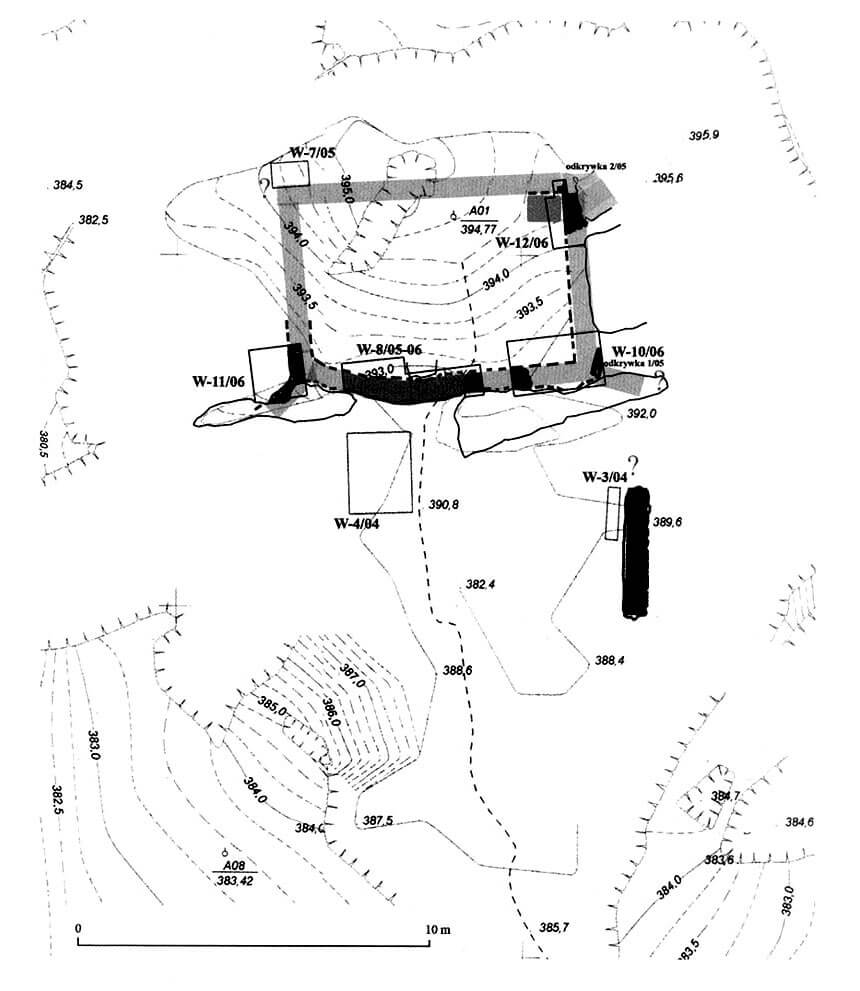
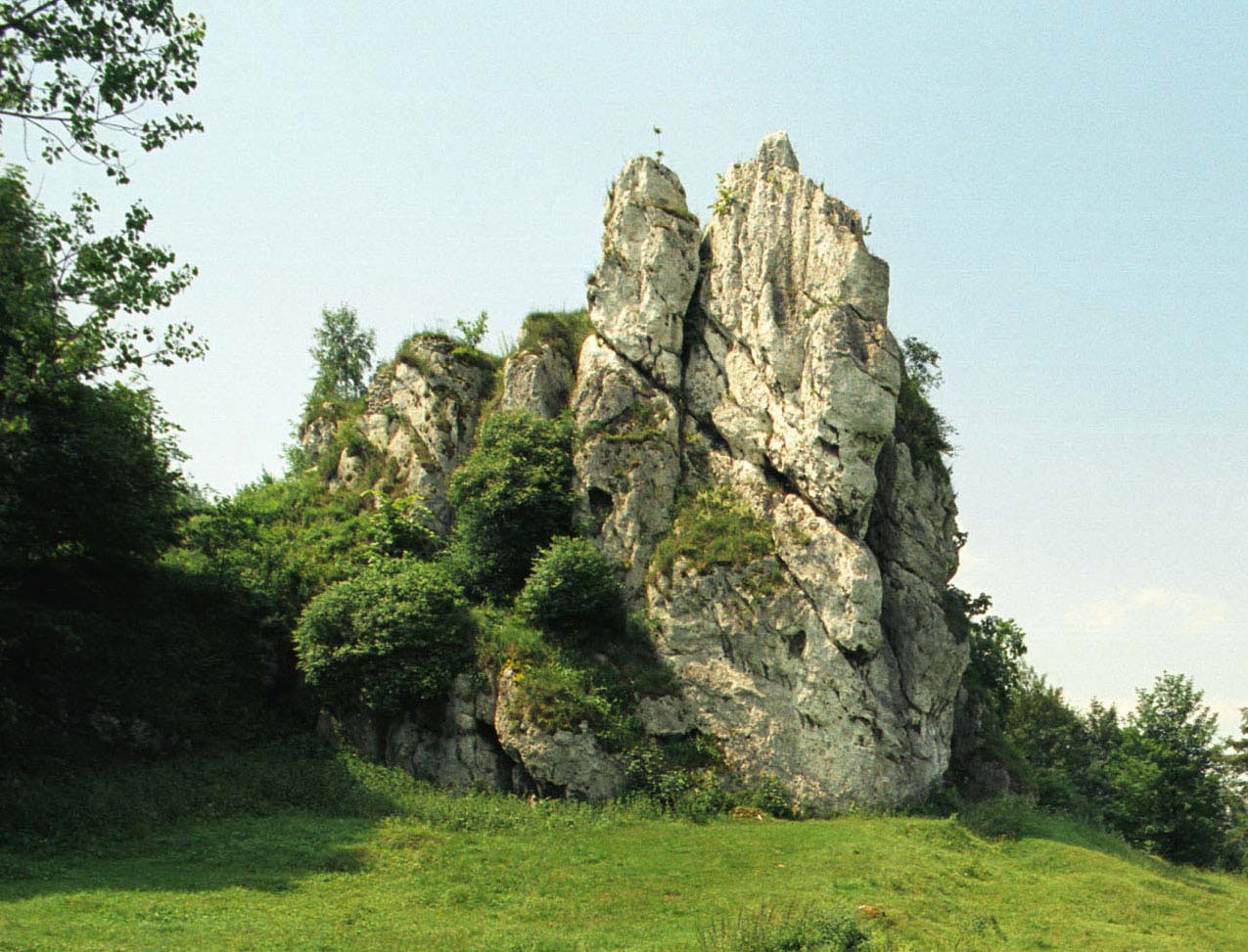
The small castle was built on a 20-meter-high rock outcrop. It was constructed of unworked stone set on a cut and leveled rock face. It likely occupied the entire summit of the outcrop, housing a quadrangular building measuring 6.3 x 9.3 meters, possibly of tower-like form. The building was supported by at least in three corner by buttresses, extending toward the edge of the rock. It was likely intended for residential purposes, given the relatively large interior dimensions of approximately 4.5 x 7.5 meters, although access was only possible via ropes or ladders. On the southern side of the outcrop, a 1.6-1.7-meter-thick wall and a ditch separated the castle bailey, which must have housed all the economic buildings for which the rock outcrop did not provide enough space (e.g., stables, granaries, servants’ quarters, etc.).
Current state
The only visible remnant of the small castle is a fragment of a stone wall, 3.5 meters long and 0.7 meters wide. Situated on a high outcrop, it is difficult to see. Direct access is only possible with climbing equipment, which in turn exposes the weathered rock and the mortar-washed relics of the walls to damages. Traces of a moat at the base of the outcrop are now virtually undetectable. Admission to the castle grounds is free.
bibliography:
Antoniewicz M., Zamki na Wyżynie Krakowsko – Częstochowskiej, Kielce 1998.
Hadamik C., Zamek w Łutowcu. Rezultaty dotychczasowych badań archeologicznych oraz potrzeby badawcze, „Wiadomości konserwatorskie województwa śląskiego”, 4/2012.
Leksykon zamków w Polsce, red. L.Kajzer, Warszawa 2003.