History
The castle at Dobra was built in the late 13th century. It was first recorded in a 1295 treaty concerning the division of lands between princes Bogusław IV and Otto I, which mentioned “castrum Doberen cum terra adiacente”. At that time, the surrounding estates belonged to the knight Behr of Mecklenburg; however in 1308, Prince Bogusław IV granted the settlement of Dobra to the knight Henry de Dobere of the Heydebreke family. This occurred shortly before an armed expedition by the Brandenburgers, who may have attacked the newly erected castle. Evidence for this includes numerous crossbow bolt heads with tips flattened from impact against the defensive wall; however, the absence of burn marks suggests that the castle was not captured.
Around 1338, the lands of Dobra, including the castle and the town, which had been chartered in 1331, were granted as a fief to Ulrich of the von Dewitz family. He took over the castle, which may have been in use or abandoned shortly before his arrival, and one of his first moves was likely the relocation of service buildings (primarily the stables) to the outer bailey. As a prominent figure at the ducal court, Ulrich would have found the simple castle inadequate for his needs, particularly regarding residential standards. Consequently, a major renovation was likely undertaken soon thereafter, replacing the timber-framed residential building with a masonry structure.
In 1348, Ulrich Dewitz’s cousin, Otto of Mecklenburg, was granted the title of Count by Charles IV and endowed with the Fürstenberg estate in Mecklenburg. Upon Otto’s death in 1363, his lands passed to Gerhard of Dobra, who in 1397 pledged the Fürstenberg estate to the princes of Mecklenburg. The funds from this transaction were likely intended to finance the expansion of the castle at Dobra. However, the fortifications proved insufficient, or perhaps no work was actually carried out, as just a year later, the castle was captured under unclear circumstances by the armed forces of Prince Bogusław VIII of Słupsk. Gerhard recaptured part of the stronghold later in 1398 and imprisoned the prince’s men, despite threats from the Grand Master of the Teutonic Order, Konrad von Jungingen. It is known that he imprisoned them in the undamaged section of the castle, whereas the part occupied by the prince was in ruins.
At the turn of the 14th and 15th centuries, Gerhard rebuilt and expanded the castle at Dobra, commissioning a new wing, an outer defensive perimeter, and a massive tower. These improvements transformed Dobra into one of the region’s most impressive knightly castles. It is known that the stronghold could accommodate around two hundred armed men if necessary, because this was the size of Bogislaw X’s retinue when they took refuge in the castle in 1478, to escape the forces of Elector Albrecht. However, faced with the fall of the castle at Szadzko and the significant numerical superiority of Albrecht’s troops, who were also equipped with artillery, Prince Bogusław signed a forced peace treaty in Dobra.
Transformations giving the castle Renaissance character took place in the 16th century. They were initiated by Jost Dewitz, one of the most enlightened Pomeranian humanists and chancellor to Philip I of Wolgast. Around 1538, at his behest, the western wing was demolished and the reconstruction of the gate wing began. Subsequently, the southern wing was raised to three stories and fitted with staircases. Despite this remodeling, the castle began to fall into gradual decline from the second quarter of the 17th century onwards. Destroyed by the Swedes in the late 18th century, it was abandoned and fell into ruin. In 1808, the owner at the time ordered parts of the walls to be blown up to obtain building material.
Architecture
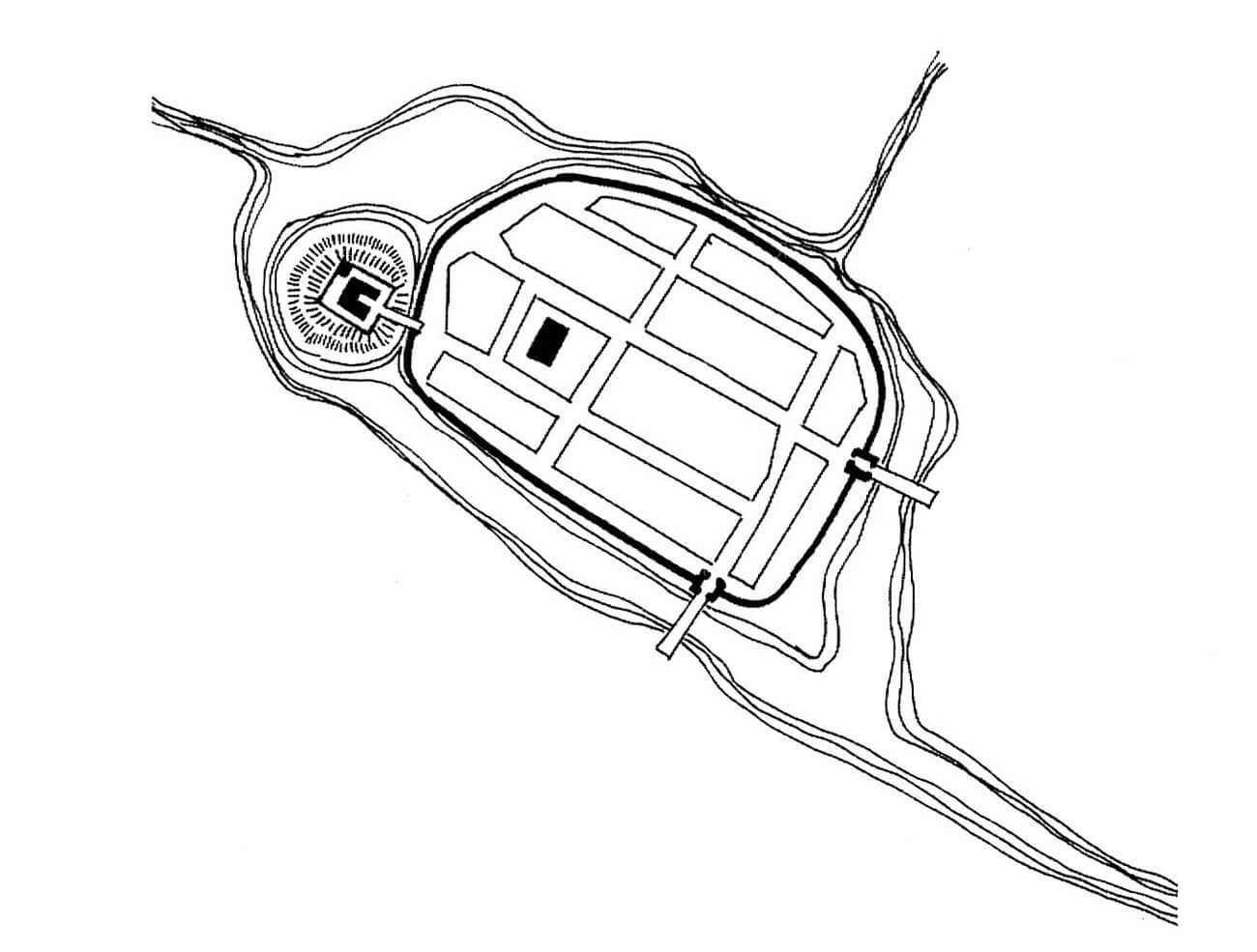
The castle was built on an irregularly shaped hill, situated amid marshes and swamps, originally characterized by relatively gentle natural slopes. Earthworks were carried out on the northern part of the elevated terrain, creating a steeply sloped mound, on which the oldest ring of fortifications was erected. The eastern part was shaped into a small plateau, which eventually began to function as an outer bailey. Ultimately, the castle core dominated the bailey, rising approximately 7-8 meters above it and 11-12 meters above the rest of the grounds. The bailey itself was elevated approximately 3 meters.
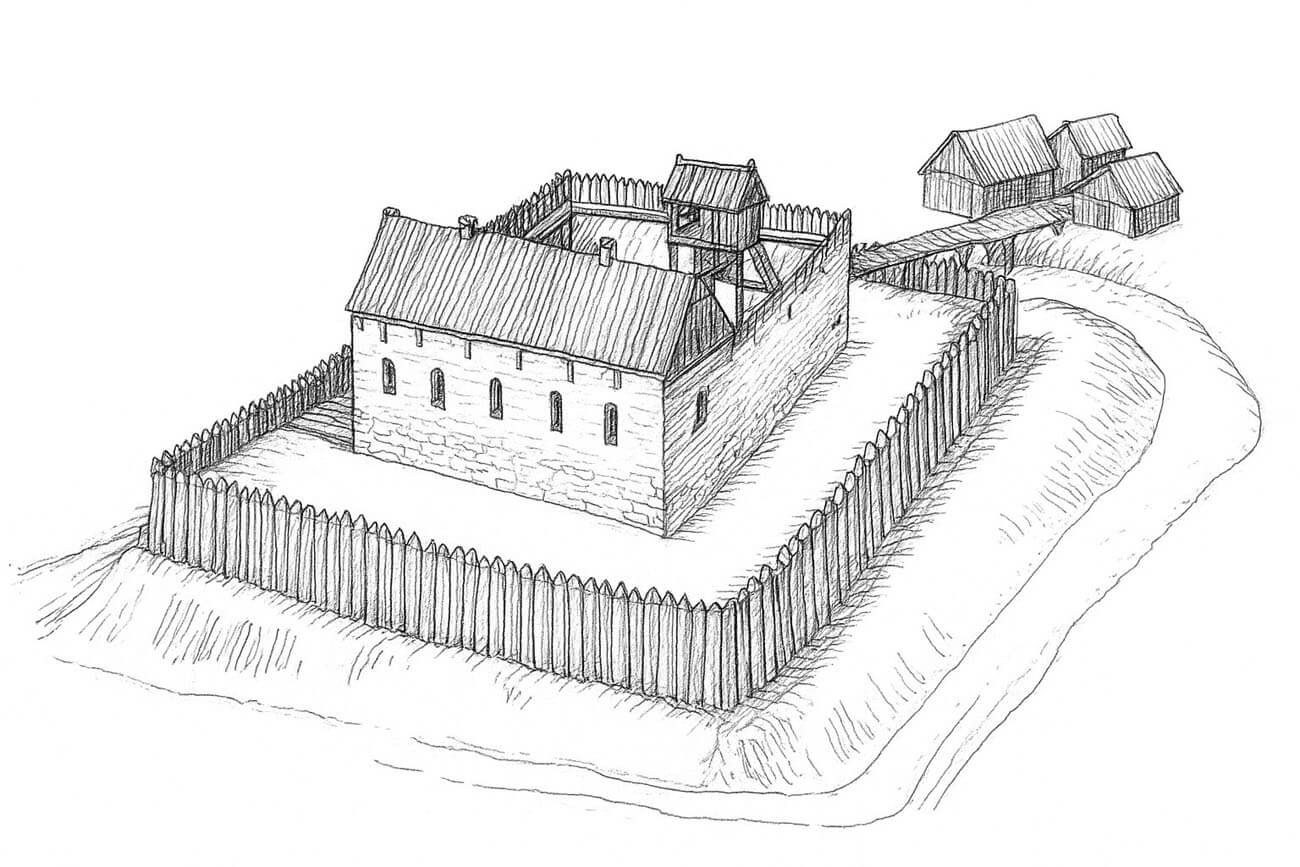
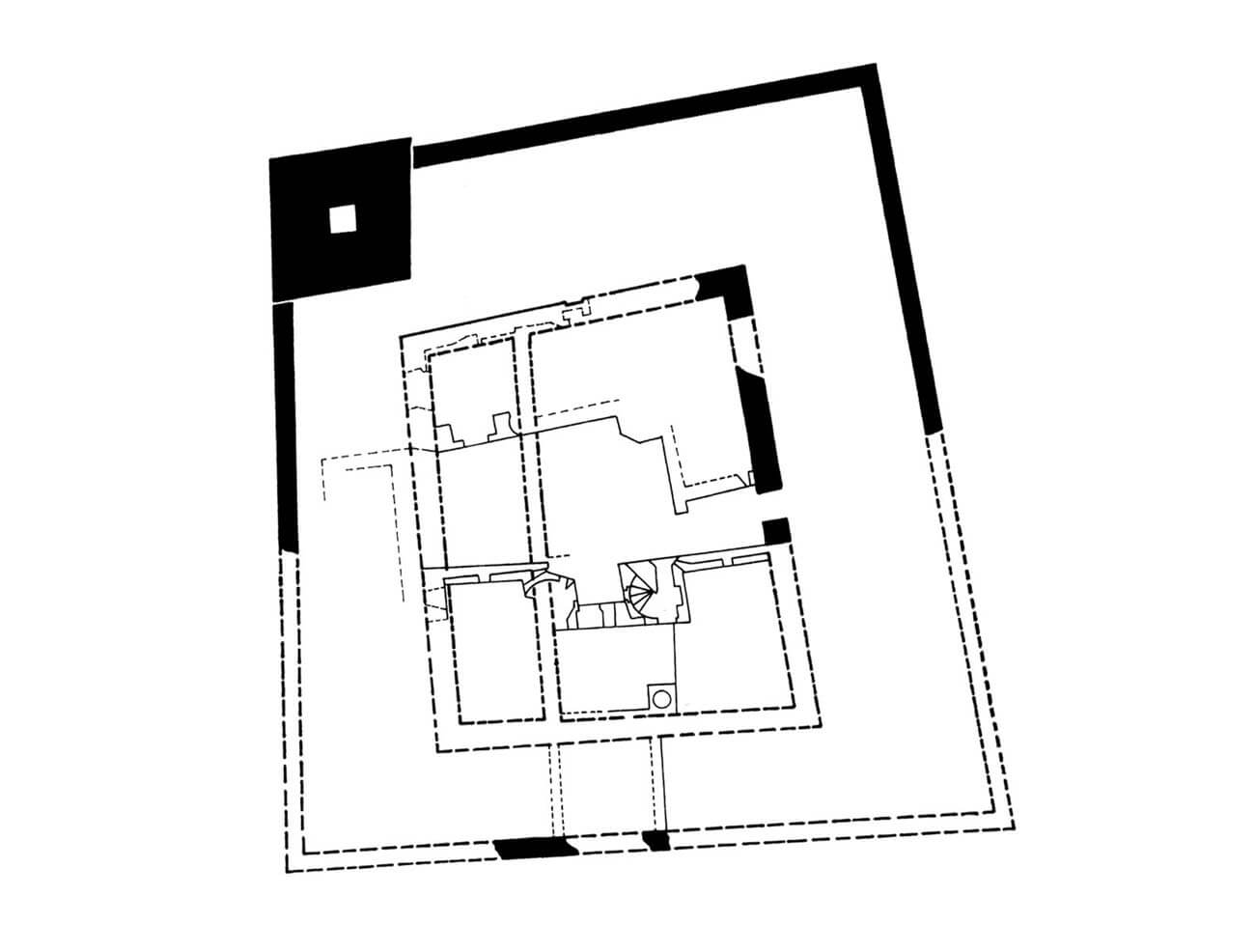
The oldest core of the castle consisted of a defensive wall built of bricks, laid in the Flemish bond and resting on a stone plinth 3.5 meters high. The entire complex had a roughly square shape, with wall lengths of 30 meters (north), 37.5 meters (east), 32.2 meters (south), and 34.5 meters (west). The entrance was located on the axis of the eastern curtain wall, facing an unfortified outer bailey, while the southern side faced the town. The gate was very simple, lacking protection from either a gatehouse or a foregate projection. Given the modest scale of the complex, the defensive wall was likely not very high, probably not exceeding 8 meters. A relatively simple and inexpensive feature was the wooden porch atop the wall; this presumably connected the residential building with the gate, above which there may have been a hoarding.
The castle’s residential quarters were traditionally located on the side opposite the gate. Initially, this was likely a half-timbered structure that incorporated three sections of the perimeter wall. In the first half of the 14th century, the original, modest house was replaced by a fully masonry building. This western wing measured 11 by 34.5 meters, occupying approximately one-third of the castle’s total area. As three of the building’s exterior elevations formed part of the defensive perimeter, it must have had at least two stories above ground, in addition to an attic space beneath a gable roof. The roof must have rested on triangular gables at the north and south ends, possibly decorated with blendes typical of the High Gothic period.
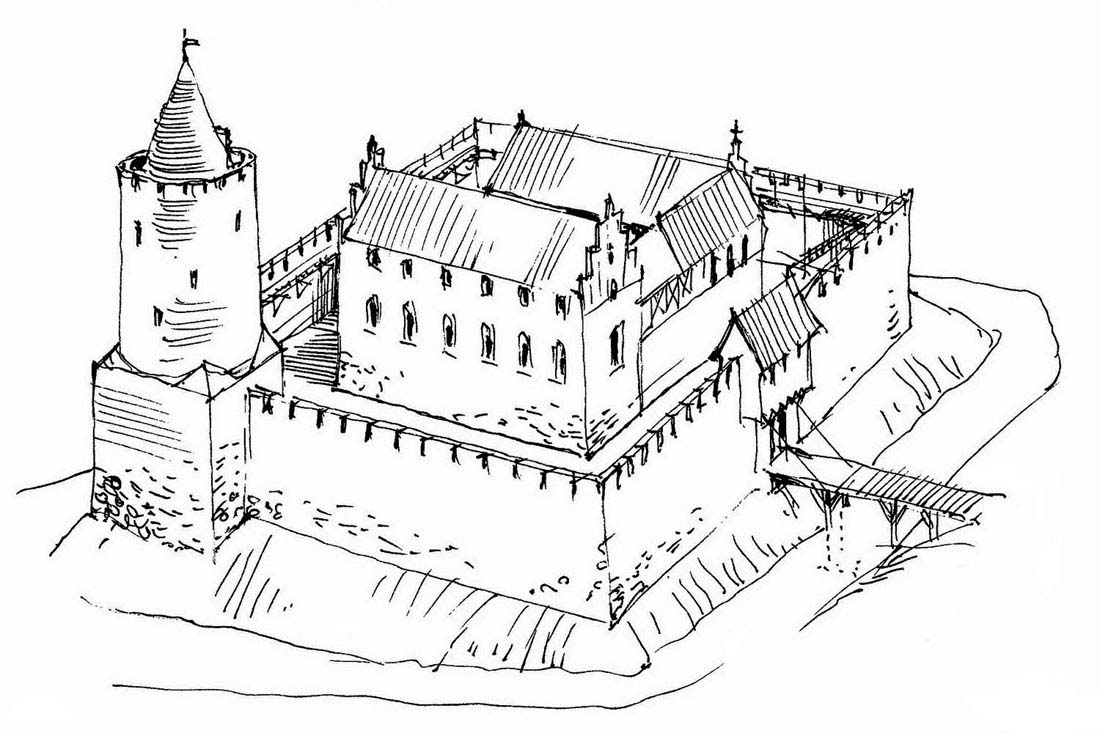
The eastern wing was constructed in the late 14th or early 15th century, replacing two older buildings from the second half of the 14th century that had flanked the gate passage. It is uncertain whether the southern wing was built at that time. However, an outer perimeter wall was erected at the foot of the hill, at an average distance of 8 meters from the main walls, featuring a tower measuring 12.5 by 11.7 meters situated at the northwest corner. The tower projected about 1 meter in front of the face of the northern wall while being in line with the face of the western wall. The outer perimeter wall was 1.5 meters thick, whereas the tower walls were as much as 5 meters thick. Standing over 6 meters high, the outer wall reached the top of the tower’s angular section; above this point, the tower likely transitioned into a cylindrical form. The close proximity of the tower and the western wing allowed for a connection via a timber overhanging gallery situated at a height of 9 meters. At the base of the tower, a square prison cell was constructed, measuring 2.5 meters on each side, carefully lined with glacial erratics.
The castle was surrounded by a deep moat, simultaneously separating it from the town. Access to the castle likely came from the south, from the town, via a drawbridge over the moat, then through the outer bailey, and from there along a gentle slope and a timber bridge to the outer and inner gates in the castle’s eastern walls. Unusually, the main tower protected neither the access road nor the gate itself, probably due to the protective role of the town itself, which was also surrounded by defensive walls. The castle tower, however, protected the castle’s forecourt, which was most vulnerable to fire and attack.
Current state
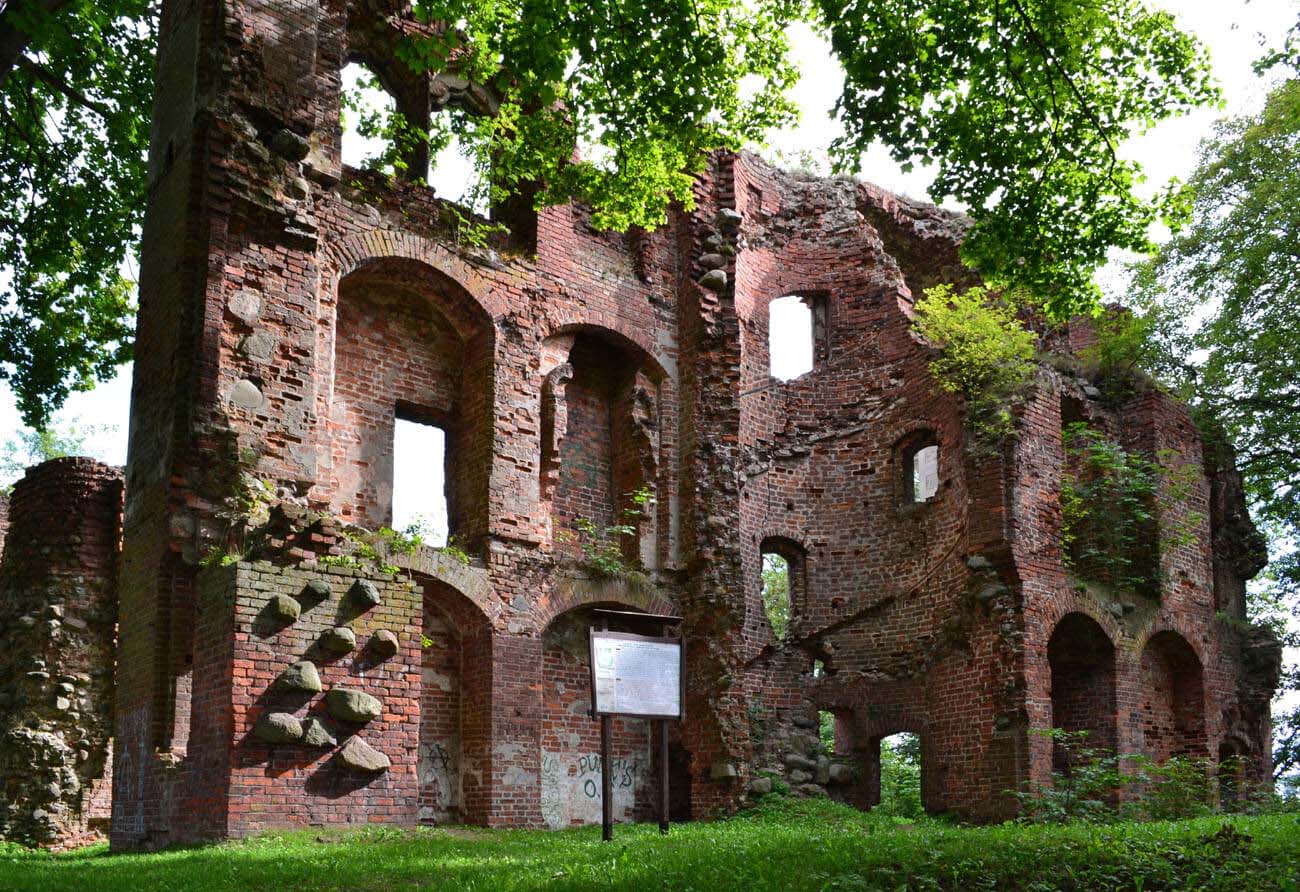
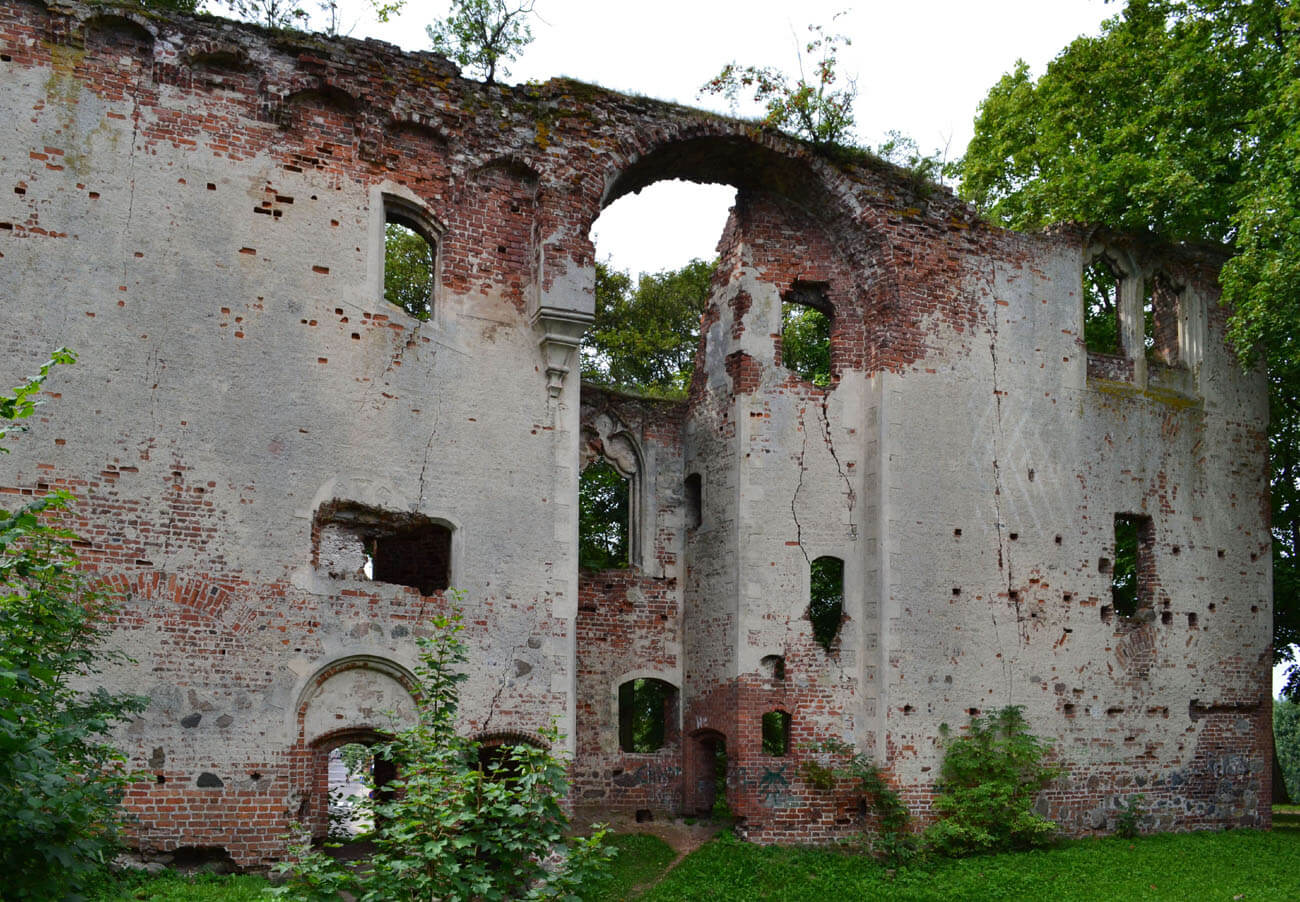
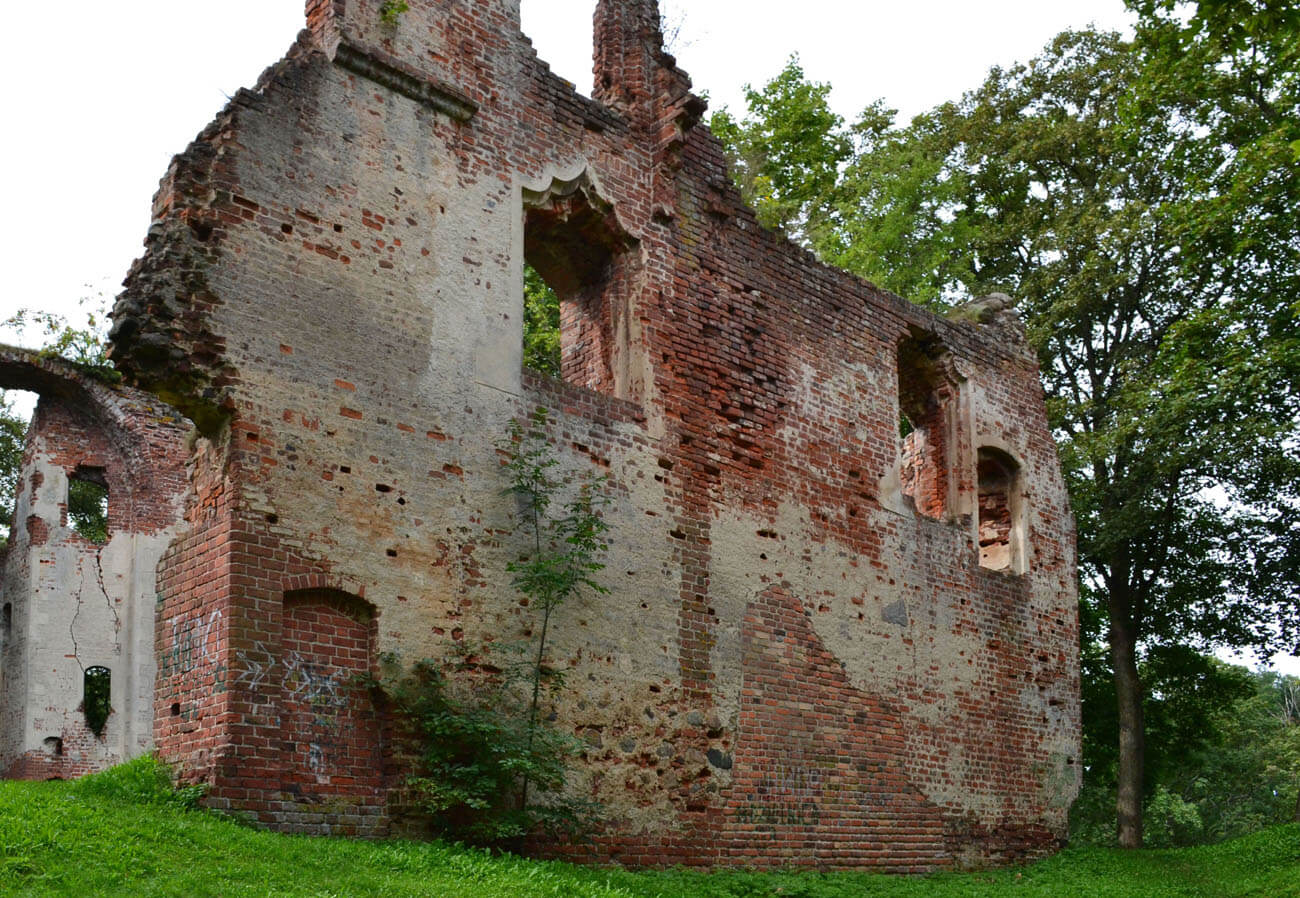
Fragments of the perimeter walls, a tower up to a height of approximately 9 meters, and ruins of residential buildings have survived to this day. Almost the entire northern wall and a small section of the western gable wall have survived from the southern wing, while extensive sections of the northern and southern walls, along with corner sections of the western gable wall, have survived from the northern wing. Both buildings feature both Late Gothic elements (windows with curtain arches and ogival window recesses) and Early Modern elements. The inner defensive wall is visible along almost the entire length of the northern section, reaching a height of 5-6 meters. The outer wall has been preserved in the western section to a height no higher than 3 meters above the surrounding terrain.
bibliography:
Cnotliwy E., Zamek rycerski w Dobrej w powiecie łobeskim, Szczecin 2025.
Leksykon zamków w Polsce, red. L.Kajzer, Warszawa 2003.
Płotkowiak M., Postulates for architectural investigation guidelines, based on a virtual reconstruction of Dobra castle near Nowogard, “Przestrzeń i Forma”, 51/2022.
Radacki Z., Średniowieczne zamki Pomorza Zachodniego, Warszawa 1976.