
History
The castle in Czarny Bór (German: Schwarzwaldau) was built in the first half of the 14th century, perhaps on the initiative of Bolko II, Prince of Świdnica-Jawor, as a watchtower on the route to Bohemia. It must have quickly come under the control of vassals, because it was first recorded in documents in 1355 (“Sworczin Walde”), as one of the strongholds against which Bolko II took military action (Cisy, Książ, Konradów and Radosno were also captured at that time). The fighting was probably associated with the rebellion of local feudal lords or the plunder they carried out from the mountain centres of the duchy.
In 1364, a succession treaty was concluded between Emperor Charles IV of Luxembourg and his son-in-law, Margrave Otto V of Brandenburg, which resulted in the transfer of several castles, including Czarny Bór. Therefore, at least until 1364, the castle remained under the direct rule of Prince Bolko II, but already in 1371 it was the property of a certain Witek Czech from Rodov (“Wittche Behem”), associated with the court of the Piasts of Ziębice and Świdnica in the years 1329-1366. In the aforementioned 1371, customs duty was supposed to be collected in the village of Czarny Bór when crossing the Lask stream. In addition, in the same year, Witek issued a document in which he transferred the castle and its properties to his wife Jutta as a life tenancy. The next owner of Lubno was Sigismundus von Schwarzwaldau, son of Witek of Rodov. In 1390, in the event of his death without heirs, Sigismund bequeathed his property, including the castle in Czarny Bór (“das hous Swarczenwalde”) to Tammo von Lasan. He was probably in full health at the time or soon recovered from his temporary infirmity, because he was recorded as the owner of Czarny Bór as late as 1394.
In the first half of the 15th century, the castle changed hands frequently, including Henlin Burgold, Georg Tannenberg, and Hermann Czetritz. During the Hussite Wars, Prince Jan of Ziębice and the cities of Wrocław and Świdnica sent 230 cavalry to Czarny Bór in 1421. According to unconfirmed tradition, the castle fell into Hussite hands, which led to a retaliatory raid by Silesian burghers in 1437, and the burning of the castle. Further destructions, after which the castle was never rebuilt, took place during the reign of King Władysław II Jagiellon in 1509. Once again, the reason for the siege was allegedly the criminal activity of the owners of Czarny Bór.
Architecture
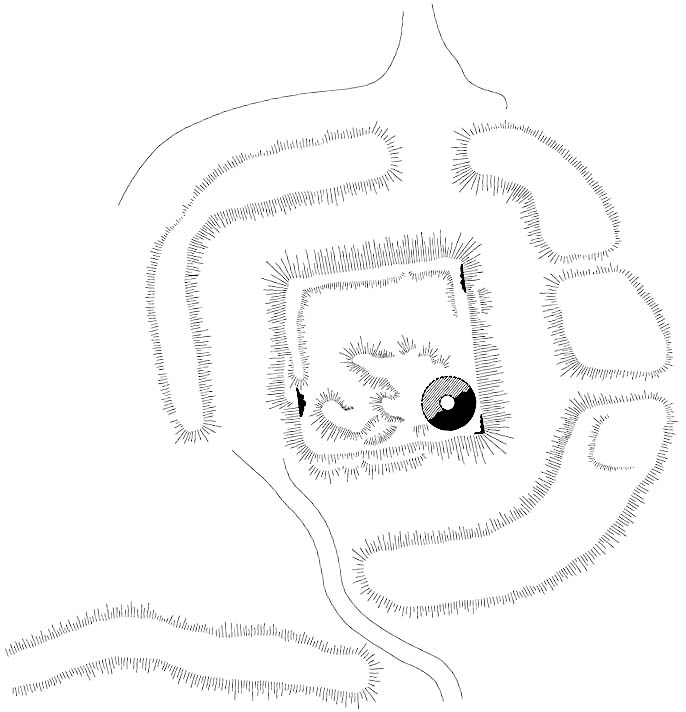
The castle was built on the floodplain of the Lesk stream valley, which flows on the southeastern side. Due to its level location, it was a regular, roughly square-shaped structure with sides approximately 23-25 meters long, with buildings on the western and northern walls and a cylindrical bergfried tower in the southeastern corner. The entire structure was surrounded by two moats and a rampart separating them, with the moats flooded by water brought from the stream. On the eastern side of the castle core was an outer bailey, within which at least one stone structure was built.
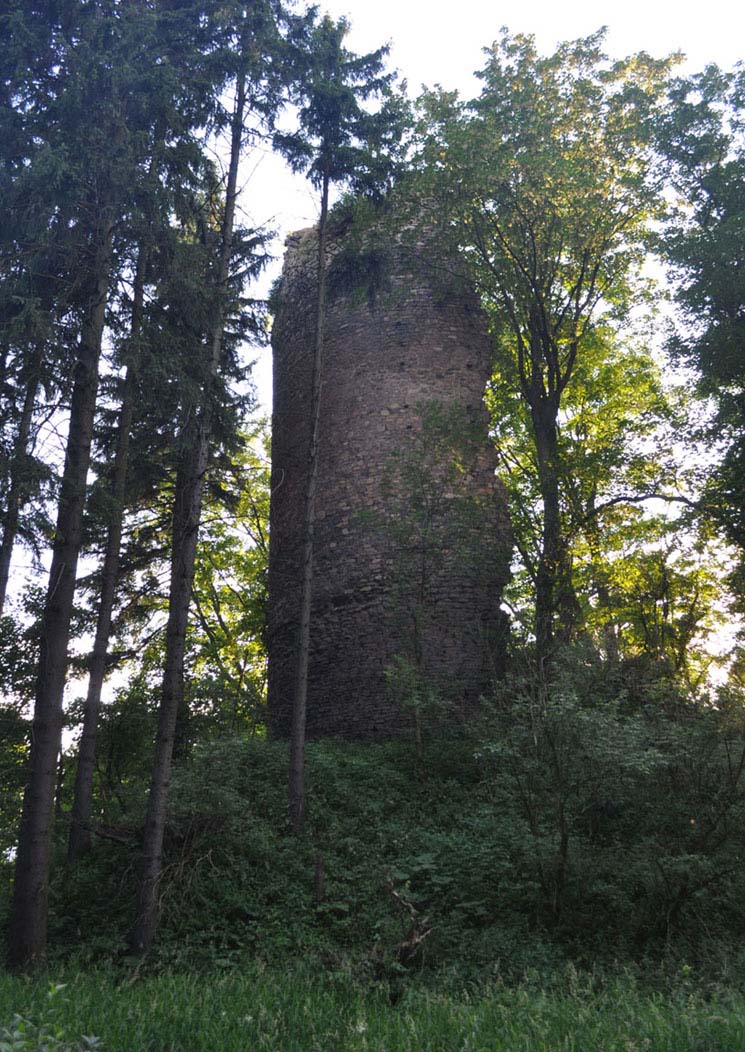
The cylindrical tower was built of unworked porphyry and had a diameter of approximately 7 meters. The lowest level was a tall, narrow shaft, likely serving as a cell or pantry. Above it, at a considerable height, probably on the second floor, was an entrance, originally accessible by ladder or via a footbridge from the top of the adjacent wall-walk. The tower’s upper floors, like other structures of this type, may have been intended for guard and defensive purposes.
Current state
A square earthen mound has survived to the present day, surrounded by two still visible moats divided by a rampart. Two causeways lead to the castle from the south and west. There are the relics of the quadrangular perimeter walls and the remains of the southern half of the cylindrical tower located in the south-eastern corner, preserved to a height of 12 meters. In its vertical cross-section, a round room in the form of a shaft and an entrance passage located above it are visible.

bibliography:
Adamska D., Błoniewski P., Boguszewicz A., Chorowska M., Dudziak T., Kwaśniewski A., Zamki i dwory obronne na Śląsku, tom 1, księstwo świdnickie, Wrocław 2026.
Boguszewicz A., Corona Silesiae. Zamki Piastów fürstenberskich na południowym pograniczu księstwa jaworskiego, świdnickiego i ziębickiego do połowy XIV wieku, Wrocław 2010.
Chorowska M., Rezydencje średniowieczne na Śląsku, Wrocław 2003.
Leksykon zamków w Polsce, red. L.Kajzer, Warszawa 2003.