History
The first mentions of Bydlin Castle began to appear in the late 14th century, with a direct record of the building in 1398. It was likely built by Niemierza of the Strzała coat of arms, writing from Bydlin in 1388, or possibly by his father, Pełka, although ownership relations must have been complicated at the time. Claims for the Bydlin were made by the brothers Klemens and Zbigniew of Łapanów and the canon Klemens of Lubcza, and in 1399 Małgorzata, wife of the castellan Klemens of Łukowa, testified under oath that Bydlin was not Pełka’s property (“non est rerum patrimonium ipsius Pelce”). At the end of the 15th century, Bydlin passed into the possession of the Brzezicki family, followed by the Szczepanowski and Boner families. At the end of the 16th century, the next owner, Mikołaj Firlej, rebuilt the castle into the church of the Holy Cross. In 1655 it was destroyed by the Swedes and, although it was reconstructed, it was gradually abandoned and fell into ruin at the end of the 18th century.
Architecture
The castle was built on a lofty, steep-sloped hill, isolated by nature, in the bend of a small river flowing around it from the north and west. Although the slopes were not rocky or rugged, the hill was characterized by a difficult approach from all sides, especially from a marshy valley to the north. The castle walls were built on the hill’s crest, using local limestone, with larger stones laid in relatively even layers and supplemented with rubble. The corners were not reinforced with ashlar.
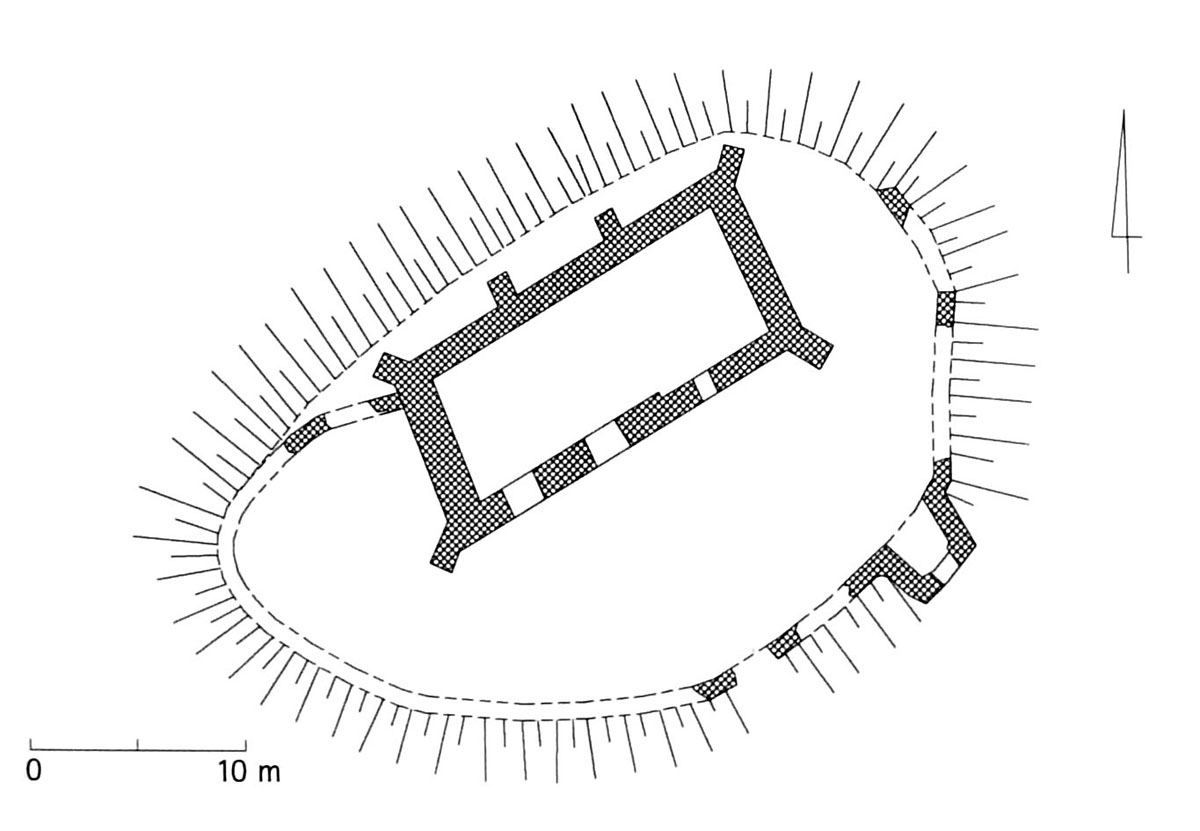
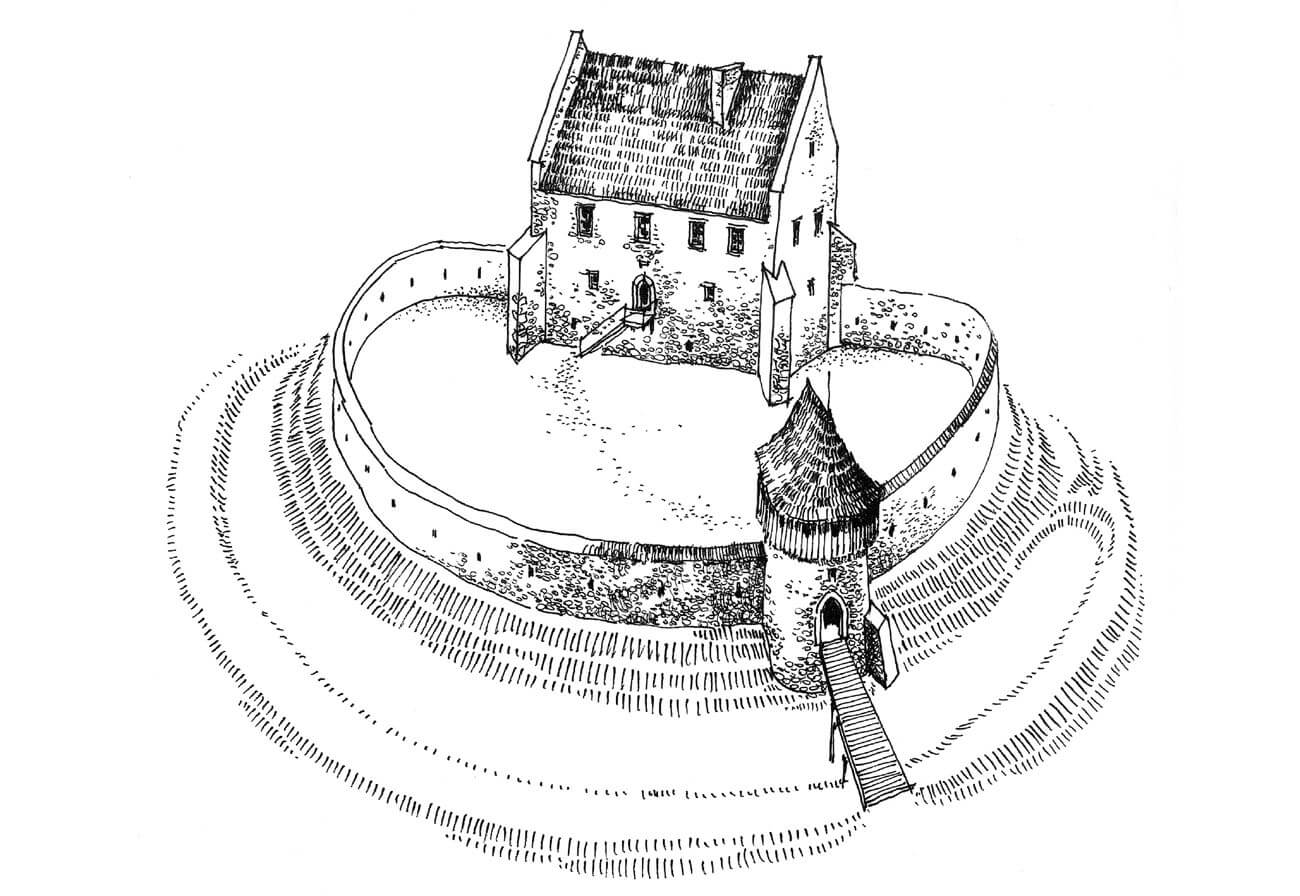
The defensive and residential complex consisted of a rectangular tower house measuring 11.4 x 24 meters with walls up to 2.3 meters thick, incorporated into a perimeter of earthen ramparts that separated a small courtyard on the south side. The main building was buttressed at the corners and pierced with slit openings and pointed windows. Inside, it contained at least three stories, each with two rooms, separated by wooden ceilings. The internal partitions were not made of stone. The entrance was located on the axis of the southern façade, at a height of 2.5 meters from the courtyard level. Therefore, it must have been accessed by a wooden staircase or ladder, which could be easily dismantled in case of danger.
During the second phase of construction, probably still in the 14th century, a perimeter wall was built, connected to the main building in two places. In the southeastern part of the complex, a gatehouse was erected with an irregular quadrangle plan, opened from the courtyard side or closed with a lighter timber wall. It protruded entirely from the face of the defensive wall. The entire castle was surrounded by a ditch partially carved in the rock and a stone and earth rampart.
Current state
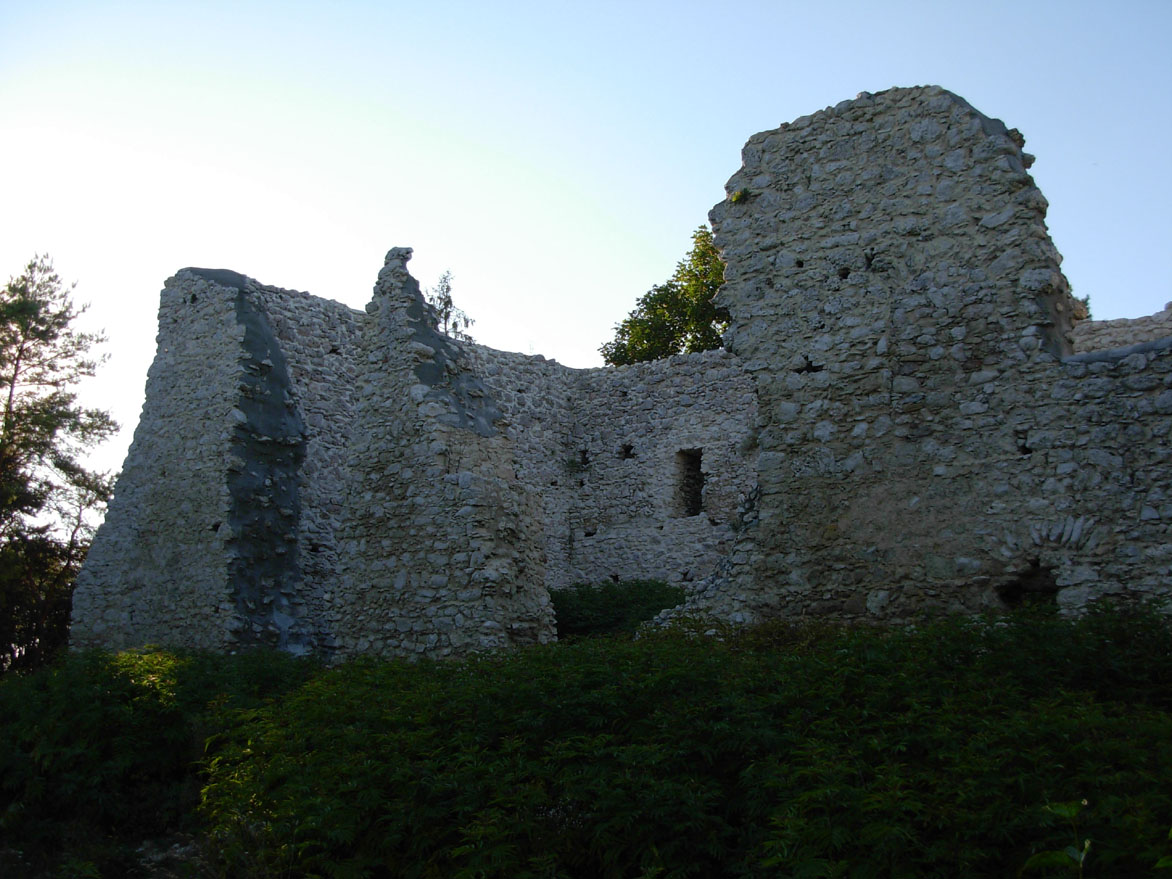
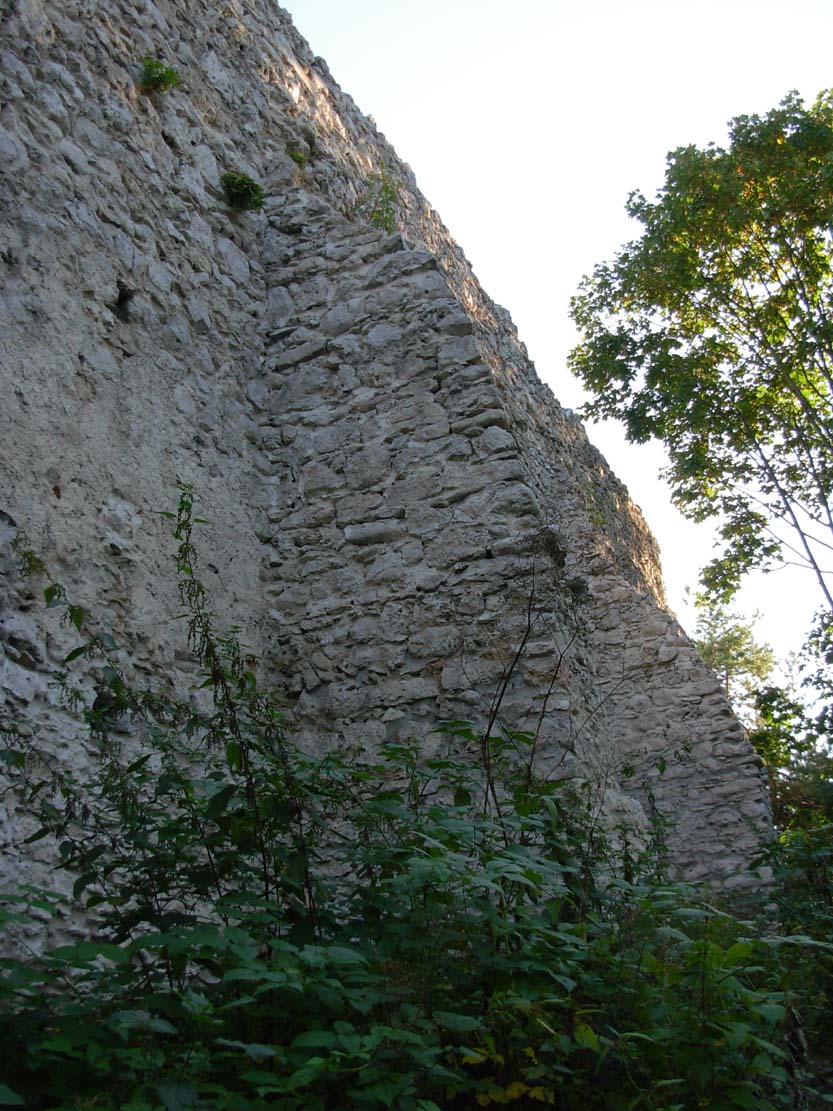
Fragments of the Bydlin Castle walls are visible, forming the ruins of the main residential building. These were reinforced and renovated several years ago, unfortunately after the partial collapse of one of the walls, which was never fully rebuilt. The remains of a ditch are also visible. Admission to the castle grounds is free.




bibliography:
Antoniewicz M., Zamki na Wyżynie Krakowsko – Częstochowskiej, Kielce 1998.
Kołodziejski S., Średniowieczne rezydencje obronne możnowładztwa na terenie województwa krakowskiego, Warszawa 1994.
Lasek P., Obronne siedziby rycerskie i możnowładcze w czasach Kazimierza Wielkiego [in:] Wielkie murowanie. Zamki w Polsce za Kazimierza Wielkiego, red. A.Bocheńska, P. Mrozowski, Warszawa 2019.
Leksykon zamków w Polsce, red. L.Kajzer, Warszawa 2003.
Sypek R., Zamki i obiekty warowne Jury Krakowsko-Częstochowskiej, Warszawa 2003.