History
The development of settlement in Bieławin dates back to the early Middle Ages, around the 9th-10th centuries, but then its intensity shifted to the south. Around the middle of the 13th century, a defensive and residential tower was built in Bieławin. Its functioning was probably related to the nearby Chełm center of power and the foundation of the Halych princes, on the initiative of which towers in Stołpie and Chełm were also erected. The founder and user of the tower could have been the Russian prince Daniel of Galicia or possibly one of his successors. The tower was surrounded by a contemporary, vast settlement of a proto-urban character, where agriculture, farming, fishing, weaving, as well as crafts and trade were cultivated. The inhabitants probably worked for the needs of the royal or princely court in Chełm.
From 1325 to 1340, after the Romanowicz dynasty died out, the Prince of Galicia-Volhynia was Yuri II Boleslav, the eldest son of Trojden I, Prince of Masovia and Maria of Galicia. He contended with the claims of King Kazimierz III the Great of Poland, the Lithuanian ruler Gediminas, and King Louis II of Hungary. The lands around Chełm changed hands at that time until, in 1377, Louis II annexed it to the Kingdom of Hungary. He left it as a fief to Prince Władysław of Opole, and appointed the Hungarians as starosts. The tower in Bieławin may have been built at the latest around that time, perhaps by one of the Hungarian starosts, as suggested by the name of the nearby Uherka River.
It is unknown when exactly the tower was abandoned or destroyed. Archaeological research suggests this may have occurred as early as the late 14th century. The cause could have been flooding in the valley due to climate change, the wars of succession of the Principality of Galicia-Volhynia after the Romanovich dynasty, which resulted in the annexation of the Chełm region to Poland in 1387, or the granting of town rights to Chełm in 1392, which may have led to the decline of crafts in Bieławin. Bieławin was first recorded in documents as late as 1464, as a village associated with a pond and a mill.
Architecture
The tower of Bieławin was situated on flat ground in the Uherka River valley, on its left bank. It was built on a sandy patch, one of many that had formed amid the wet meadows on both sides of the river, which meandered from south to north. The forested areas of the Chełm Hills to the west provided exceptionally favorable conditions for farming and cattle grazing, while the extensive marshlands to the east, stretching almost continuously to the Bug River valley, provided Bieławin with considerable protection.
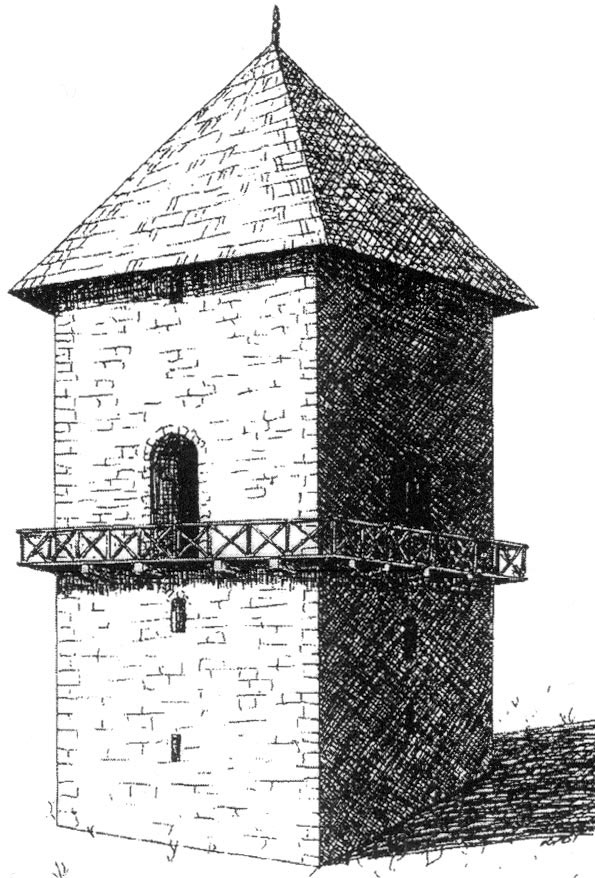
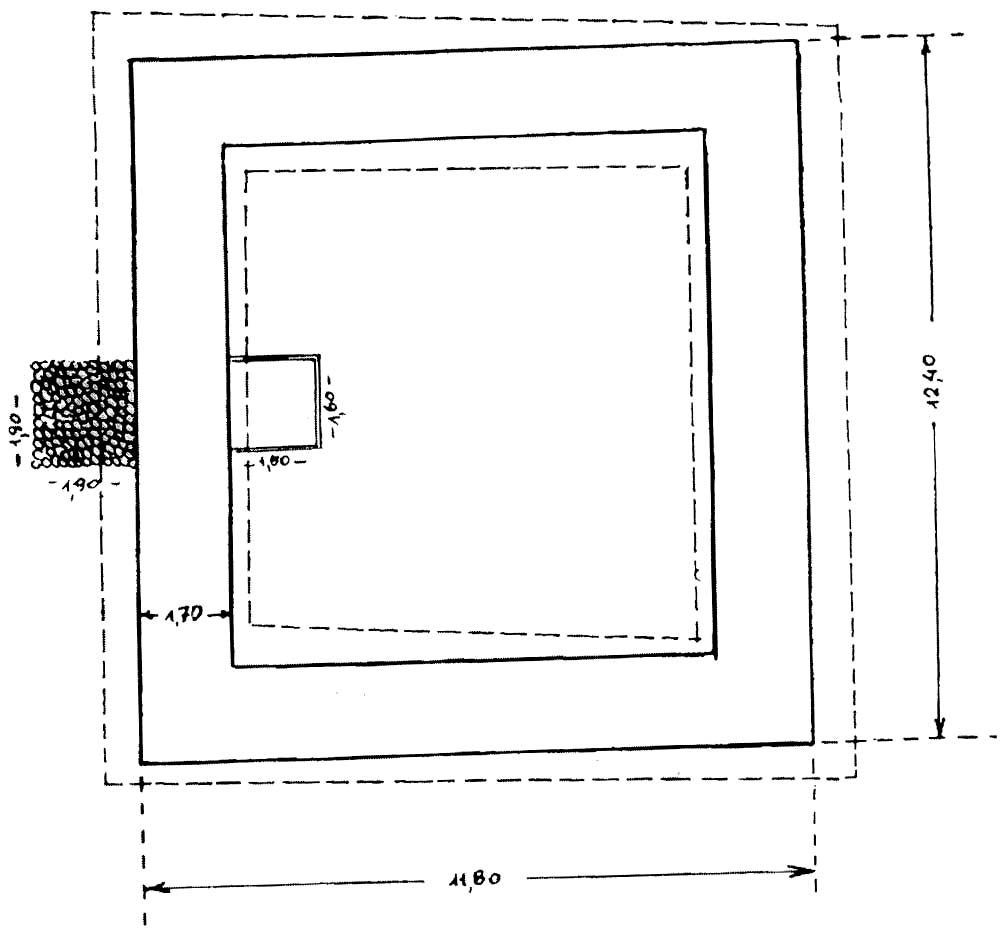
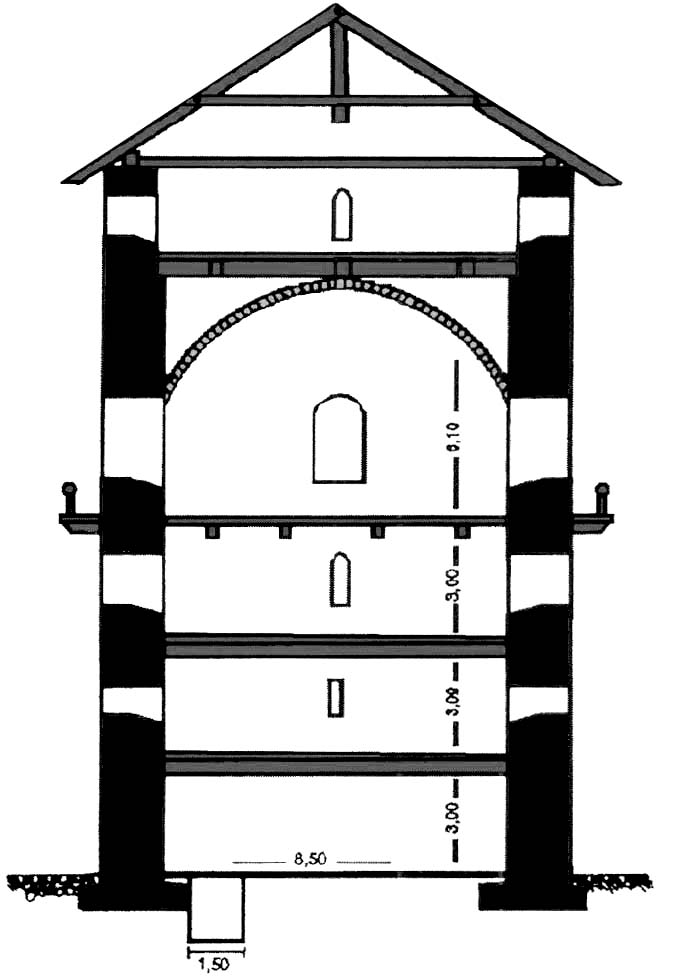
The tower was built of irregularly shaped local stone, bonded with sand-lime mortar. Additionally, finger-made bricks and glazed ceramic tiles were used to decorate the interior. It was erected on a large quadrilateral plan with dimensions of 12.4 x 11.8 meters. The thickness of the wall was not very large, oscillating between 1.6 and 1.7 meters, while the height probably reached four or five storeys above ground, i.e. about 16 meters. It is assumed that there were additional accompanying timber buildings around the tower, it could also be surrounded by a moat with a rectangular or oval outline.
The interior of the lowest floor probably served as a kitchen and pantry, and at its western wall there was a small dungeon that could be a small treasury or water store in the event of a siege. The ground floor of the tower was 3 meters high and did not have large windows, but a portal formed in the north wall led to it. The second and third storeys were not much more than 3 meters high. Narrow windows were placed in them, which probably also served as arrowslits. Like the ground floor, they were all covered with wooden, flat ceilings, with beams embedded in openings in the wall. The fourth storey had a representative character and was the only one with a cross vault. At its height, a timber porch ran outside, and the main entrance to the tower led to this floor, up the stairs or a ladder from the west side. The windows on the fourth floor were large and richly decorated, and the vault was finished with green stone. The fifth floor probably lacked a ceiling and was intended only for defense.
Current state
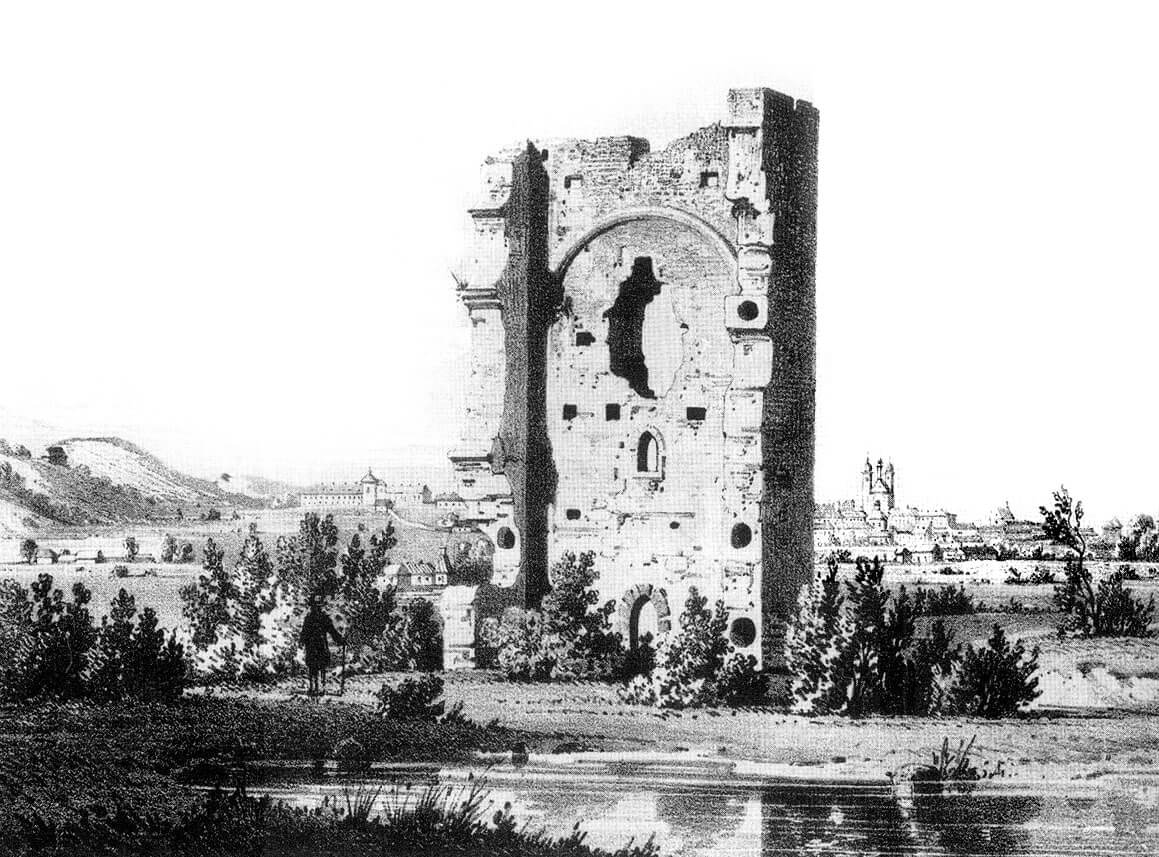
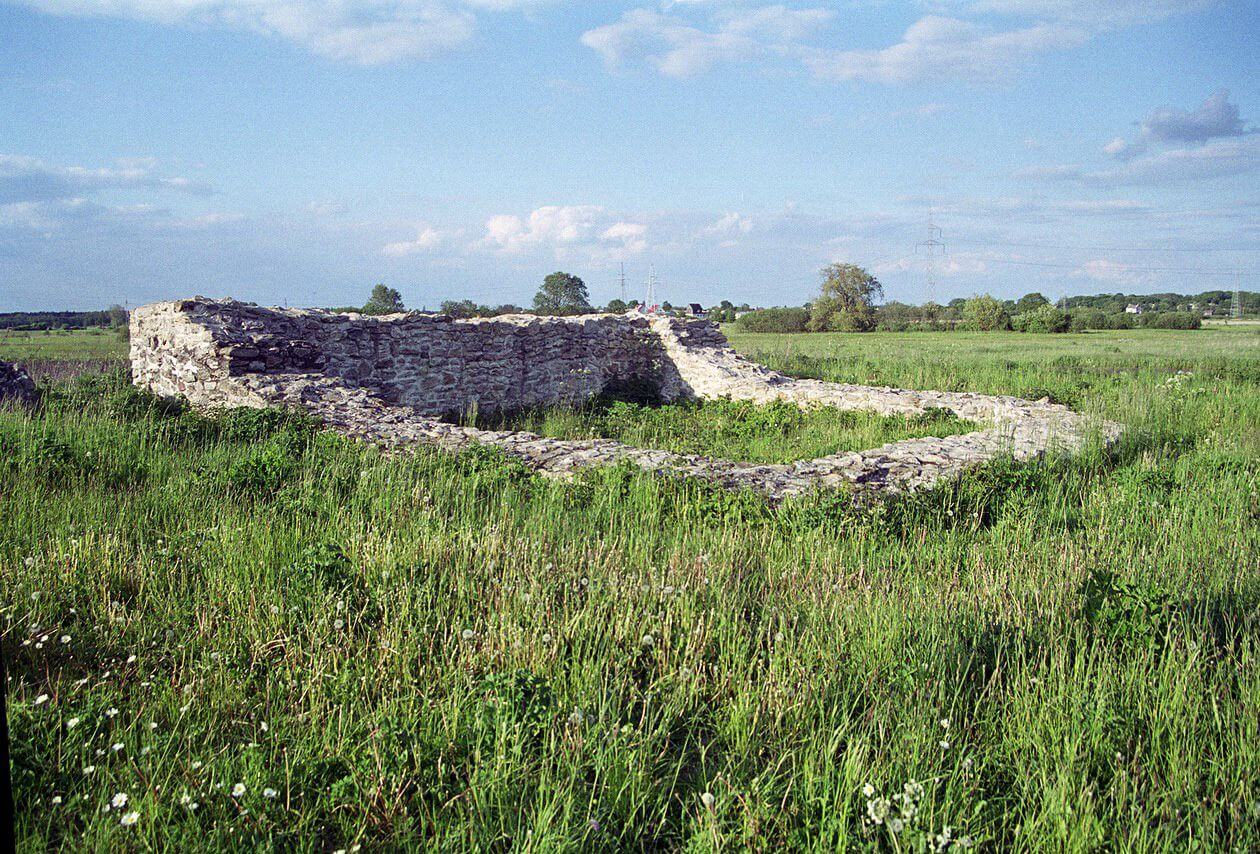
Before World War II, almost the entire northern wall of the tower, approximately 17 meters high, and fragments of the eastern and western walls still existed. These were deliberately destroyed by the Germans in 1944, and the building materials were subsequently taken by local villagers. In the 1990s, the ruins were secured by building on them the upper parts of the walls from the remaining rubble, to a height of approximately 2 meters. Currently, the remains of the tower are located on the right bank of the river, due to the modern shifting of its bed.
bibliography:
Buko A., Średniowieczne kamienne wieże ziemi chełmskiej, “Przegląd Archeologiczny”, vol. 62/2014.
Grody Lubelszczyzny od XI do XIV wieku, red. E.Banasiewicz-Szykuła, Lublin 2019.
Leksykon zamków w Polsce, red. L.Kajzer, Warszawa 2003.
Lubaszewski Z., Mazurek T., Mazurek W., Chełm-Bieławin, Chełm 2022.
Ruszkowska U., Chełm – Bieławin. U źródeł miasta [in:] Badania archeologiczne. O początkach historii Chełma, red. Banasiewicz-Szykuła E., Lublin 2002.
Ruszkowska U., Pradziejowy i średniowieczny zespół osadniczy w Chełmie – Bieławinie, “Rocznik Chełmiński”, 20/2016.