
History
The Franciscan friary in Viljandi (German: Fellin) was founded by papal decree in 1466, which also permitted the Master of the Livonian Order to establish Franciscan houses in the Livonian towns of Tartu and Limbaži. Together, they formed the Livonian Custody, later expanded to include Prussian centers (“custodia Livonize et Prussiae”). Construction work on the claustrum and monastery church in Viljandi lasted from approximately 1466 to 1472. The date of completion, or at least its advanced stage, was set by the provincial chapter in Riga, which was attended among others by monks from Viljandi.
The friary was destroyed during the Livonian War in 1560. The church may have been rebuilt as early as the 16th century, after the Polish capture of the town. The building then began to be used as a parish church, taking its name from the destroyed older parish church of St. John on the market square. Further renovations and alterations to the former Franciscan church took place in the 17th century. In the second half of the 18th century, it received a new sacristy and a Baroque spire, which had been destroyed in the fire of 1811. After World War II, in 1950, the church was converted into a warehouse. The last major renovation was carried out in 1992.
Architecture
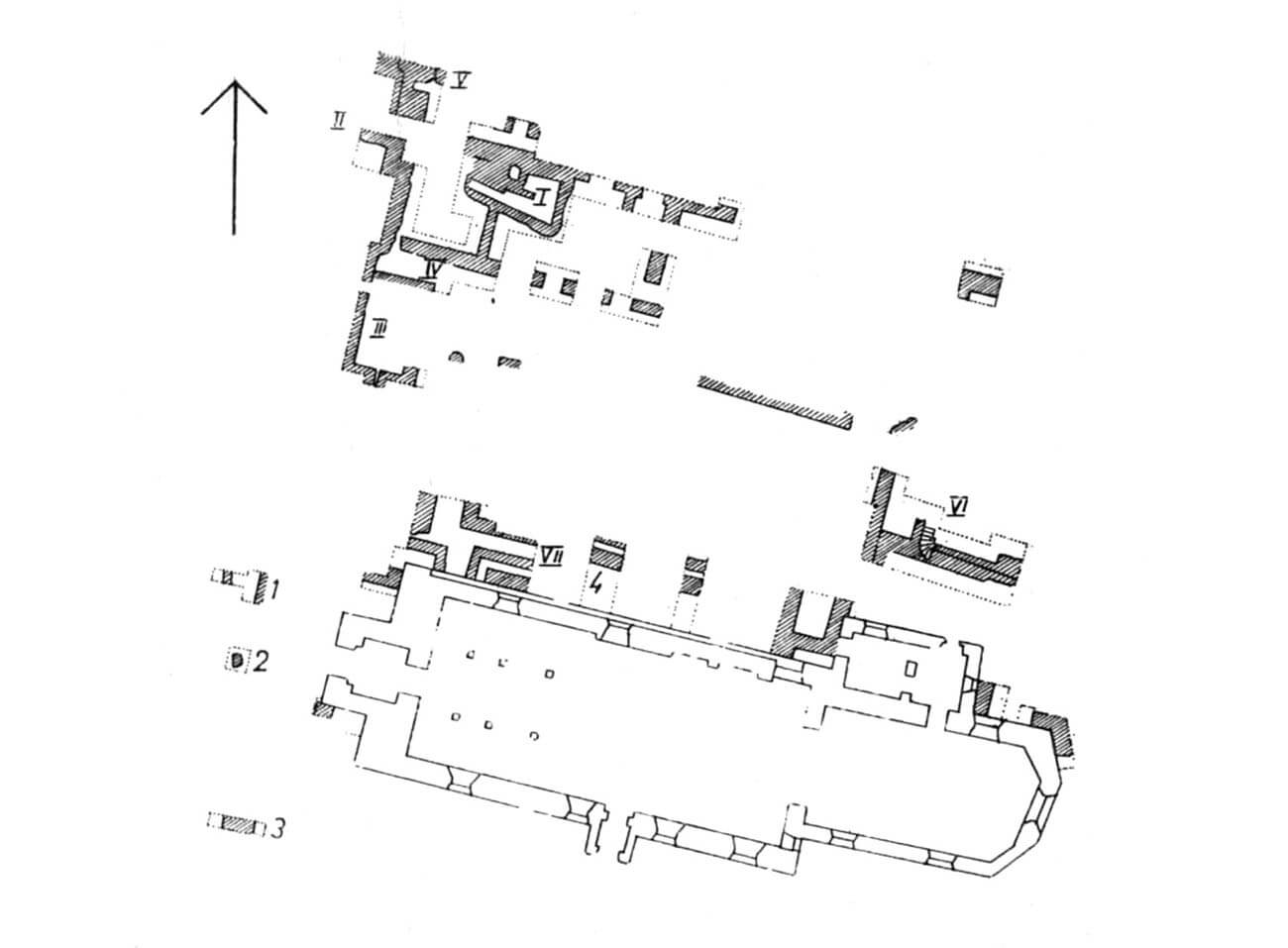
The Franciscan friary was located in the southwestern part of the medieval town, within the town walls that adjoined it to the west, and adjacent to the Teutonic castle’s outer bailey, which moat, somewhat further away, bounded the monastery to the south. On the northeastern side of the monastery, a town street curved, leading towards the western town gate. To the east, there may have been a monastery cemetery. On the town side, the monastery was likely surrounded by some form of fencing, separating the sacral and monastic buildings from the secular ones.
The monastery church was a relatively simple but spacious structure, with a single rectangular nave, which adjoined a narrower and lower chancel to the east. The chancel’s three-sided, yet asymmetrical closure was created by the longer northern wall than the southern one. On the western side, a quadrangular tower was built, partially integrated into the nave of the building. This was an unusual tower position for Franciscan churches, which typically had only slender turrets on the sides of the chancel. In Fellin, the more massive western tower may have been due to the proximity of the defensive walls and the desire to strengthen the town’s defenses. The church’s exterior facades were decorated in the eastern part with pairs of niches with gabled heads, above which were circular blendes. The church’s interior was characterized by simplicity, sparse decoration, and the absence of vaults.
The buildings of the monastery claustrum were located on the north side of the church. It consisted of three brick wings of varying sizes, enclosing, along with the church, a significantly elongated cloistered garth, measuring approximately 22 x 12 meters. The eastern wing adjoined the church’s chancel, while the western wing likely had a shorter length and did not reach the tower or the nave. The claustrum buildings had basements, as the western section of the northern wing contained a cross-vaulted chamber housing a hypocaust furnace, which heated the ground-floor rooms with warm air. Another hypocaust furnace was located in the southern section of the eastern wing, from where it likely heated the adjacent chapter house. The main room in the northern wing was the refectory, adjacent to the passage with gate leading north from the friary.
Current state
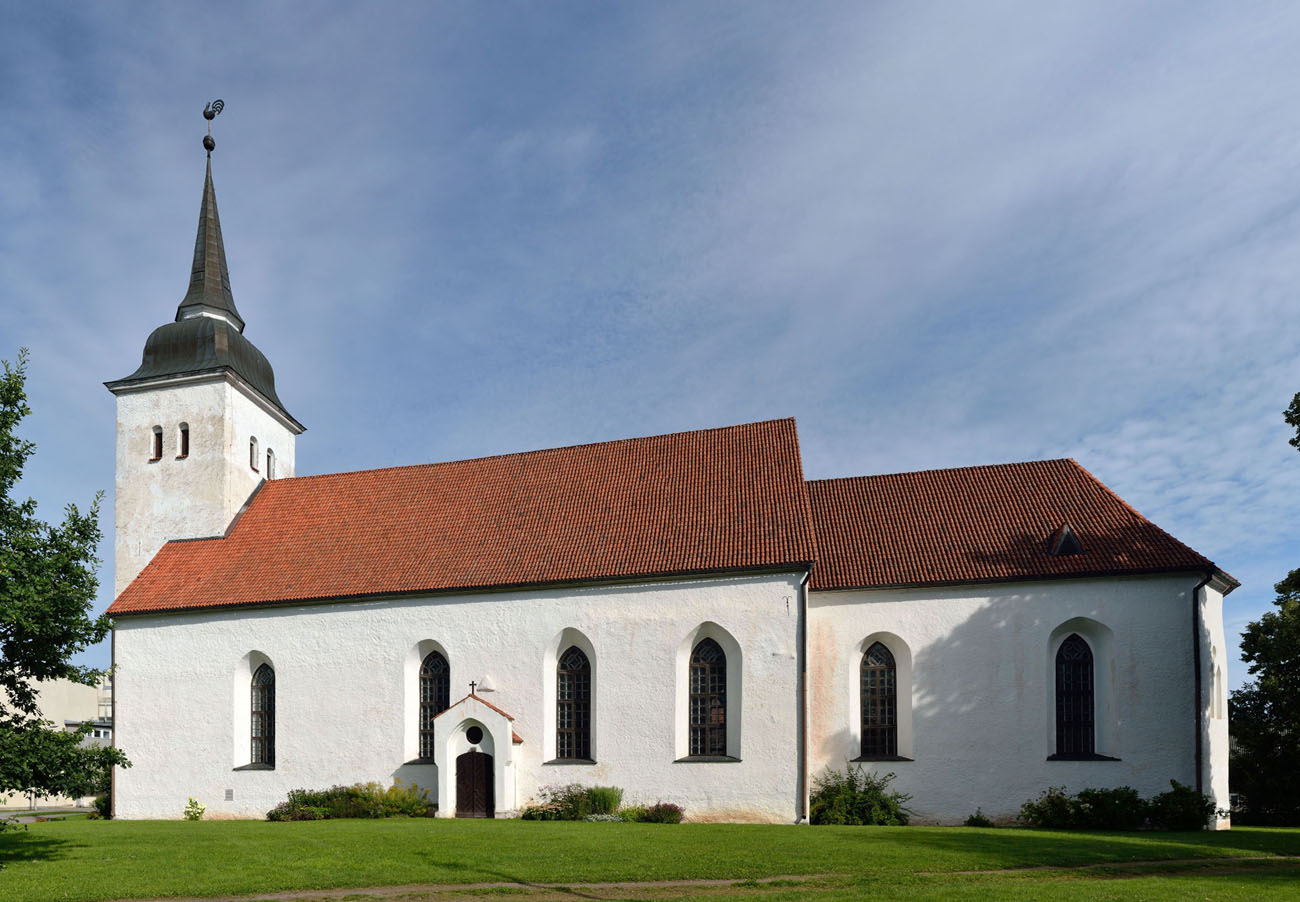
The only visible structure remaining from the medieval Franciscan monastery is St. John’s Church. Its form is the result of multiple early modern transformations. Most of the windows have been enlarged, a porch has been added to the south, a sacristy to the north, a new spire has been placed on the tower and the interior rood arcade has been reshaped. Currently, the historic building serves as a concert hall.


bibliography:
Alttoa K., Viljandi endise frantsisklaste kloostri (hilisem Jaani kirik) ajalooline õiend, Tallinn 1979.
Borowski T., Miasta, zamki i klasztory. Inflanty, Warszawa 2010.
Selirand U., Ausgrabungen auf dem Territorium des Franziskanerklosters in Viljandi, “Proceedings of the Estonian Academy of Sciences”, Vol. 30, 4/1981.
Selirand U., Über die Untersuchungen des Franziskanerklosters in Viljandi, “Proceedings of the Estonian Academy of Sciences”, Vol. 31, 4/1982.